DC-7C Seven Seas
Douglas
Historical Context & Origins
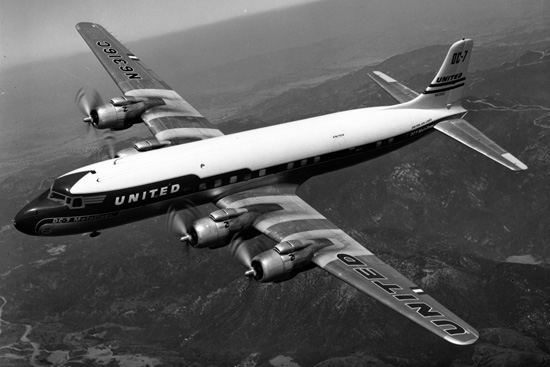
The Douglas DC-7C Seven Seas, whose first flight was in 1956, emerged in an era of fierce airline competition. The companies aspired to offer non-stop flights across oceans, a luxury still unattainable for many piston-powered aircraft of the time. Douglas Aircraft responded to the growing need for direct transoceanic connections, challenging the dominance of the Lockheed Super Constellation.
The predecessor, the DC-7, although advanced, did not have the fuel capacity necessary to cover long transatlantic distances non-stop in adverse conditions. An enhanced version was imperative, capable of exceeding the limits of autonomy and payload. Thus was born the "Seven Seas", a name that immediately evoked its ambition to conquer the global skies.
Architecture & Technological Design
To realize its transoceanic ambitions, the DC-7C underwent significant structural modifications, in particular a wing span extension of 3.05 meters for each wing. This increase not only improved aerodynamic performance, but more importantly allowed the integration of additional fuel tanks directly into the wings, bringing the total capacity to over 23,470 liters.
The beating heart of the Seven Seas were the four Wright R-3350-EA1 Turbo-Compound radial engines. These engines, with their turbochargers that recovered energy from exhaust gases, delivered 3,400 horsepower each, ensuring the thrust needed for full-load takeoffs and crucial efficiency on long hauls. The fuselage was lengthened by 1.02 meters to increase passenger or cargo capacity.
Attention was also placed on comfort, with measures to reduce vibrations and noise in the cabin, making long journeys more bearable for passengers of the time. The DC-7C represented the pinnacle of piston aeronautical engineering, a true jewel of power and autonomy, designed to dominate intercontinental routes.
Onboard Specifications
- ◆Wright R-3350-EA1 Turbo-Compound Engines: Four 3,400 HP radial thrusters with energy recovery system for efficiency and power.
- ◆Increased Wingspan: Increased by 6.1 meters compared to the standard DC-7, reaching 38.86 meters, critical for stability and fuel capacity.
- ◆Integrated Wing Fuel Tanks: Maximum fuel capacity for non-stop flights of over 7,400 km.
Operational Career & Operators
The DC-7C quickly became the aircraft of choice for long-haul passenger services, offering the thrill of non-stop transatlantic flights for the first time. Prestigious airlines such as Pan American World Airways, BOAC, SAS (Scandinavian Airlines System), Delta Air Lines and our Alitalia used it extensively. It was the first piston airliner capable of connecting Europe and the West Coast of the United States without an intermediate stop.
Despite its success, Seven Seas' career was relatively short at the top. The introduction of jet aircraft such as the Boeing 707 and Douglas DC-8 in the late 1950s and early 1960s, with their superior speed and comfort, quickly made them obsolete for scheduled passenger transport. Many DC-7Cs were later converted for cargo duty, extending their operational life.
Legacy & Cultural Impact
The Douglas DC-7C Seven Seas is universally recognized as the pinnacle of piston airliner development. It represents the swansong of a glorious era, a technological bridge between the age of propellers and the imminent age of jets. Its ability to connect continents non-stop has redefined the concept of international travel, making it more accessible and faster.
The Seven Seas embodies an era of glamor and adventure, when transoceanic flight was still a luxury experience and a bold engineering feat. Although its glory was ephemeral, the DC-7C left an indelible mark on the history of aviation, demonstrating the greatest potential achievable with piston engine technology and paving the way for modern long-range aviation.
Telemetria Specs (HUD)
Hangar Trivia & Curiosità
- 💡It was the first commercial airliner capable of flying non-stop across the Atlantic Ocean in both directions, westbound against prevailing winds.
- 💡The 'Seven Seas' nickname reflected its extended range capabilities, designed to connect continents and cross vast oceanic distances.
- 💡Despite its advanced piston-engine design, the DC-7C's reign was short-lived, quickly superseded by the advent of commercial jetliners like the Boeing 707 and Douglas DC-8.
Archivio Avvistamenti Spotter
Immagini scattate dalla community in tutto il mondo
Vettori Rilevati (Flotta Attiva)




Vettori Rilevati (Flotta Storica / Dismessa)


American Airlines
Stato: Dismesso

Südflug International
Stato: Dismesso

Swissair
Stato: Dismesso
Conair of Scandinavia
Stato: Dismesso
Sabena
Stato: Dismesso
Atlantis
Stato: Dismesso

Alitalia
Stato: Dismesso

BOAC (British Overseas Airways Corporation)
Stato: Dismesso
British Caledonian
Stato: Dismesso