DC-7B
Douglas
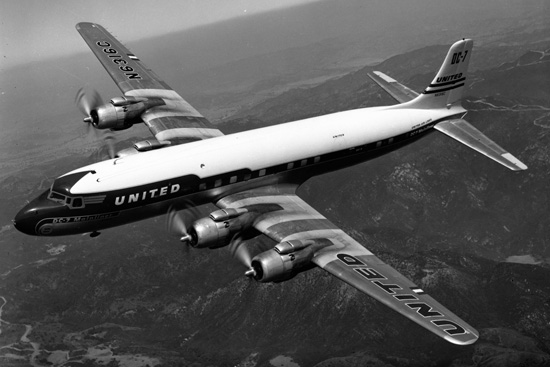
Historical Context & Origins
In the post-war era, the commercial aviation sector was booming, with airlines competing fiercely for ever-longer and faster routes. The Douglas DC-7, launched in 1953, represented the pinnacle of piston-powered aircraft, but the need for an aircraft with even greater range for non-stop transcontinental and transatlantic flights soon emerged.
It was in this context that the Douglas Aircraft Company developed the DC-7B, whose first flight occurred in 1955. This improved variant directly responded to requests from American airlines such as American Airlines and Eastern, wanting to fly over the United States from coast to coast without interruption, a revolutionary feat for piston engines at the time.
The DC-7B was not just an upgrade, but a bold engineering response to push the limits of the technological capabilities of the time, ensuring faster and more efficient air links essential for a rapidly globalizing world. It represented the pinnacle of piston technology before the relentless advent of the jet age.
Architecture & Technological Design
The Douglas DC-7B stood out for its robust and refined architecture, designed for the challenges of long-range flights. Externally, it retained the sleek silhouette of the DC-7, but beneath the skin it contained critical structural and aerodynamic upgrades aimed at increasing performance and reliability in extended operating conditions.
The beating heart of the DC-7B was its four Wright R-3350 Turbo-Compound radial engines, an engineering marvel that extracted extra power from the exhaust gases. These engines, with their characteristic "power-recovery turbines", provided the energy necessary for full-load takeoffs and the constant thrust required to cross oceans and continents.
The real innovation, however, lay in its fuel transport capacity. The DC-7B was the first of the series to have fuel tanks integrated into the internal engine nacelles, in addition to larger wing ones, drastically increasing autonomy and finally allowing the desired non-stop flights.
Onboard Specifications
- ◆Wright R-3350 Turbo-Compound Engines: Powerful radial engines with energy recovery turbines for superior efficiency and thrust.
- ◆Increased wing and engine nacelle tanks: Increased fuel capacity for non-stop transcontinental and transoceanic flights.
- ◆Advanced pressurized and air-conditioned cabin: Passenger comfort optimized for long hours of flight at high altitude.
Operational Career & Operators
The Douglas DC-7B gloriously entered service with several world-famous airlines, marking a golden age for propeller-driven air travel. It was immediately used on strategic routes, first and foremost the non-stop transcontinental flights in the United States, a true watershed for passenger transport.
Airlines such as American Airlines, Delta Air Lines, Eastern Air Lines and United Air Lines used it extensively to connect the east and west coasts of the United States, significantly reducing travel times. International carriers such as BOAC, SAS and Pan American also employed it on Atlantic routes.
His career was relatively short, however. The advent of jetliners, such as the Boeing 707 and the Douglas DC-8 itself, starting in the late 1950s, offered unparalleled speed and capability. Despite its efficiency and autonomy, the DC-7B, symbol of its time, had to give way to the new era of jet propulsion.
Legacy & Cultural Impact
The Douglas DC-7B remains a powerful symbol of the pinnacle of the piston-powered aircraft era and a masterpiece of aeronautical engineering. It represented the maximum that the technology of the time could offer in terms of speed and autonomy for a propeller-driven aircraft, making aerial connections possible that were previously only a dream.
Its ability to fly non-stop across vast territories and oceans drastically reduced distances, bringing cultures and trade closer together. This aircraft pioneered and demonstrated market viability for long-haul flights, paving the path for the acceptance and success of subsequent jetliners.
While its tenure in the skies as a top airliner was ephemeral, its influence is lasting. The DC-7B is remembered not only as a technically advanced aircraft, but as a pioneer that helped shape the future of global air travel, cementing its place in aviation history as a true giant of the air.
Telemetria Specs (HUD)
Hangar Trivia & Curiosità
- 💡Fu l'ultima serie di aerei di linea a pistoni di grandi dimensioni prodotta dalla Douglas Aircraft Company.
- 💡Molti DC-7B furono successivamente convertiti in aerei cargo (DC-7F) a causa dell'avvento di jet più efficienti.
- 💡Il DC-7B era dotato di serbatoi di carburante più grandi e motori Wright R-3350 Turbo-Compound più potenti rispetto al DC-7 originale, migliorandone le capacità di volo senza scalo.
Archivio Avvistamenti Spotter
Immagini scattate dalla community in tutto il mondo