DC-7
Douglas
Historical Context & Origins
The Douglas DC-7, whose first flight was in 1953, emerged in a period of great turmoil for commercial aviation. In the post-war era, the imperative was to connect distant destinations with direct and rapid flights, pushing the industry to overcome the limits of piston-powered aircraft.
The Douglas Aircraft Company had to respond to the challenge launched by the Lockheed Super Constellation, which already promised transcontinental routes. The DC-7 was born as a bold evolution of the DC-6B, specifically designed to offer greater speed, extended range and superior comfort, reaffirming Douglas leadership.
Architecture & Technological Design
The propulsion heart of the Douglas DC-7 consisted of four Wright R-3350 Duplex-Cyclone turbo-compound radial engines. These engines, delivering 3,250 horsepower each, used turbines to recover energy from exhaust gases, significantly increasing efficiency and thrust, crucial for long distances.
The fuselage was stretched by over one meter compared to the DC-6B, increasing passenger capacity and improving interior spaces. An optimized aerodynamic design allowed the DC-7 to reach cruising speeds of approximately 570 km/h and a remarkable range, extended up to almost 6,500 km.
Passenger comfort was a priority. The DC-7 incorporated an advanced pressurization system, improved soundproofing and optimized air conditioning. These measures were essential to make long transcontinental and transoceanic journeys a more pleasant experience, standing out in the aeronautical panorama.
Onboard Specifications
- ◆Wright R-3350 Turbo-Compound Engines: Record power and efficiency thanks to energy recovery from exhaust gases.
- ◆Pressurized and Soundproof Cabin: Superior comfort for extended flights, reducing passenger fatigue.
- ◆Increased Fuel Capacity: Unprecedented autonomy for the time, allowing direct transcontinental and transoceanic connections.
Operational Career & Operators
The Douglas DC-7 debuted with American Airlines in November 1953, revolutionizing travel with the first coast-to-coast non-stop service in the United States, such as the Los Angeles-New York route. This ability to connect the two coasts without intermediate stops drastically reduced travel times.
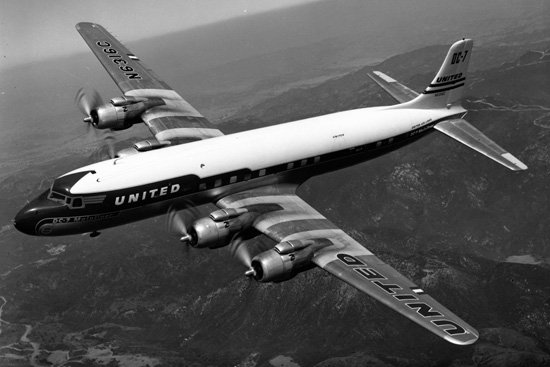
Numerous global carriers, including United Air Lines, Delta Air Lines, Pan American World Airways and BOAC, adopted the DC-7 and its variants, most notably the transoceanic DC-7C "Seven Seas". The latter set new range records, cementing the DC-7's reputation as a pioneer of global air travel.
Legacy & Cultural Impact
The Douglas DC-7 represents the culmination of the piston airliner era, serving as a technological bridge to the jet age. Its dominance was short-lived, quickly supplanted by jet engines like the Boeing 707, but its impact was profound.
Its ability to offer direct flights over long distances has significantly contributed to defining the expectations of modern travellers, making intercontinental travel a comfortable and accessible reality. Many DC-7s were later converted for cargo or firefighting uses, demonstrating robustness and versatility that prolonged their legend.
Telemetria Specs (HUD)
Hangar Trivia & Curiosità
- 💡It was the first commercial airliner to offer scheduled non-stop passenger service from coast-to-coast across the United States.
- 💡Many DC-7s were converted into cargo aircraft (DC-7F) or specialized aerial tankers for firefighting, extending their operational life significantly.
- 💡Despite its advanced design, the DC-7's reign as a premier passenger airliner was brief, quickly overshadowed by the superior speed and efficiency of early jetliners like the Boeing 707.
Archivio Avvistamenti Spotter
Immagini scattate dalla community in tutto il mondo
Vettori Rilevati (Flotta Attiva)




Vettori Rilevati (Flotta Storica / Dismessa)


American Airlines
Stato: Dismesso

Südflug International
Stato: Dismesso

Swissair
Stato: Dismesso
Conair of Scandinavia
Stato: Dismesso
Sabena
Stato: Dismesso
Atlantis
Stato: Dismesso

Alitalia
Stato: Dismesso

BOAC (British Overseas Airways Corporation)
Stato: Dismesso
British Caledonian
Stato: Dismesso