DC-6
Douglas
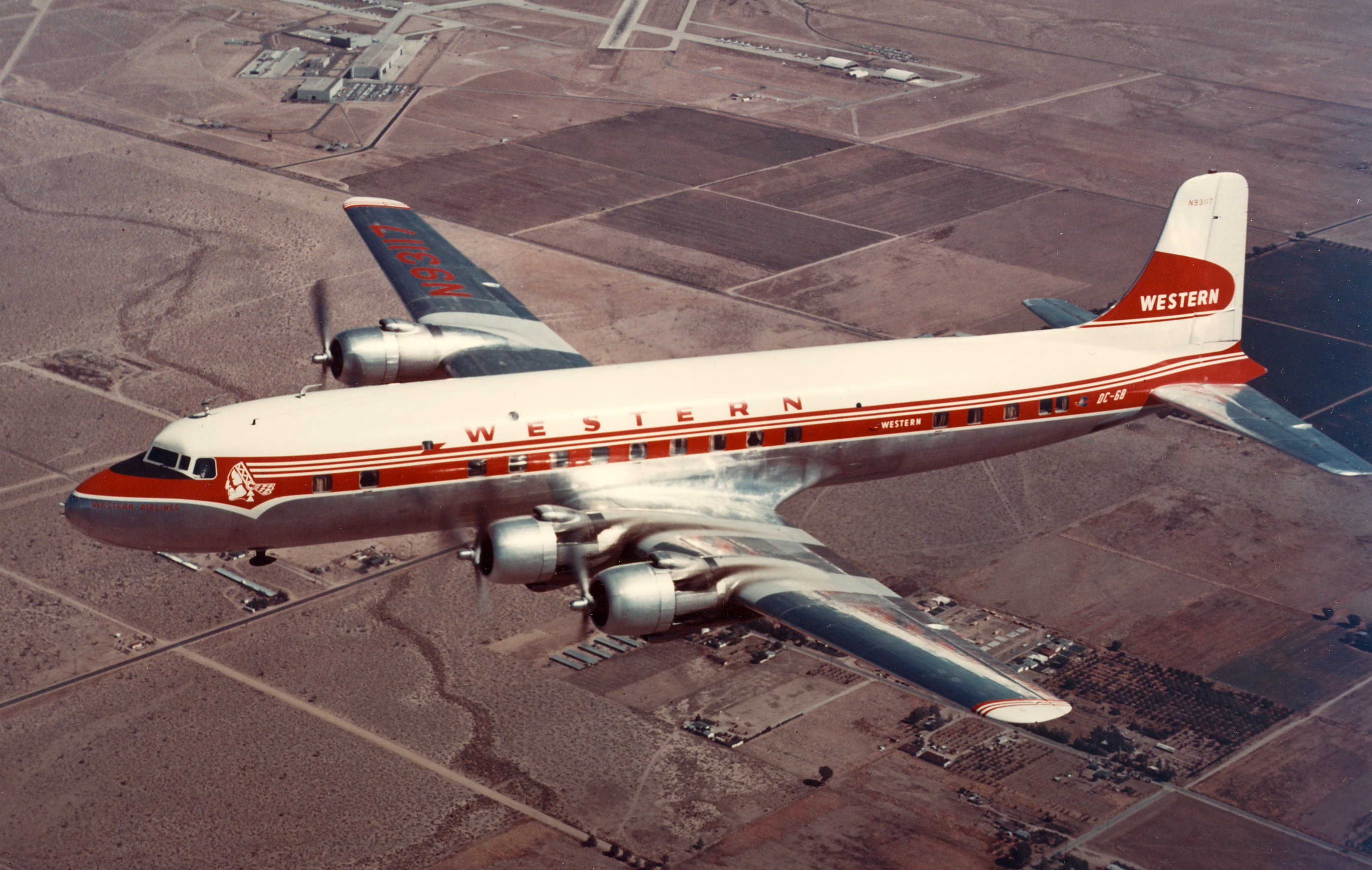
Historical Context & Origins
The epic of the Douglas DC-6 begins in the turbulent period immediately following the Second World War, when global civil aviation was ready for an unprecedented leap in quality. The Douglas Aircraft Company, thanks to the success of the DC-3 and DC-4, sensed the growing demand for faster, more comfortable and capable aircraft for long-range routes.
Initially conceived as a long-range military transport aircraft, the C-118 Liftmaster, the project was quickly converted to meet the needs of the civilian market. Airlines required aircraft that could offer passengers a superior travel experience, overcoming the limitations of previous models. The Douglas DC-6 answered this call with an engineering mastery that would redefine the standards of its time.
Its first flight occurred in 1946, marking the beginning of a legendary career that would span decades. The DC-6 was proposed as a direct evolution of the DC-4, but with substantial improvements that would distinguish it as one of the pillars of post-war propeller-driven aviation.
Architecture & Technological Design
The architecture of the Douglas DC-6 was a triumph of aeronautical engineering, designed to maximize efficiency, comfort and safety. Its airframe, longer and more robust than its predecessor DC-4, housed a revolutionary innovation for the time: the pressurized cabin. This innovation allowed flying at higher altitudes, where the air is more stable, reducing turbulence and ensuring a significantly more pleasant journey for passengers.
The aircraft was powered by four Pratt & Whitney R-2800 Double Wasp radial engines, a choice dictated by their proven reliability and power. These engines, capable of delivering approximately 2,200 horsepower each, gave the DC-6 exceptional performance for a propeller-driven aircraft, allowing a cruising speed of 507 km/h and an impressive range of almost 4,800 km.
The design also included aerodynamic and structural improvements aimed at increasing the aircraft's strength and longevity, features that would contribute to its extraordinary operational career. Every detail was taken care of to offer an optimal balance between performance, comfort and safety, making it a true technological jewel of its time.
Onboard Specifications
- ◆Pressurized cabin: For more comfortable flights at high altitudes, reducing passenger and crew fatigue.
- ◆Pratt & Whitney R-2800 Double Wasp radial engines: Four thrusters of 2,200 hp each, synonymous with power and reliability in long-range flight.
- ◆Hot air degiver system: Crucial innovation for operational safety in adverse weather conditions, ensuring the maintenance of wing surfaces.
Operational Career & Operators
The Douglas DC-6 quickly entered service with the world's most prestigious airlines, including United Airlines, American Airlines and Pan American World Airways. It became the aircraft of choice for ambitious transatlantic and transcontinental routes, ushering in the Golden Age of Commercial Flight. Its ability to carry a greater number of passengers in unprecedented comfort made it an icon of the skies.
In addition to passenger transport, the DC-6 demonstrated remarkable versatility, also operating as a cargo and military role. It was successfully used during the Berlin Airlift and in the Korean War, demonstrating its robustness and reliability in extreme conditions. Its ability to operate from unprepared runways made it invaluable in multiple scenarios.
Many continued to fly well beyond the introduction of jets, finding new life in cargo transport, firefighting or specialized roles in remote regions. Its extraordinary longevity testifies to the quality of the original design and the care with which it was built.
Legacy & Cultural Impact
The Douglas DC-6 was not simply an airplane; he was a pioneer who helped shape the modern airline industry. His introduction of the pressurized cabin became an industry standard, transforming the travel experience for millions of people. It represented the pinnacle of propeller technology, serving as a bridge between the pre-war era and the imminent advent of jet aircraft.
Its presence in the skies around the world, for decades, has cemented its image as a symbol of progress and reliability. The DC-6 set new standards for speed, comfort and safety, influencing subsequent generations of aircraft and engineers. Even today, several examples are in operation, keeping its legend alive.
The cultural impact of the DC-6 is undeniable, embodying the spirit of an era of exploration and innovation. It has remained in the collective imagination as one of the most elegant and iconic aircraft ever built, celebrated by aviation enthusiasts and historians for its fundamental role in the development of commercial flight.
Telemetria Specs (HUD)
Hangar Trivia & Curiosità
- 💡Originariamente concepito come trasporto militare (XC-112) durante la Seconda Guerra Mondiale, fu rapidamente convertito per il servizio civile post-bellico.
- 💡Il DC-6, nella sua versione militare VC-118 Liftmaster, fu il principale aereo per i viaggi presidenziali degli Stati Uniti prima dell'avvento dell'era dei jet.
- 💡Molti esemplari di DC-6 hanno continuato a volare ben oltre il 21° secolo, spesso riconvertiti per il trasporto merci, la lotta antincendio o ruoli specializzati grazie al loro design robusto.
Archivio Avvistamenti Spotter
Immagini scattate dalla community in tutto il mondo
Vettori Rilevati (Flotta Attiva)


Martinair
In Flotta: x9 u.

Conair Group
In Flotta: x5 u.

Air France
In Flotta: x11 u.
Ethiopian Airlines
In Flotta: x10 u.
Air Greenland
In Flotta: x6 u.
SATA Air Açores
In Flotta: x7 u.

Luftwaffe
In Flotta: x6 u.
Líneas Aéreas del Estado (LADE)
In Flotta: x11 u.Vettori Rilevati (Flotta Storica / Dismessa)

Aigle Azur (1946)
Stato: Dismesso

American Airlines
Stato: Dismesso
Aeromaritime
Stato: Dismesso

British Eagle
Stato: Dismesso
British United Airways
Stato: Dismesso

Balair
Stato: Dismesso

Alitalia
Stato: Dismesso
Adria Airways
Stato: Dismesso

Aviaco
Stato: Dismesso
Caledonian Airways
Stato: Dismesso
Olympic Airways
Stato: Dismesso
Braathens Regional Airlines
Stato: Dismesso