DC-5
Douglas
Historical Context & Origins
In the lively aeronautical landscape of the 1930s, dominated by the undisputed success of the DC-3, the Douglas Aircraft Company sought to explore new market niches. The idea was that of a smaller airliner, designed for medium-range regional routes and airports with less well-equipped runways, which could offer greater operational flexibility than the giants of the time.
The Douglas DC-5, which made its first flight in 1939, was born from this ambitious vision. Despite its innovative design, it positioned itself as a complement rather than a successor to its illustrious predecessors, aiming to capture a distinct market segment less served by larger aircraft.
Architecture & Technological Design
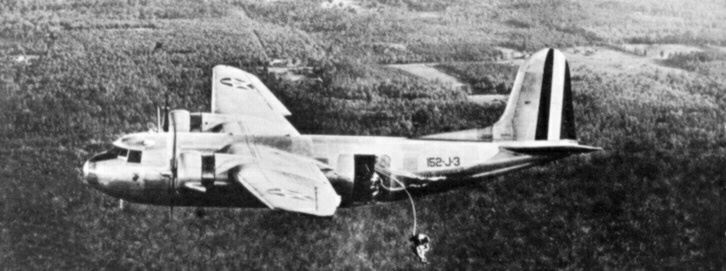
The DC-5 clearly distinguished itself from the previous Douglas line, adopting a high wing configuration that offered passengers an unobstructed view and facilitated loading operations. This design choice made it an almost unique example among airliners of the time, many of which preferred the low wing for aerodynamic and structural reasons.
A key technical innovation was the adoption of retractable tricycle landing gear, a then cutting-edge feature for a civil transport aircraft. This gave the DC-5 better stability on the ground and greater efficiency during take-off and landing, crucial aspects for operation on less sophisticated airfields.
The aircraft was powered by two 900 hp Wright Cyclone GR-1820-F62 radial engines, known for their reliability and power. Its carrying capacity was approximately 16-18 passengers, in a surprisingly spacious environment for its size, promising comfort and operational versatility.
Onboard Specifications
- ◆Retractable tricycle landing gear: Improved maneuverability on the ground and reduced drag in flight.
- ◆High wing: It offered panoramic visibility to passengers and facilitated access for loading and unloading goods.
- ◆Wright Cyclone radial engines: Powerful and proven propulsion, guarantee of operational robustness.
Operational Career & Operators
The DC-5's operational career was unfortunately short and overshadowed by the impending outbreak of World War II. Only 12 examples were produced, an extremely limited number compared to the thousands of DC-3s. Early customers included KLM West Indies and Pennsylvania Central Airlines (PCA).
KLM deployed its two aircraft, nicknamed "Zon-Vogel" (Sunbird) and "Meeuw" (Seagull), on routes in the Dutch Caribbean. As the conflict escalated, many civilian DC-5s were requisitioned and converted for military use, primarily by the US Navy under the designation R3D, or by allied air forces such as the Dutch and Australians, operating as transport and utility aircraft.
Legacy & Cultural Impact
Despite its limited commercial diffusion, the Douglas DC-5 remains a fascinating piece of aeronautical history, an example of bold technical innovation in a period of great change. His adoption of the tricycle landing gear was a pioneering vision, anticipating a standard that would become the norm in later commercial aviation.
Its story is one of technical success not replicated commercially, due to unpredictable global circumstances. Today, the DC-5 is a rare testament to a transitional era, with only one example partially preserved at the Museum of Flight in Seattle. His legacy is a warning of how external events can redefine the fate of otherwise promising projects.
Telemetria Specs (HUD)
Hangar Trivia & Curiosità
- 💡Fu l'unico aereo della serie "Douglas Commercial" (DC) a presentare un design ad ala alta.
- 💡Furono costruiti solo 12 esemplari civili del DC-5, rendendolo uno degli aerei di linea di produzione più rari.
- 💡Molti dei DC-5 civili furono requisiti per il servizio militare e ridesignati R3D dalla Marina e dal Corpo dei Marines degli Stati Uniti durante la Seconda Guerra Mondiale.
Archivio Avvistamenti Spotter
Immagini scattate dalla community in tutto il mondo