DC-4
Douglas
Historical Context & Origins
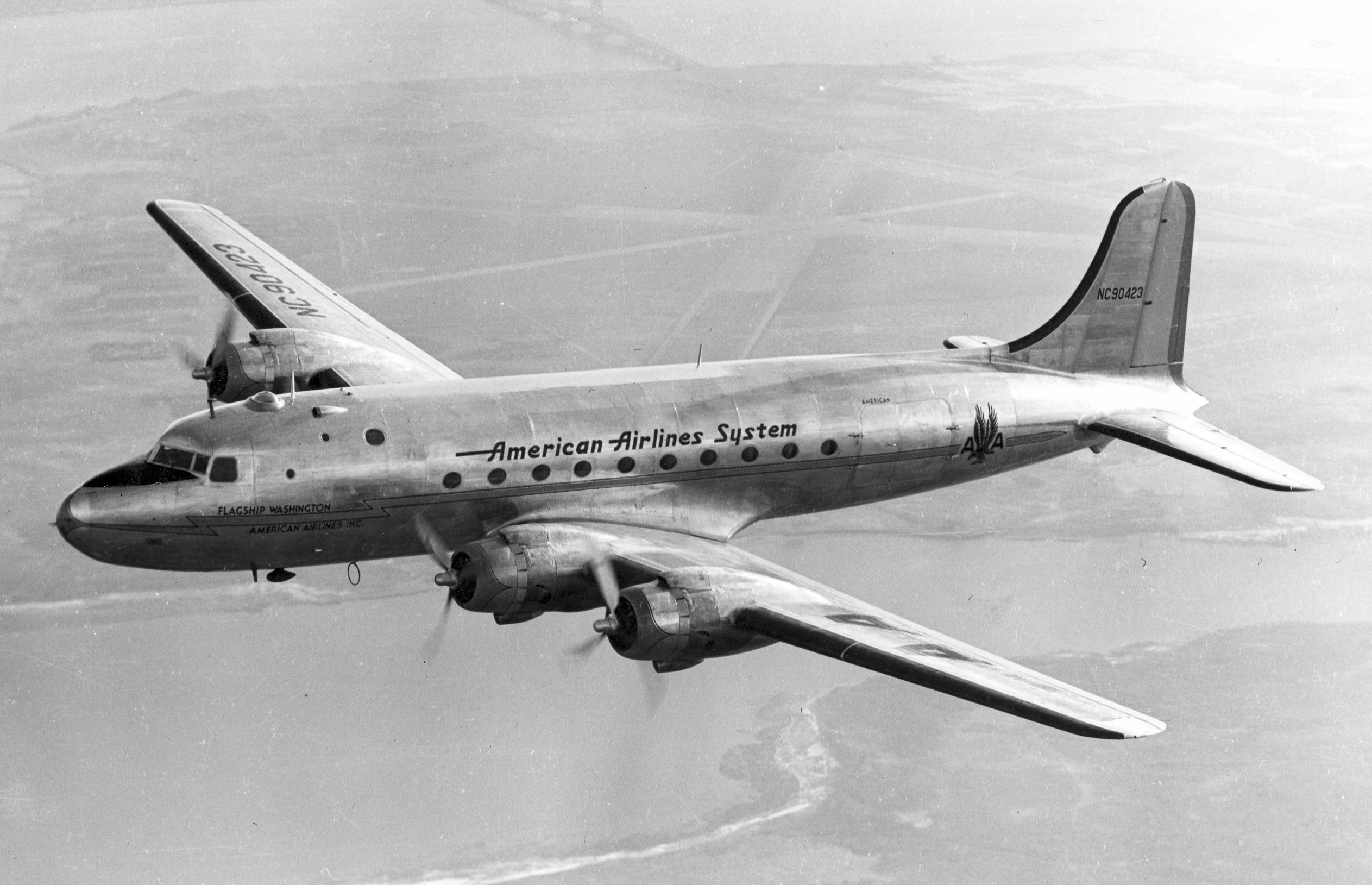
The Douglas DC-4, with its first flight in 1942, emerged from an ambitious pre-war need to surpass the capabilities of the legendary DC-3. Initially conceived as a larger and more complex four-engine airliner, the DC-4E (Explorer) prototype proved to be excessively expensive and intricate, pushing Douglas to a radical redesign to optimize costs and simplicity.
This revision led to the birth of a more agile and pragmatic aircraft, whose production was almost immediately diverted towards the war effort. With the entry of the United States into World War II, the DC-4 took on the iconic military name of C-54 Skymaster, becoming the workhorse for the strategic transport of troops and materials on a global scale.
Its robustness and reliability proved fundamental on the war fronts, laying the foundations for its future civilian career. The C-54/DC-4 was an irreplaceable player in military air transport, from transoceanic routes to the most critical logistical operations, demonstrating unprecedented versatility and resistance.
Architecture & Technological Design
The DC-4 represented a milestone in aeronautical engineering, introducing a four-engine architecture to a large airliner for the first time. Its structure was entirely in metal, with a monocoque fuselage that guaranteed strength and lightness.
One of the most significant innovations was the adoption of retractable tricycle landing gear, a design that significantly improved ground maneuverability and visibility for pilots, distinguishing it from previous models that used the tail wheel. This configuration would later become the standard for future commercial aircraft.
Powered by four Pratt & Whitney R-2000 Twin Wasp radial engines, the DC-4 provided the power needed for long-range, higher-altitude flights. Its design was oriented towards maximum reliability and ease of maintenance, crucial characteristics for its tireless military and then civil service.
Onboard Specifications
- ◆Retractable tricycle landing gear: A cutting-edge solution that improves safety and operation.
- ◆Partially pressurized cabin (in civilian versions): Although not in the first military variant, subsequent civilian versions reintroduced this essential comfort for passengers on long-haul flights.
- ◆Pratt & Whitney R-2000 Radial Engines: Four robust and reliable thrusters, critical to the aircraft's performance and range.
Operational Career & Operators
The operational career of the DC-4 was legendary, beginning with its role as the C-54 Skymaster during World War II. It was the plane that made possible the largest airlift in history: the Berlin Airlift (1948-1949), delivering vital supplies to the besieged city.
Post-war, a huge surplus of C-54s were repurposed for civil service, becoming the DC-4. These rugged, relatively inexpensive planes democratized long-haul air travel. Carriers such as Pan American World Airways, American Airlines and United Airlines used it extensively on transcontinental and transoceanic routes.
Its reliability and load capacity made it a mainstay of commercial aviation for decades. Even after the introduction of more modern aircraft, many DC-4s were converted into cargo aircraft, continuing to operate in remote regions of the world, testament to its incredible longevity and versatility.
Legacy & Cultural Impact
The Douglas DC-4 was not just an airplane, but a symbol of progress and connectivity. It set the standard for future four-engine airliners, directly influencing the development of successors such as the DC-6 and DC-7, and even the competing Lockheed Constellation.
Its introduction of the tricycle landing gear and pressurized cabin (in civil variants) radically improved the travel experience and flight operations. It proved that mass transoceanic air travel was not only possible, but also safe and affordable, ushering in the modern era of commercial aviation.
Even today, a few examples of the DC-4 continue to fly, mainly as cargo or charter aircraft, an incredible testament to its robust engineering and timeless design. Its history is steeped in adventure, innovation and a legacy that continues to inspire aviation enthusiasts around the world.
Telemetria Specs (HUD)
Hangar Trivia & Curiosità
- 💡Durante la Seconda Guerra Mondiale, fu ampiamente utilizzato dall'esercito americano come C-54 Skymaster, compiendo missioni di trasporto vitali in tutto il mondo.
- 💡Molti DC-4 furono fondamentali nel Ponte Aereo di Berlino (1948-1949), rifornendo Berlino Ovest di beni essenziali quando l'accesso via terra era bloccato.
- 💡È stato uno dei primi grandi aerei da trasporto a disporre di un carrello d'atterraggio triciclo, semplificando la movimentazione a terra rispetto ai modelli con ruotino di coda.
Archivio Avvistamenti Spotter
Immagini scattate dalla community in tutto il mondo