DC-3
Douglas
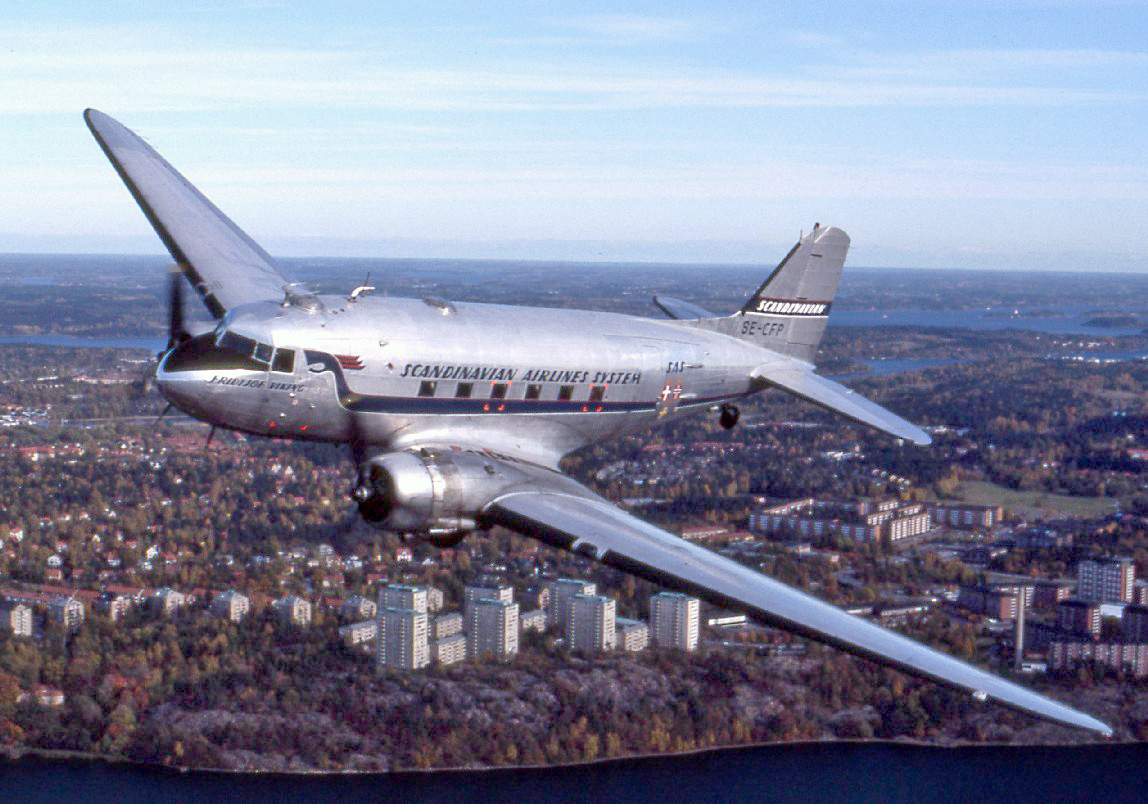
Historical Context & Origins
The Douglas DC-3 (Douglas Commercial 3) is widely considered the most important airliner ever built. Designed in the mid-1930s at the request of C.R. Smith, president of American Airlines, the DC-3 was born as an evolution of the successful DC-2, with the aim of offering an aircraft equipped with bunks for American transcontinental night flights.
The DC-3 made its maiden flight in December 1935 and entered service in 1936. Its introduction revolutionized air transport, as it was the first aircraft capable of generating operating profits by carrying passengers alone, without having to depend on government subsidies for postal transport.
Architecture & Technological Design
The DC-3 was an all-metal low-wing monoplane, constructed of aluminum alloy with a rugged multi-spar structure invented by Jack Northrop. This feature gave the aircraft exceptional structural resistance, which allowed it to operate in extreme conditions.
It was powered by two twin-star radial engines Wright R-1820 Cyclone or Pratt & Whitney R-1830 Twin Wasp. The landing gear was of the conventional retractable (bicycle) type, with the tail resting on a skid or ground caster wheel.
Onboard Specifications
- ◆Full metal structure in high resistance aluminium
- ◆Heated and soundproofed passenger cabin, with capacity from 21 to 32 passengers
- ◆Exceptional flight safety, capable of maintaining altitude and maneuvering even with only one engine operating
Operational Career & Operators
Before World War II, the DC-3 dominated American skies, carrying more than 90 percent of the country's passengers. Pioneer airlines such as American Airlines, TWA (Trans World Airlines), Delta Air Lines and Eastern Air Lines structured their domestic services on this legendary aircraft.
During the war, the militarized version C-47 Skytrain (or Dakota) was produced in over 10,000 examples, used for launching paratroopers, towing gliders and logistical transport. After the war, thousands of surplus C-47s were repurposed for civilian use, becoming the backbone of hundreds of fledgling airlines around the world, including Italy's Alitalia.
Legacy & Cultural Impact
General Dwight Eisenhower cited the C-47/DC-3 as one of the four technologies that allowed the Allies to win World War II. Its reliability has become legendary.
Even today, ninety years after the first flight, a few dozen DC-3s and C-47s continue to fly commercially in remote regions of the world or as restored historic aircraft. The DC-3 is not only a historical monument, but an immortal example of industrial engineering perfection.
Telemetria Specs (HUD)
Hangar Trivia & Curiosità
- 💡Un famoso detto aeronautico recita: 'L'unico sostituto per un DC-3 è un altro DC-3', evidenziando l'insostituibilità delle sue eccezionali doti di decollo e atterraggio corto su piste sterrate.
- 💡Durante la seconda guerra mondiale, un C-47 militare fu attaccato da un caccia giapponese che speronò la sua coda. Il C-47 riuscì comunque a volare e ad atterrare in sicurezza, nonostante i gravissimi danni strutturali.
- 💡Il DC-3 ridusse il tempo di volo da New York a Los Angeles a sole 15 ore, richiedendo solo tre scali per il rifornimento rispetto alle oltre 25 ore dei modelli precedenti.
Archivio Avvistamenti Spotter
Immagini scattate dalla community in tutto il mondo
Vettori Rilevati (Flotta Attiva)


Martinair
In Flotta: x7 u.

Lufthansa
In Flotta: x3 u.

Air France
In Flotta: x5 u.
Ethiopian Airlines
In Flotta: x2 u.
Air New Zealand
In Flotta: x8 u.

Air Inuit
In Flotta: x14 u.
SATA Air Açores
In Flotta: x12 u.
Luftwaffe
In Flotta: x7 u.
Líneas Aéreas del Estado (LADE)
In Flotta: x6 u.Vettori Rilevati (Flotta Storica / Dismessa)


Southern Airways
Stato: Dismesso
Aigle Azur (1946)
Stato: Dismesso
American Airlines
Stato: Dismesso
Ozark Air Lines
Stato: Dismesso

British European Airways
Stato: Dismesso
Provincetown-Boston Airlines
Stato: Dismesso
Piedmont Airlines
Stato: Dismesso
Olympic Airways
Stato: Dismesso