DC-2
Douglas
Historical Context & Origins
In the 1930s, commercial aviation was in turmoil, driven by the need for faster, safer and more efficient aircraft. After the famous Fokker F.10 Trimotor disaster of 1931, which highlighted the limitations of wood and canvas construction, the industry looked for more robust solutions. Transcontinental and Western Air (TWA), eager to overcome the monopoly of the Boeing 247, launched a bold challenge.
TWA requested a plane superior to the Boeing 247, with rigorous specifications: twin-engine, capable of flying on a single engine, and with greater passenger capacity. The Douglas Aircraft Company responded with the DC-1 prototype, which soon evolved into the magnificent Douglas DC-2, whose first flight occurred in May 1934. This aircraft embodied the dawn of a new era for air transport.
Architecture & Technological Design
The Douglas DC-2 was a pioneer of aeronautical engineering, abandoning obsolete wood and canvas structures to embrace a revolutionary all-metal semi-monocoque construction. This innovation not only ensured greater strength and durability, but also allowed for an unprecedented aerodynamic design, reducing drag and increasing speed.
Equipped with two Wright Cyclone radial engines, the DC-2 offered reliable power and superior safety, thanks to the ability to maintain flight even with one engine inactive. The retractable landing gear and variable-pitch propellers were cutting-edge features that optimized performance on both takeoff and cruise, marking a clear departure from its predecessors.
The interior of the DC-2 was no different, designed for the comfort of 14 passengers. The pressurized cabin, a luxury for its time, and well-appointed interior helped make air travel a pleasant and accessible experience, cementing the DC-2's reputation as a true high-altitude flying lounge.
Onboard Specifications
- ◆Semi-monocoque all-metal construction: Advanced construction for strength and light weight.
- ◆Variable pitch propellers: Maximum propulsive efficiency in every phase of flight.
- ◆Retractable landing gear: Drastic reduction in drag and increase in speed.
Operational Career & Operators
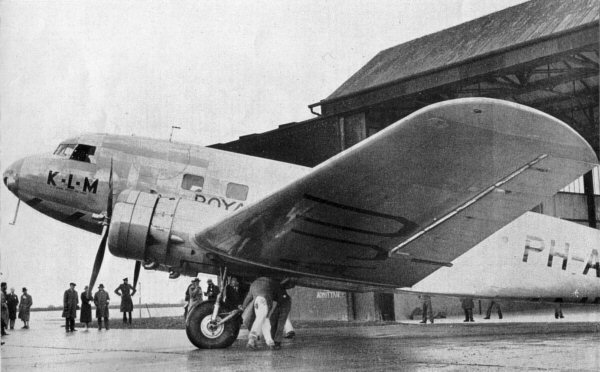
The DC-2 enjoyed immediate and resounding success, becoming the backbone of many rapidly expanding airlines. Carriers such as TWA, KLM, Eastern Air Lines, Swissair and Lufthansa quickly adopted it, recognizing its extraordinary operational capabilities and economic potential. Its reliability and speed revolutionized national and international routes.
An iconic moment in his career was the 1934 MacRobertson Air Race, where a KLM DC-2, named "Uiver", finished second among transport aircraft, challenging racing prototypes and demonstrating to the world its exceptional combination of speed and range. This event consolidated its global fame, accelerating sales and adoption by other nations.
Durante la Seconda Guerra Mondiale, molti DC-2 furono requisiti e convertiti per uso militare, servendo come trasporti e aerei da collegamento. Their robustness and versatility made them valuable even in war contexts, extending their operational life well beyond their initial civilian use and testifying to the solidity of their design.
Legacy & Cultural Impact
Il Douglas DC-2 è stato molto più di un semplice aereo; fu un catalizzatore che diede forma all'aviazione moderna. Ha dimostrato la fattibilità di un trasporto aereo sicuro, veloce e redditizio, gettando le basi per l'espansione globale delle linee aeree. Il suo successo convinse l'industria che gli aerei passeggeri potevano essere un affare sostenibile e di massa.
Above all, the DC-2 is recognized as the direct predecessor of the legendary Douglas DC-3, one of the most produced and successful aircraft in history. The structural and operational innovations introduced by the DC-2 were refined into the DC-3, which inherited much of its DNA, but it was the DC-2 that showed the way and set the standard for airliners of the future.
Telemetria Specs (HUD)
Hangar Trivia & Curiosità
- 💡Despite its success, only 156 DC-2s were built, dwarfed by the over 16,000 DC-3s that followed.
- 💡A KLM DC-2 named "Uiver" famously placed second in the 1934 MacRobertson Air Race from England to Australia, only beaten by a purpose-built racer, showcasing its impressive capabilities.
- 💡The DC-2's design was initially a response to a TWA specification for a three-engine aircraft, but Douglas convinced them a more efficient two-engine design could meet performance requirements.
Archivio Avvistamenti Spotter
Immagini scattate dalla community in tutto il mondo