DC-1
Douglas
Historical Context & Origins
In the turbulent aeronautical landscape of the early 1930s, the air transport industry was in turmoil, but also marked by tragic accidents. The disaster of TWA flight 599 in March 1931, caused by the structural failure of the wing of a wood and canvas Fokker F.10A, profoundly shook public opinion and confidence in the aircraft of the time.
Transcontinental & Western Air (TWA) responded with a radical request to the major manufacturers: a safe, robust and innovative passenger aircraft, preferably three-engine for greater reliability or, alternatively, twin-engine with superior performance. Donald Douglas, defying convention, proposed a revolutionary twin-engine design that promised to exceed all expectations.
Thus, in response to this pressing need for safety and progress, the Douglas Commercial-1 (DC-1) was born, a prototype destined to rewrite the rules of civil aviation. Its first flight, which occurred on July 1, 1933, marked the beginning of a new era for commercial air transport.
Architecture & Technological Design
The DC-1 was a true milestone in aeronautical engineering, almost completely abandoning traditional wood and canvas structures in favor of an all-metal semi-monocoque construction. This choice not only ensured unprecedented structural strength, but also paved the way for more efficient and safer designs.
Another crucial innovation was the adoption of hydraulically retractable landing gear, an element that drastically improved the aerodynamics of the aircraft, allowing higher cruising speeds and reducing fuel consumption. Its cantilever wings, with Clark YH profile, were carefully designed to maximize aerodynamic efficiency.
Powered by two Wright SGR-1820F Cyclone radial engines rated at 710 horsepower each, the DC-1 promised exceptional performance. Last but not least, passenger comfort was at the heart of the project, with a soundproof and heated cabin, an almost unthinkable luxury for the time, which raised the standards of air travel.
Onboard Specifications
- ◆Semi-monocoque all-metal construction for strength and safety.
- ◆Hydraulically retractable landing gear for superior aerodynamics.
- ◆Soundproofed and heated passenger cabin for revolutionary comfort.
Operational Career & Operators
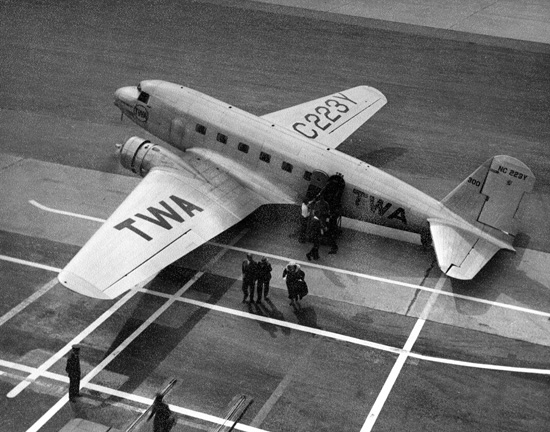
Only a single Douglas DC-1 was ever built, registered as NC223Y. This prototype served TWA for an intensive test and evaluation program, fully demonstrating its exceptional capabilities of speed, autonomy and, above all, safety. TWA was so impressed that they ordered an improved version.
The company's requests included a slightly longer fuselage to accommodate more passengers, more powerful engines and some structural changes, elements that would lead to the birth of the famous DC-2, the first production aircraft of the series. The DC-1, therefore, never went into mass production.
After service with TWA, the sole DC-1 was sold to Lord Forbes, a British private individual, and subsequently operated in Spain with Líneas Aéreas Postales Españolas (LAPE) and later with Aviación Nacional during the Spanish Civil War. His fate ended tragically in 1938 in Malaga, due to an accident during a landing.
Legacy & Cultural Impact
Despite its very short operational career and the existence of only one example, the impact of the Douglas DC-1 on aviation was monumental. It was the direct precursor to two of the most influential aircraft in history: the DC-2 and, in particular, the iconic DC-3, which would democratize global air travel.
The DC-1 unequivocally demonstrated the superiority of all-metal twin-engine transport aircraft in terms of safety, efficiency and performance. It set new standards for commercial aircraft design, influencing each subsequent generation of aircraft and accelerating the abandonment of obsolete wood and canvas structures.
Its bold concept and cutting-edge technological solutions radically transformed the expectations of passengers and airlines. The Douglas DC-1, although unique, was the catalyst that sparked a revolution in air travel, making it faster, safer and more accessible, a legacy that continues to resonate today.
Telemetria Specs (HUD)
Hangar Trivia & Curiosità
- 💡Only a single Douglas DC-1 prototype (tail number NC223Y) was ever built; it served as the direct testbed for the successful DC-2.
- 💡It was designed in response to a TWA request following a fatal Fokker F.10a crash, demonstrating the superiority of twin-engine, all-metal designs over the then-common trimotors.
- 💡The DC-1 introduced several groundbreaking features for its era, including retractable landing gear, wing flaps, and a stressed-skin fuselage, setting new standards for airliner design.
Archivio Avvistamenti Spotter
Immagini scattate dalla community in tutto il mondo