Dart Herald
Handley Page
Historical Context & Origins
The post-World War II period generated a pressing demand for regional transport aircraft: robust, reliable and economical aircraft, capable of connecting smaller urban centers and isolated communities. In this dynamic context, Handley Page, a historic name in the British aeronautical industry, presented the H.P.R.3 Herald, initially equipped with Alvis Leonides radial engines.
However, the market was rapidly moving towards new propulsion technologies. The lack of sufficient commercial interest in the piston version pushed Handley Page to a courageous and far-sighted revision of the project. This strategic decision led to the adoption of the most modern and high-performance turboprop engines.
The redesign created the H.P.R.7 Dart Herald, an aircraft that would write an important chapter in regional aviation. The first flight of the Dart Herald occurred in 1958, marking the beginning of a rather long-lived and successful operational career, which would prove its validity in the field.
Architecture & Technological Design
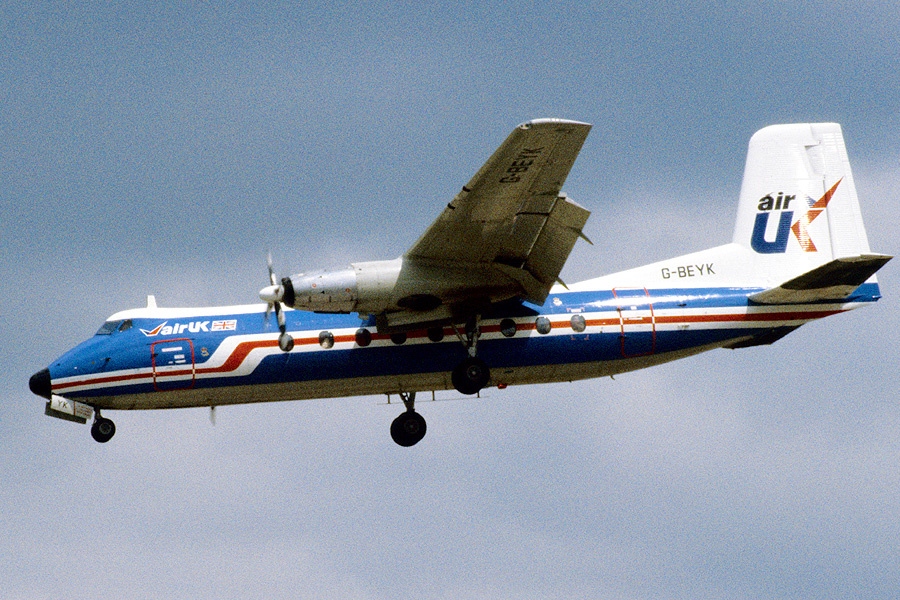
The Handley Page Dart Herald stood out for its essential but extremely functional architecture, designed for maximum operational versatility. Its characteristic high wing configuration was not only a distinctive feature, but a precise engineering choice, aimed at guaranteeing ample ground clearance for the propellers, facilitating operations on unpaved or semi-prepared runways.
The design included ultra-rugged tricycle landing gear, designed to withstand the stresses of landing and taking off from uneven surfaces. The cabin, for 44-56 passengers, was pressurized, a major step forward for comfort on regional flights at the time, significantly improving the travel experience.
The true technological heart of the Herald was represented by the Rolls-Royce Dart engines, the same reliable turboprops that powered the Vickers Viscount. These engines were renowned for their efficiency, low noise and, above all, legendary mechanical reliability, making the Dart Herald a true "workhorse" with low operating cost.
Onboard Specifications
- ◆Robust structure and high wing: Optimized to ensure maximum operability even from airports with limited infrastructure.
- ◆Rolls-Royce Dart Engines: Turboprops proven for their efficiency, silence and exceptional reliability.
- ◆Pressurized cabin: Provided a comfortable flight, a distinctive feature for regionals of its time.
Operational Career & Operators
The Handley Page Dart Herald entered service with British European Airways (BEA), finding immediate appreciation for its reliability and ability to operate on demanding routes, such as those to the Channel Islands. Its agility on short runways and its robustness quickly made it a favorite for regional connectivity.
Over its operational life, the Dart Herald was adopted by a variety of regional airlines globally. From Eastern Provincial Airways in Canada, to European operators such as Itavia and Air UK, to companies in Asia and Africa, the aircraft demonstrated surprising adaptability to extremely different climatic and infrastructural conditions.
Despite competition from models such as the Fokker F27 and Avro 748, the Handley Page Dart Herald carved out a significant niche, remaining a mainstay of regional air travel for over three decades and cementing its reputation as a pragmatic and durable solution.
Legacy & Cultural Impact
The Handley Page Dart Herald was much more than just a plane; it was a catalyst for the development of regional airline networks in many parts of the world. His long and versatile career allowed him to connect communities and destinations that were previously difficult to reach, democratizing air transport on a local scale.
This aircraft represents a tangible symbol of British aeronautical engineering of the era, a period of great innovation and pragmatism. Although most examples were retired from active service by the end of the 20th century, some have been lovingly preserved in museums, a testament to their significant historical impact.
The Dart Herald's legacy lies in demonstrating that the combination of rugged design and reliable technology could produce an aircraft of extraordinary longevity and utility. It is a fundamental chapter in the history of regional aviation, remembered as a tireless "workhorse" of the skies.
Telemetria Specs (HUD)
Hangar Trivia & Curiosità
- 💡Initially conceived as a piston-engined aircraft (HP.1 Herald), it was re-designed to incorporate turboprop engines, becoming the more successful Dart Herald (HP.100 series and beyond).
- 💡Its distinctive high-wing configuration provided excellent propeller clearance, a key feature for its intended operations from unpaved or semi-prepared runways.
- 💡Despite its robust design and versatility, only 50 Dart Heralds were built, reflecting stiff competition in the regional airliner market of its era.
Archivio Avvistamenti Spotter
Immagini scattate dalla community in tutto il mondo