CV-990 Coronado
Costruttore Sconosciuto
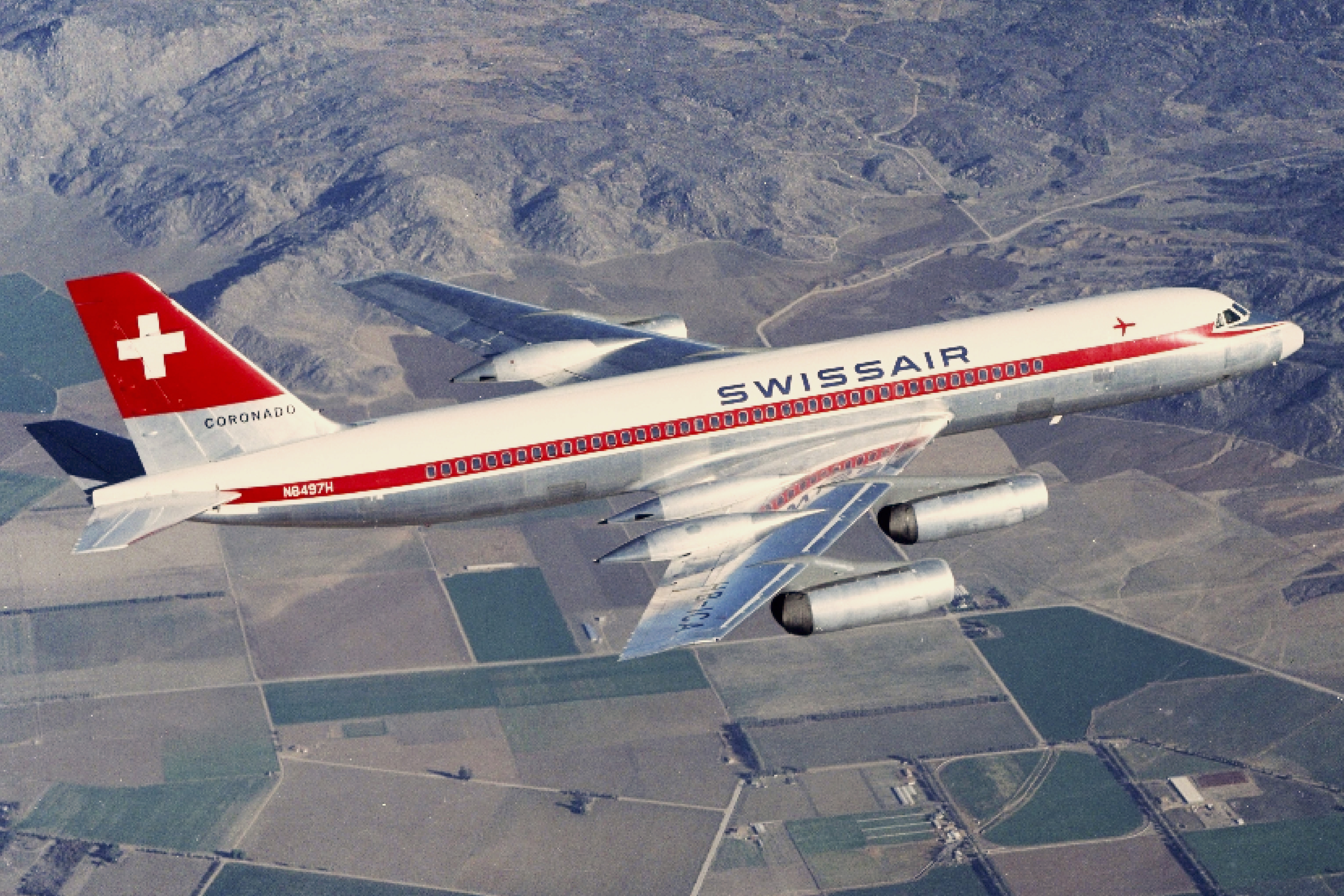
Historical Context & Origins
The early 1960s were a time of fervent innovation in civil aviation, dominated by competition between the giants Boeing 707 and Douglas DC-8. In this ambitious scenario, Convair, thanks to its experience with the CV-880, tried to carve out a space for itself with an even faster and technologically advanced aircraft.
The Convair CV-990 Coronado was born upon the specific request of American Airlines, which wanted a jet for medium-long routes, capable of exceeding its direct competitors in terms of cruising speed. This led to a significant evolution compared to the CV-880, aiming for superior aerodynamic performance. Its first flight was in 1961, a pivotal time for air travel.
Architecture & Technological Design
The Coronado was an engineering marvel, designed for speed. Its distinctive feature was the four "anti-shock bodies" or "Küchemann carrots", located on the wings. These visually distinctive elongated fairings served to reduce transonic drag and shift the wavefront, allowing the aircraft to reach exceptionally high cruising speeds.
Under the wings, the CV-990 was powered by four General Electric CJ-805-23B turbofan engines, a civilian version of the powerful J79 military engine. These thrusters, which incorporated an innovative after-cooling cycle for additional thrust under certain conditions, were cutting-edge and contributed significantly to its high-speed capabilities.
Onboard Specifications
- ◆General Electric CJ-805-23B Engines: Turbofan with aftercooler for superior thrust and optimal high-altitude performance, a bold choice for a civil jet.
- ◆Anti-shock bodies (Küchemann Carrots): Key aerodynamic innovation to reduce transonic drag, optimizing airflow over the wing and enabling higher cruising speeds.
- ◆Internal engine nacelle airbrakes: Four airbrakes integrated into the internal engine nacelles, an advanced system for descent speed control and landing.
Operational Career & Operators
The CV-990 entered service with American Airlines in 1962, followed by major international airlines such as Swissair and SAS. Despite its extraordinary performance in terms of speed, which made it one of the fastest airliners of the time, the Coronado faced a complex operational career full of economic challenges.
The high fuel consumption of the first generation turbofan engines and a lower passenger carrying capacity than its competitors made it less operationally efficient. This, combined with unfavorable market timing and high acquisition cost, limited its diffusion, making it a commercial failure for Convair, with only 37 units produced.
Legacy & Cultural Impact
Despite its commercial failure, the Convair CV-990 Coronado is remembered as a masterpiece of aeronautical design and engineering. He was a pioneer in the pursuit of speed in civil skies, pushing the limits of aerodynamic design and propulsion for his time. Its unique silhouette, with distinctive wing "carrots", made it instantly recognisable.
Today, the Coronado is celebrated by aviation enthusiasts as a "cult plane," an airplane that dared to challenge the status quo. Although it did not replicate the success of its contemporaries, its technological impact and futuristic aesthetic place it among the most fascinating and technically ambitious aircraft ever built, symbolizing an era of design audacity.
Telemetria Specs (HUD)
Hangar Trivia & Curiosità
- 💡Il CV-990 era uno dei jet commerciali subsonici più veloci mai costruiti, raggiungendo velocità di crociera di Mach 0.84-0.86.
- 💡Le sue caratteristiche 'Küchemann carottes', o corpi anti-shock, posizionate sui bordi d'uscita alari, erano progettate per ridurre la resistenza aerodinamica a velocità elevate.
- 💡Nonostante le sue prestazioni avanzate e la velocità, furono prodotti solo 37 esemplari, rendendolo un insuccesso commerciale per Convair.
Archivio Avvistamenti Spotter
Immagini scattate dalla community in tutto il mondo