CV-340
Costruttore Sconosciuto
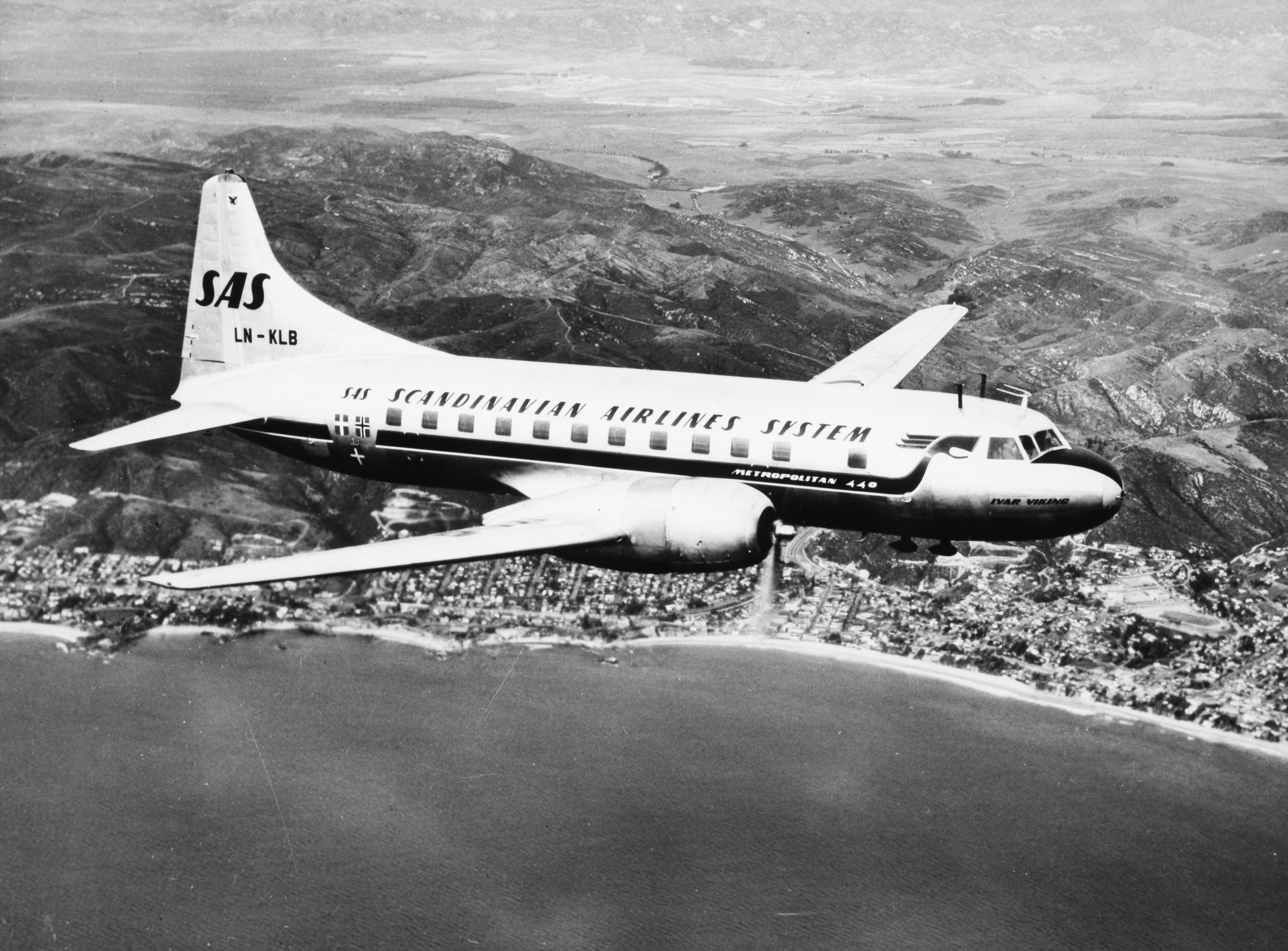
Historical Context & Origins
In the lively post-war scenario, with civil aviation rapidly expanding, the need for increasingly efficient and comfortable regional aircraft emerged. Convair, building on the success of its CV-240, a pioneering twin-jet engine, responded to the growing needs of airlines.
The Aviation CV-340, a direct evolution of its predecessor, was designed to offer greater passenger capacity, extended range and superior on-board comfort. Its first flight, which occurred in 1951, marked the beginning of a new era for medium-range connections, consolidating Convair's position in the piston airliner market.
This development reflected a crucial transition: airlines were demanding larger aircraft for longer routes but which maintained the reliability of piston engines, before the dominant advent of turbofans. The CV-340 represented the perfect answer to this question, combining robustness and innovation.
Architecture & Technological Design
The Convair CV-340 stood out for its robust and proven architecture, derived from the success of the previous model but with significant improvements. Its fuselage was lengthened by 1.37 meters and the wingspan increased, allowing it to accommodate up to 44-48 passengers compared to the 40 of the CV-240, increasing operational efficiency.
At the heart of its design were the powerful and reliable Pratt & Whitney R-2800 Double Wasp radial engines, the same ones that powered numerous military aircraft in World War II. This choice ensured exceptional performance and well-known maintenance, crucial for daily operations.
Its construction included a semi-monocoque aluminum structure, light but extremely resistant, designed to operate in different conditions. The particular wing shape and aerodynamic efficiency contributed to excellent stability and maneuverability, appreciated by both pilots and passengers.
Onboard Specifications
- ◆Pressurized and air-conditioned cabin: a key innovation for passenger comfort on longer routes.
- ◆Pratt & Whitney R-2800 Double Wasp radial engines: synonymous with power (2,500 horsepower per engine) and unparalleled reliability.
- ◆Retractable tricycle landing gear: Robust and tested design, essential for frequent operations at various airports.
Operational Career & Operators
The Convair CV-340 quickly established itself as a "workhorse" for many major global airlines. Carriers such as United Airlines, Braniff International, KLM Royal Dutch Airlines and Lufthansa used it extensively to expand their regional and medium-distance networks, appreciating its reliability and low operating costs.
Its versatility was remarkable: in addition to passenger transport, many examples were converted for cargo roles, demonstrating surprising adaptability. Its ability to operate from airports with limited infrastructure made it ideal for connecting remote communities to major hubs.
The operational life of the CV-340 was extended and transformed thanks to turboprop conversions, giving rise to models such as the Convair 540, 580, 600 and 640. These modifications modernized its performance and efficiency, ensuring its presence in the skies for decades, a testament to its structural robustness.
Legacy & Cultural Impact
The Convair CV-340 was not just an airplane, but a mainstay of commercial aviation in the era of transition from piston engines to jets. It contributed significantly to the expansion of scheduled air travel, making it more accessible and comfortable for an ever-wider audience.
Its durability and ability to be converted to a turboprop highlight forward-thinking engineering and superior construction. Many of these aircraft continued to fly in cargo roles or as corporate jets well beyond their "age", demonstrating their incredible longevity and robustness.
The CV-340's legacy is that of an aircraft that has adapted and stood the test of time, a symbol of mid-century aeronautical engineering. It left an indelible mark, facilitating the growth of regional air traffic and demonstrating the validity of well-conceived design.
Telemetria Specs (HUD)
Hangar Trivia & Curiosità
- 💡First flew on October 5, 1951, as an upgrade to the earlier Convair CV-240/300 designs.
- 💡Many CV-340s were later modified with turboprop engines, primarily Allison 501-D13s, becoming the Convair CV-580.
- 💡The United States Air Force operated the CV-340 under the designation C-131B Samaritan for medical evacuation and VIP transport duties.
Archivio Avvistamenti Spotter
Immagini scattate dalla community in tutto il mondo
Vettori Rilevati (Flotta Attiva)






Vettori Rilevati (Flotta Storica / Dismessa)


Braniff International Airways
Stato: Dismesso
Frontier Airlines
Stato: Dismesso
Linjeflyg
Stato: Dismesso

ALM Antillean Airlines
Stato: Dismesso
Delta Air Lines
Stato: Dismesso
Continental Airlines
Stato: Dismesso