CRJ700
Bombardier
Historical Context & Origins
The Bombardier CRJ700 emerges as a strategic response to the evolution of the regional aviation market, capitalizing on the success and experience accumulated with its predecessors, the CRJ100/200. The latter had already revolutionized the sector with their efficiency and speed compared to turboprops, demonstrating the validity of the regional jet concept.
The need for a regional jet with greater capacity, comfort and range was palpable, driven by growing airline demands and pilot contract clauses that limited the size of regional planes. Bombardier, with its far-sighted vision, embarked on the development of a larger family, culminating in the first flight of the CRJ700 in 1999.
This aircraft was not just a simple "stretch" but represented a significant step forward, designed to expand market opportunities and consolidate Bombardier's leadership in the 70-90 seat regional jet segment, offering a superior value proposition in terms of comfort and operability.
Architecture & Technological Design
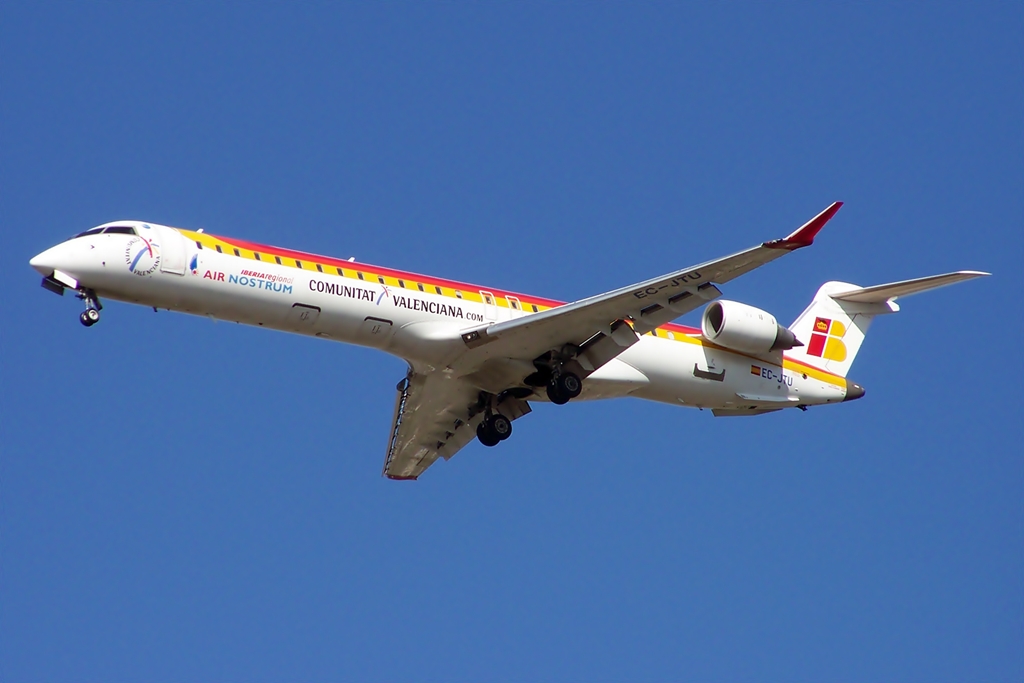
The CRJ700 is distinguished by an architecture that, while maintaining the recognizable silhouette of the CRJ family, incorporates significant structural and aerodynamic innovations. The fuselage has been lengthened by 5.69 meters compared to the CRJ200, but the real difference lies in a completely redesigned wing to maximize efficiency.
This new wing features a larger span, extended chord and optimized geometry, resulting in superior aerodynamics, improved takeoff and landing performance and greater efficiency in cruise flight. The engines, two powerful General Electric CF34-8C1 turbofans, are mounted in a rear position, ensuring a quieter travel experience for passengers.
The attention to detail also extended to the on-board systems. The CRJ700 integrated a more sophisticated flight control system and strengthened landing gear, key elements to handle the increased weight and size, while ensuring the operational reliability and robustness required for frequent regional use.
Onboard Specifications
- ◆Expanded and reconfigured cabin: Offers greater space for passengers, with a typical configuration of 4 seats per row (2+2) and a capacity of up to 78 passengers, ensuring superior comfort compared to previous models.
- ◆Redesigned wing with larger span: Significantly improves aerodynamic efficiency, reducing drag and enabling better performance at different altitudes and speeds, including increased fuel efficiency.
- ◆Advanced Honeywell Primus 1000 Avionics: Integrates a Flight Management System (FMS) and a cockpit with 5 Electronic Flight Instrument System (EFIS) displays, providing pilots with superior situational awareness and facilitating flight management.
Operational Career & Operators
Since its introduction, the Bombardier CRJ700 has enjoyed rapid and widespread adoption by regional airlines around the world. Its combination of capacity, efficiency and comfort made it the ideal aircraft for connecting smaller airports to large hubs, filling a critical gap in point-to-point air transport.
Prestige carriers such as Lufthansa CityLine, SkyWest Airlines and PSA Airlines have made the CRJ700 the backbone of their regional fleets, leveraging its versatility to operate frequent and reliable flights on medium-haul routes. Its ability to operate at airports with limited infrastructure has further strengthened its commercial attractiveness.
This aircraft has helped define the business model of many regional airlines, allowing them to offer competitive jet service where previously only turboprops were employed. Its reliability and reasonable operating costs have cemented its position as the industry's "workhorse" for decades.
Legacy & Cultural Impact
The Bombardier CRJ700 was not just a successful aircraft; has left an indelible mark on the aviation industry, redefining the regional jet segment. Its introduction demonstrated the feasibility and profitability of larger, more comfortable aircraft for regional transport, influencing the development of future models.
It paved the way for subsequent, even more capable variants, such as the CRJ900 and CRJ1000, solidifying Bombardier's family philosophy and setting new standards for regional jet design and operation. Its legacy is manifested in its persistent presence in global skies and its ability to connect communities.
Although the CRJ program was later sold to Mitsubishi Heavy Industries in 2020, the CRJ700 remains a symbol of Canadian aerospace ingenuity and innovation. It has shaped the way we travel regionally and continues to be a benchmark for efficiency and comfort in its segment, a true pillar of modern air travel.
Telemetria Specs (HUD)
Hangar Trivia & Curiosità
- 💡Il CRJ700 è una versione allungata e migliorata del popolare CRJ200, offrendo maggiore capacità e comfort per i passeggeri.
- 💡Condivide una 'type rating' comune con gli altri membri della famiglia CRJ (CRJ700/900/1000), facilitando la formazione e il trasferimento dei piloti tra i diversi modelli.
- 💡È stato progettato per competere direttamente con la serie Embraer E-Jets nel segmento dei jet regionali.
Archivio Avvistamenti Spotter
Immagini scattate dalla community in tutto il mondo