CRJ1000
Bombardier
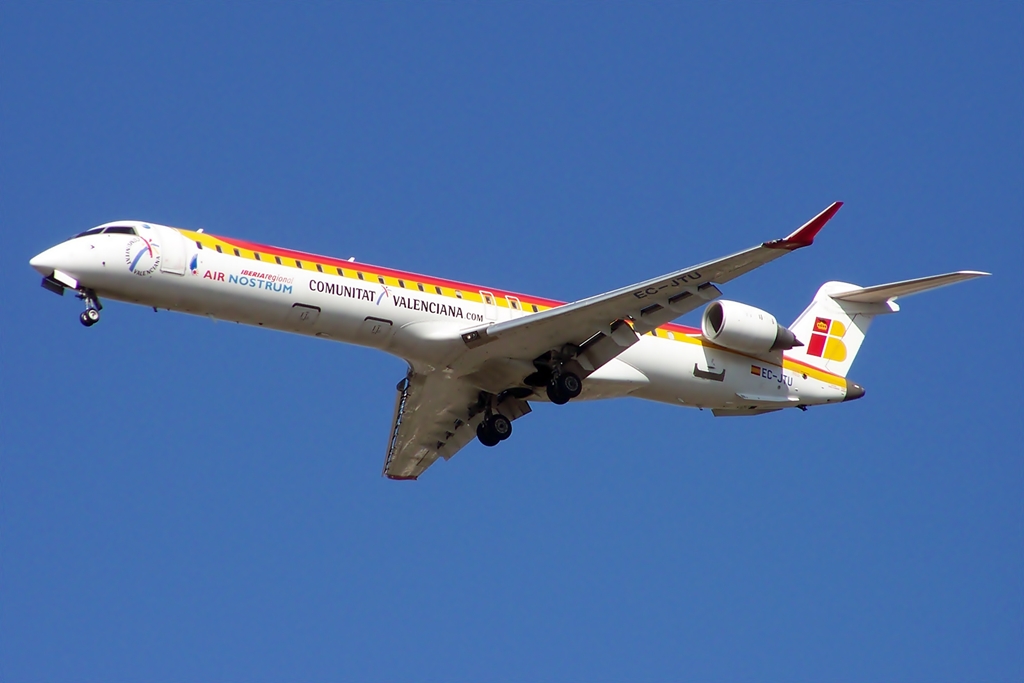
Historical Context & Origins
The Bombardier CRJ1000, the largest and most ambitious member of the famous CRJ (Canadair Regional Jet) family of regional jets, embodies Bombardier Aerospace's response to the growing demand for aircraft with greater capacity on short and medium-range routes. Its genesis is rooted in the success of the previous CRJ700 and CRJ900 models, which had already demonstrated the effectiveness of the optimized regional jet concept.
With the project starting in 2007, the CRJ1000 was designed to offer a significant increase in seating capacity, acting as an ideal bridge between smaller regional jets and narrow-body airliners, while ensuring excellent operating economics. The first flight of this impressive aircraft occurred on 7 September 2008, marking a crucial moment for the regional aviation industry and for Bombardier itself.
Architecture & Technological Design
The architecture of the CRJ1000 represents the culmination of the evolution of the series, characterized by an elongated fuselage that allows it to accommodate up to 104 passengers in a typical two-class configuration, or 100 passengers in a single-class configuration, exceeding the capacity of the CRJ900 by approximately 15-20 seats. This lengthening required structural reinforcements and a review of the aerodynamics to maintain optimal performance.
Powered by two General Electric CF34-8C5A1 turbofan engines, the CRJ1000 boasts optimized thrust-to-weight ratio and remarkable fuel efficiency for its class, allowing it to cover distances of up to 3,130 km (1,691 nm). The design retained significant parts and systems commonality with its predecessors, a key factor in reducing maintenance and training costs for CRJ family operators.
Onboard Specifications
- ◆Advanced Rockwell Collins Pro Line 4 Avionics: A cockpit glass that offers pilots integrated information and cutting-edge navigation systems for greater situational awareness.
- ◆General Electric CF34-8C5A1 engines: Specifically optimized to provide the necessary thrust with improved efficiency, reducing operating costs and emissions.
- ◆Optimized wing and redesigned winglets: to improve aerodynamic efficiency, increase range and reduce drag, contributing to superior flight performance.
Operational Career & Operators
The CRJ1000's entry into service in 2010 with French airlines Brit Air and Air Nostrum (part of the Iberia group) quickly established its reputation as a reliable and cost-effective aircraft. It allowed regional carriers to expand their routes and offer greater capacity where smaller jets weren't enough, but a mainline airliner would have been overkill.
Over the years, the CRJ1000 has been adopted by several airlines around the world, including Lufthansa CityLine and Garuda Indonesia, becoming a key pillar for regional connectivity. Its robustness and versatility have made it a favorite for frequent operations and on challenging routes, proving the validity of the original Bombardier design.
Legacy & Cultural Impact
The Bombardier CRJ1000 represents a significant chapter in the history of regional aviation, consolidating the concept of "mainline look and feel" in a regional format. It has raised the standard of passenger experience on short- and medium-haul flights, offering comfort and amenities previously only associated with larger aircraft.
With the acquisition of the CRJ program by Mitsubishi Heavy Industries in 2020, the CRJ1000 also marked the end of an era for Bombardier in the regional jet industry. Nonetheless, his legacy continues to soar across global skies, a testament to Canadian innovation and the lasting impact that well-conceived design can have on the efficiency and accessibility of air transportation.
Telemetria Specs (HUD)
Hangar Trivia & Curiosità
- 💡È la variante più estesa e capiente della famiglia Bombardier CRJ, progettata per trasportare fino a 104 passeggeri.
- 💡È entrato in servizio nel 2010 con le compagnie aeree europee Brit Air (Francia) e Air Nostrum (Spagna).
- 💡Il CRJ1000 è caratterizzato da una fusoliera allungata rispetto ai suoi predecessori, posizionandosi come diretto concorrente nel mercato dei jet regionali da 100 posti.
Archivio Avvistamenti Spotter
Immagini scattate dalla community in tutto il mondo