Convair 990 Early
Costruttore Sconosciuto
Historical Context & Origins
In the tumultuous post-war period, the American aeronautical industry was in full effervescence, with General Dynamics Convair among the pioneers. Already in 1949, an evocative year of bold prototypes and futuristic visions, Convair began to outline strategies for the commercial aircraft of the future.
The era was dominated by piston engines, but the horizon was already marked by the advent of the jet age. The vision of a jet airliner, capable of surpassing its contemporaries in speed and comfort, took shape in the Convair studios.
The Convair 990, although its first real flight occurred in 1961, embodies the pinnacle of this ambition, inheriting the DNA of previous designs. It was conceived as an improved and larger version of the Convair 880, to tap the high-speed long-range flight market.
Architecture & Technological Design
The design of the Convair 990 was bold and innovative for its time, the result of engineering aimed at maximum aerodynamic efficiency and speed. Its slender silhouette concealed cutting-edge technical solutions.
One of the most distinctive features were the four General Electric CJ805-23 turbofan engines, a civilian version of the military J79, mounted in nacelles at the rear of the wing. These guaranteed exceptional thrust, allowing the 990 to reach astonishing speeds.
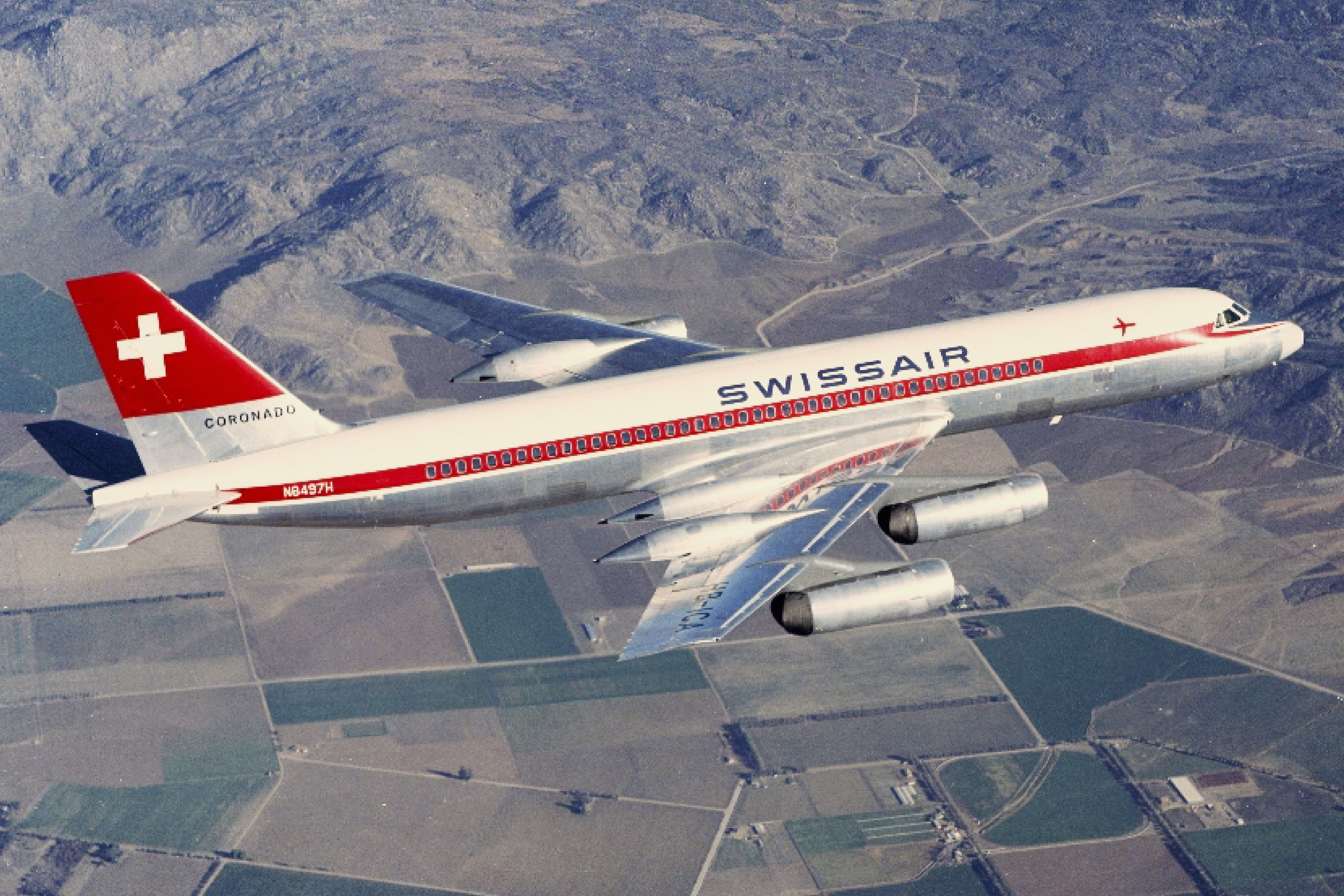
The most iconic, and technologically advanced, aspect were the noticeable "pods" or protuberances on the trailing edge of the wings, known as anti-shock bodies or Kuchemann fairings. These reduced wave drag at high transonic speeds, optimizing airflow.
Onboard Specifications
- ◆GE CJ805-23B Turbofan Engines: Four units for high speeds.
- ◆Anti-shock Bodies (Kuchemann Carrots): Wing structures to reduce wave drag and improve efficiency.
- ◆Passengers on Board: Capacity between 96 and 149 passengers, depending on the configuration.
Operational Career & Operators
The Convair 990 entered service with high expectations, promoted for speed and comfort. American Airlines was the main buyer, supported by important European carriers such as Swissair and SAS (Scandinavian Airlines System).
Despite its advanced capabilities and remarkable cruising speed, often higher than its competitors, the 990 struggled to conquer the market. High operating costs and lower passenger capacity proved to be insurmountable obstacles.
His operational career was short but intense, characterized by impeccable service and unmistakable aesthetics. Many enthusiasts remember it for its elegance and performance, a technological jewel albeit commercially unfortunate.
Legacy & Cultural Impact
Despite its limited commercial success, the Convair 990 left an indelible mark on aviation history. It represents a bold attempt by Convair to push the boundaries of speed and aerodynamics in jetliner design.
Its innovative anti-shock body technology has demonstrated the importance of advanced aerodynamic engineering for performance. The 990 has become a symbol of an era of fervent innovation, where every manufacturer sought to push the limits.
Today, the Convair 990 is revered by aviation enthusiasts as a classic, an example of engineering beauty and courageous vision. Its presence helped define the landscape of commercial aviation, demonstrating that technical excellence does not always translate into commercial triumph, but leaves a legacy.
Telemetria Specs (HUD)
Hangar Trivia & Curiosità
- 💡It featured unique 'speed capsules' or anti-shock bodies on the trailing edge of its wings, intended to increase its critical Mach number.
- 💡The Convair 990 was one of the fastest sub-sonic airliners ever built, capable of cruising at speeds exceeding 900 km/h.
- 💡Despite its advanced design, the 990 achieved limited sales, primarily due to fierce competition, higher fuel consumption, and operational costs compared to rivals like the Boeing 707 and Douglas DC-8.
Archivio Avvistamenti Spotter
Immagini scattate dalla community in tutto il mondo