Constellation L-749
Lockheed
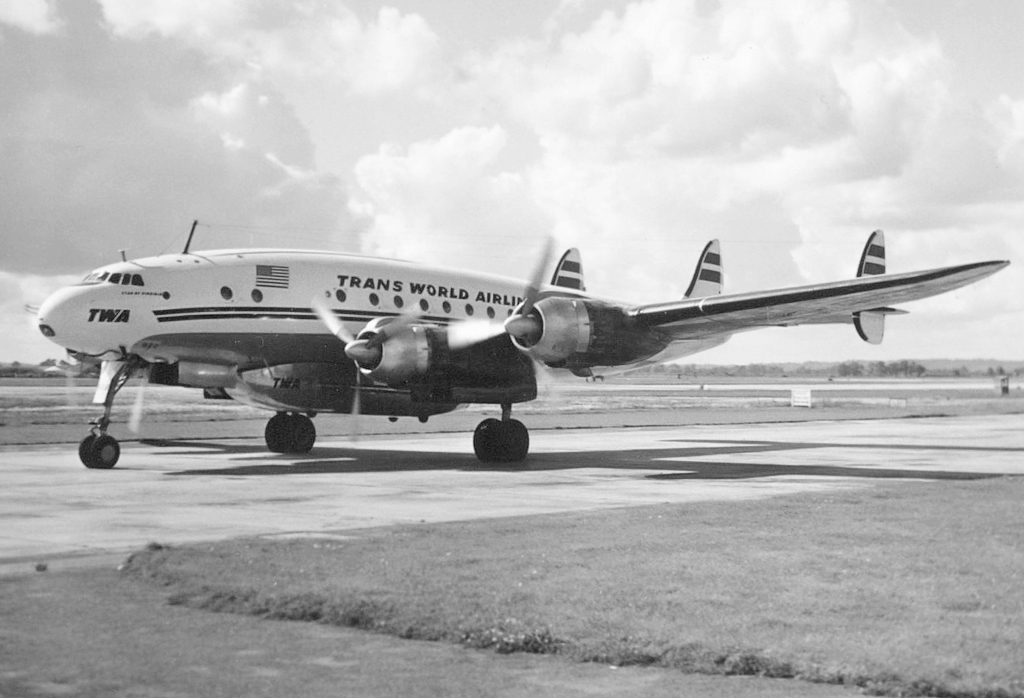
Historical Context & Origins
The Lockheed Constellation L-749 emerged in a golden age for civil aviation, when the world was recovering from World War II and global distances suddenly seemed closer. This magnificent aircraft represented the pinnacle of piston-powered aircraft engineering, promising a future of faster, more comfortable and more reliable air travel for the masses.
Its direct ancestor, the L-049 Constellation, had already set new standards, but the need for greater range and load capacity was growing. The L-749 version, with its first flight in 1947, was Lockheed's response to these evolutionary needs, consolidating the reputation of the "Connie" as a true workhorse for transcontinental and intercontinental routes.
This iteration featured additional fuel tanks in the wings and structural improvements, significantly extending its range and making it ideal for long-distance direct links. The Lockheed L-749 soon became the symbol of luxury and efficiency in post-war aviation.
Architecture & Technological Design
The aesthetics of the Constellation L-749 were unmistakable and visionary, characterized by its distinctive triple vertical tail and dolphin-shaped fuselage, which was not just a stylistic quirk but a masterpiece of aerodynamics. This tail configuration allowed it to fit into existing hangars, maintaining sufficient control surface for an aircraft of this size.
Its fuselage was not only elegant, but also technologically advanced for its time, being pressurized. This innovation allowed passengers to fly at higher altitudes, where the air was more stable and the turbulence was less, ensuring a significantly more comfortable journey. The tapered shape reduced aerodynamic drag, contributing to the aircraft's exceptional speed and range.
At the heart of the L-749 pulsated four powerful and complex Wright R-3350 Duplex-Cyclone radial engines, each delivering up to 2,500 horsepower. Although extremely power efficient, these engines required meticulous and specialist maintenance, but delivered flight performance unrivaled for the piston engine era.
Onboard Specifications
- ◆Advanced pressurized cabin: Enabled an unprecedented flying experience, reducing passenger and staff fatigue on long-haul routes.
- ◆Hot air defrost systems: A crucial innovation for safety and operation in various climate conditions, preventing ice formation on wing surfaces.
- ◆Integrated Engine Management System: Optimized the performance of the complex Wright R-3350 engines, although it required significant crew training.
Operational Career & Operators
The Lockheed L-749 quickly became the aircraft of choice for the world's major airlines, ushering in an era of regular and reliable intercontinental air connections. Prestigious carriers such as TWA, Pan Am, KLM, Air France and BOAC used it on their most sought-after routes, from the Atlantic to the Pacific.
These planes were synonymous with luxury and impeccable in-flight service, offering spacious cabins, high-quality meal service and the feeling of traveling on a cutting-edge machine. The “Connie” solidified the idea that air travel could be a classy experience, not just transportation.
Its reliability and ability to cover long distances without intermediate stops made it an indispensable tool for the globalization of travel, with thousands of flight hours accumulated and millions of passengers transported safely. Despite its mechanical complexity, the L-749 demonstrated remarkable operational resilience.
Legacy & Cultural Impact
The L-749, and the Constellation in general, was not just an airplane; he was an icon, a symbol of post-war progress and optimism. Its unmistakable silhouette remained etched in the collective memory, appearing in countless films, advertisements and posters that evoked the thrill of air travel.
Although it was eventually overtaken by the advent of jets, such as the Boeing 707 and Douglas DC-8, the Constellation L-749 laid the foundation for modern commercial aviation, demonstrating the potential of long-haul flights. Its influence on the design and philosophy of aviation is undeniable.
Even today, restored examples of the Constellation capture the imagination, bearing witness to a time when flying was a luxurious and glamorous adventure. Its legacy endures as a tribute to Lockheed's ingenuity and the vision of an Air Force that knew how to dream big.
Telemetria Specs (HUD)
Hangar Trivia & Curiosità
- 💡The Constellation was initially developed for TWA, partially funded by Howard Hughes, who requested an aircraft capable of flying non-stop across the United States.
- 💡Its unique triple-tail design was necessitated by Lockheed's maximum hangar height, allowing a shorter vertical stabilizer while maintaining sufficient directional control surface.
- 💡Despite its civilian success, the Constellation airframe also served as a military transport (C-69) and later as a crucial early warning radar platform (EC-121 Warning Star).
Archivio Avvistamenti Spotter
Immagini scattate dalla community in tutto il mondo