Concorde
Aérospatiale/BAC
Historical Context & Origins
The Concorde is the most famous supersonic transport aircraft (SST) in history, a masterpiece of joint Franco-British engineering developed by Sud Aviation (later Aérospatiale) and the British Aircraft Corporation. Born in the early 1960s, the project aimed to connect the main world metropolises at a speed faster than the rotation of the Earth.
Concorde made its first flight in March 1969 and entered commercial service in January 1976. Despite representing the technological pinnacle of civil aviation, the Concorde remained a niche aircraft, limited by high operating costs and restrictions on sonic boom in flights over land.
Architecture & Technological Design
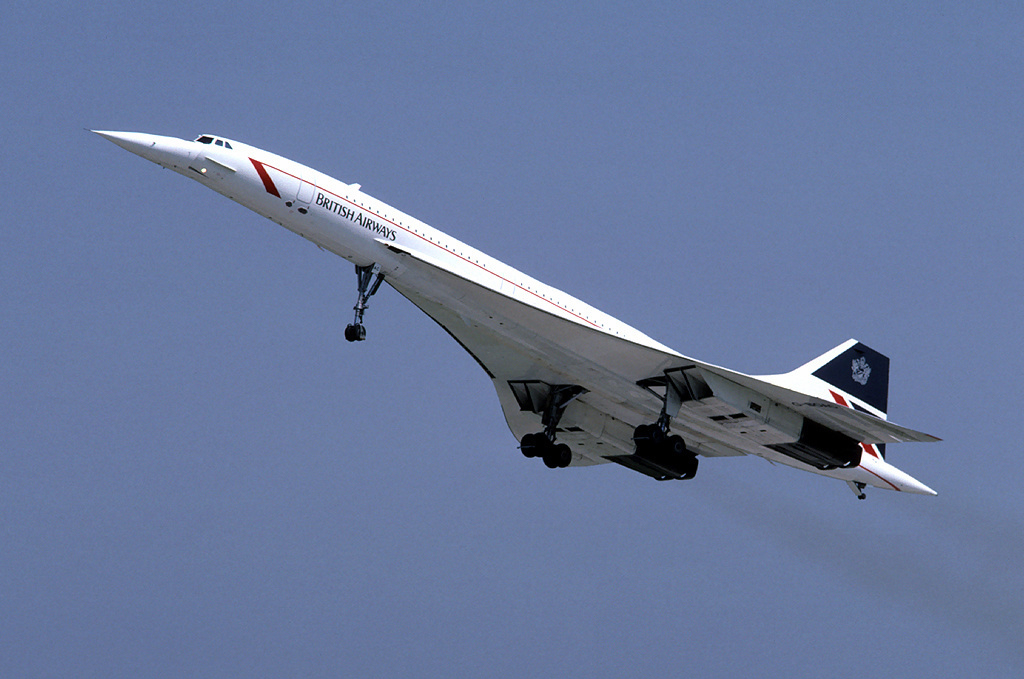
The Concorde was notable for its extraordinary pointed delta wing and the lack of separate flaps or rudders (it used elevons). To ensure pilots' visibility during take-off and landing phases at a high angle of attack, the aircraft was equipped with a characteristic droop nose.
The engines were four powerful Rolls-Royce/Snecma Olympus 593 turbojets equipped with afterburners, positioned in pairs under the wings. Concorde was capable of flying at a cruise speed of Mach 2.04 (approximately 2,180 km/h) at an altitude of over 18,000 meters, where the curvature of the Earth was clearly visible.
Onboard Specifications
- ◆Movable nose with variable geometry to improve visibility upon landing
- ◆Special aluminum structure designed to resist kinetic heat generated by air friction at supersonic speeds
- ◆Narrow passenger cabin with 4-seat configuration per row (2+2) to minimize the front section
Operational Career & Operators
Only two airlines operated the Concorde throughout its commercial career: British Airways and Air France. The main routes were transatlantic flights from London and Paris to New York and Washington, covered in less than three and a half hours (half the time of a subsonic jet).
For a short time, Singapore Airlines also operated joint flights with Concordes painted in their own livery on the left side of the fuselage. Passenger service was elite, offering caviar, champagne and five-star service on board.
Legacy & Cultural Impact
The Concorde has become an icon of modern design, admired for its sharp lines and striking silhouette. It represented the dream of supersonic aviation for entire generations.
Service was permanently discontinued in 2003, following the tragic crash of Air France Flight 4590 in 2000, post-9/11 passenger declines, and unsustainable increases in maintenance costs. Concorde remains one of the very few examples in which humanity has taken a technological step backwards, giving up civilian supersonic speed.
Telemetria Specs (HUD)
Hangar Trivia & Curiosità
- 💡A causa dell'estremo calore cinetico generato a Mach 2, la fusoliera del Concorde si allungava fino a 20-30 centimetri durante il volo supersonico.
- 💡Per riflettere il calore solare e cinetico e proteggere la struttura in alluminio, il Concorde doveva essere verniciato con una speciale vernice bianca ad altissima riflettanza.
- 💡Volando verso ovest da Londra a New York, il Concorde atterrava a un'ora locale precedente a quella di partenza, consentendo ai passeggeri di 'viaggiare indietro nel tempo'.
Archivio Avvistamenti Spotter
Immagini scattate dalla community in tutto il mondo



