Comet 4B
de Havilland
Historical Context & Origins
The de Havilland Comet, the world's first jet airliner, revolutionized air travel in 1952. A series of tragic accidents between 1953 and 1954, caused by structural fatigue, halted its rise, casting a shadow over the jet industry.
The subsequent investigations were among the most thorough in aviation, leading to fundamental discoveries about metal fatigue and pressurized cabin design. These pioneering studies provided the foundation for radically new safety standards essential to the future of jet aircraft.
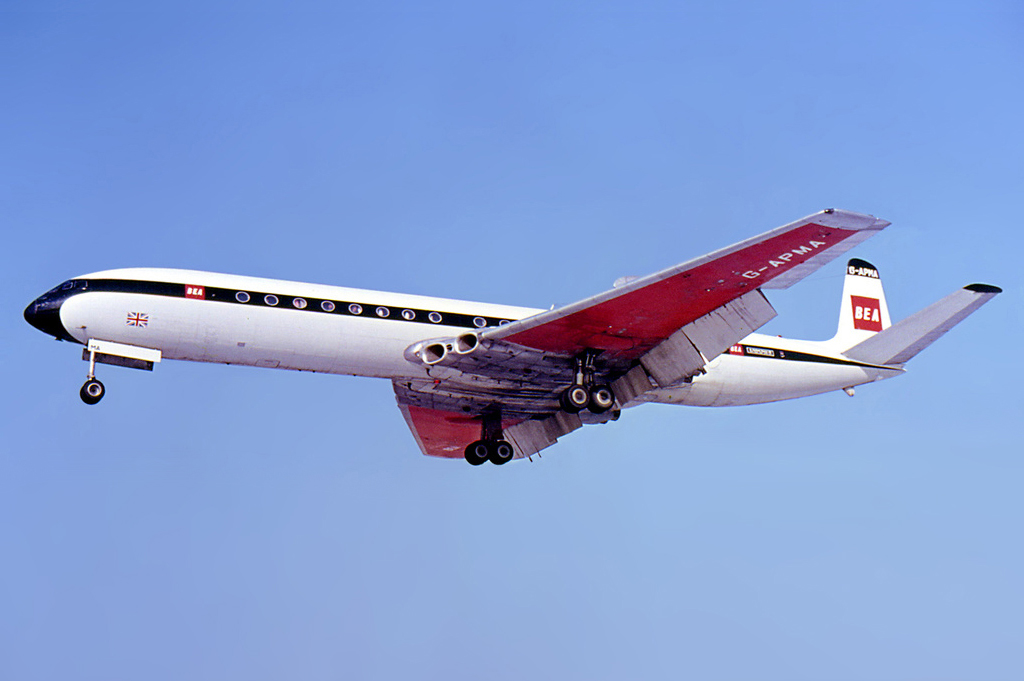
From these ashes emerged the Comet 4 series, a testament to British perseverance. The de Havilland Comet 4B, with its first flight in 1959, represented the ultimate expression of this renaissance, incorporating all the lessons learned and aiming to regain public trust in a rapidly evolving industry.
Architecture & Technological Design
The Comet 4B was distinguished by a configuration specifically optimized for European and medium-distance routes. It featured a fuselage lengthened by 2.06 meters compared to the Comet 4, which allowed it to accommodate more passengers, and slightly shorter wings, without external auxiliary tanks for greater efficiency at low altitude.
The propulsive heart of the 4B consisted of four Rolls-Royce Avon Mk 524 turbojet engines, positioned at the root of the wings. These engines provided significant thrust and proven reliability, crucial for shorter route operations with frequent takeoffs and landings.
The structure benefited from all the post-survey modifications: the square windows had been replaced by sturdy reinforced oval windows. The fuselage had been redesigned with rounded corners and increased skin thickness, as well as improved construction techniques to prevent structural fatigue, making it a pioneer in structural safety.
Onboard Specifications
- ◆Rolls-Royce Avon Mk 524 Engines: Four powerful and reliable turbojets, each capable of generating considerable thrust, ideal for medium-range routes.
- ◆Increased passenger capacity: Up to 100-103 passengers in typical configuration, thanks to the fuselage lengthened by 2.06 meters compared to the Comet 4, optimizing the payload for European routes.
- ◆Optimized wing design: Slightly shorter wings, without the external tanks typical of long-range versions, for better performance and greater efficiency over medium distances.
Operational Career & Operators
The Comet 4B entered operational service on 1 April 1960 with British European Airways (BEA), which used it intensively to connect the main European cities. Its speed and comfort quickly made it a favorite for business and leisure travel.
Another prominent operator was Olympic Airways, which purchased several examples to expand its international network. The Comet 4B proved highly reliable and profitable for these carriers, setting the standard for jet service on European and Mediterranean routes.
Despite competition from aircraft such as the Boeing 727, its reputation for reliability and pioneering remained intact, cementing its place in aviation history as a workhorse for many airlines in a period of transition.
Legacy & Cultural Impact
The de Havilland Comet 4B, and the Comet series, hold a unique place in aeronautical history. The commitment to overcoming initial difficulties transformed the Comet into a catalyst for the improvement of safety standards in global civil aviation, an invaluable legacy.
Its elegant aesthetics and cutting-edge technology have made it an icon of the "jet age", symbolizing the promise of a future of faster and more accessible air travel. It has inspired generations of engineers and pilots, demonstrating that significant innovations can arise from challenges.
Although its operational career was relatively short, the Comet 4B played a crucial role in shaping the airline industry. It demonstrated the economic and technical viability of jets for medium-distance routes, laying the foundation for the design of modern airliners.
Telemetria Specs (HUD)
Hangar Trivia & Curiosità
- 💡Unlike other Comet 4 variants, the 4B featured a noticeably longer fuselage and a shorter wingspan, a configuration specifically tailored for high-speed, medium-range European routes.
- 💡Its primary operators were British European Airways (BEA) and Olympic Airways, making it a common sight in European skies during the early jet age.
- 💡The Comet 4B, like all Comet 4 series aircraft, incorporated extensive structural redesigns and safety improvements following the tragic accidents of the original Comet 1, successfully restoring public confidence in jet travel.
Archivio Avvistamenti Spotter
Immagini scattate dalla community in tutto il mondo