Comet 1
de Havilland
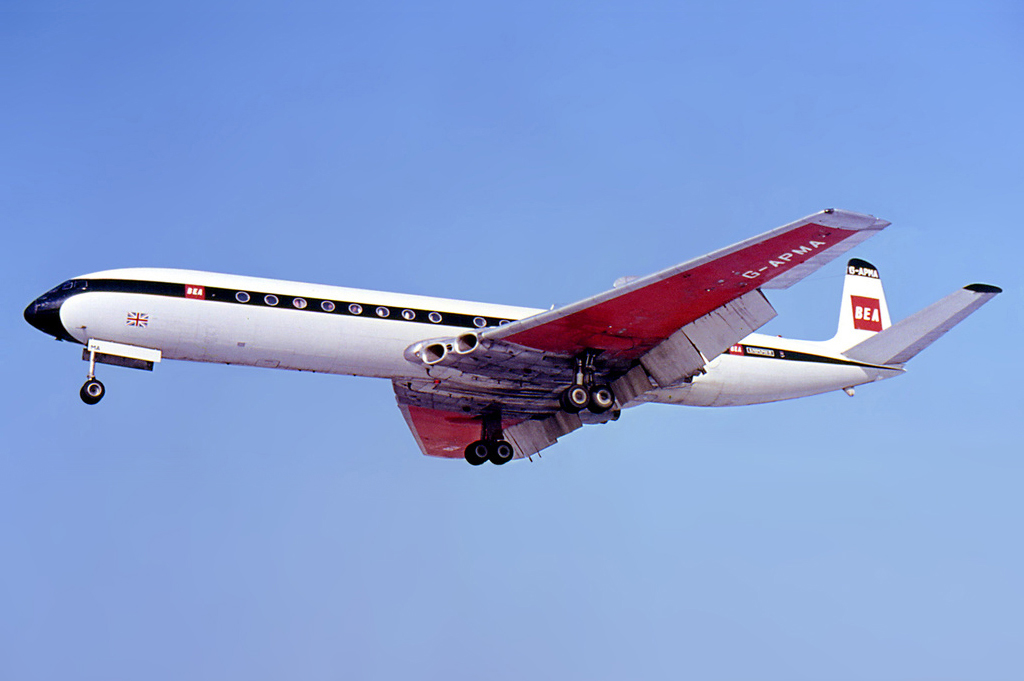
Historical Context & Origins
The de Havilland Comet 1, with its first flight on July 27, 1949, was not just an airplane; it was the dawn of a new era. This extraordinary British aircraft represented the definitive leap into the future of civil aviation, promising faster, quieter and more comfortable air travel than ever imagined. Great Britain, a veteran of the Second World War, aimed to re-establish its technological primacy in the sector.
The genesis of the Comet is rooted in the recommendations of the 1943 Brabazon Committee, which outlined the need for advanced post-war airliners. The Type IV, a short-range jet airliner, became de Havilland's ambitious plan for an aircraft capable of connecting the British Empire at high speed. The idea of a civilian jet was bold and visionary.
De Havilland, with his unrivaled experience in designing fast aircraft, embraced the challenge. The goal was to create an aircraft that not only harnessed the power of jet engines, but that integrated structural and aerodynamic innovations to offer a revolutionary flight experience to passengers, ahead of its competitors by decades.
Architecture & Technological Design
Il Comet 1 era una meraviglia ingegneristica per la sua epoca, caratterizzato da linee elegantissime e un design aerodinamico puro. Its moderately swept wings and configuration with four de Havilland Ghost turbojet engines integrated into the wing root, were cutting-edge solutions that ensured clean aesthetics and superior aerodynamic performance.
One of the most significant innovations was the pressurized cabin, which allowed the Comet to fly at higher altitudes (around 11,000-12,000 meters) compared to its propeller-driven contemporaries. This ensured a flying experience above atmospheric turbulence, offering greater comfort and unprecedented cruising speed for passenger transport.
Extensive use of lightweight alloys and advanced construction techniques, including wire rowing, made the airframe incredibly light and strong. However, the search for lightness and the adoption of square windows tragically represented critical points that emerged only after prolonged operating cycles at high altitude.
Onboard Specifications
- ◆De Havilland Ghost 50 Mk.1 turbojet engines: the first to power a civil airliner, delivering 22 kN of thrust each.
- ◆Pressurized cabin: Allowed a pressure differential of 55 kPa, maintaining similar conditions at 2,400 meters altitude even at high cruising altitudes.
- ◆Integral monocoque structure in aluminum alloy: innovative in terms of strength and lightness, but subsequently revealed to be vulnerable to metal fatigue.
Operational Career & Operators
Comet 1's operational debut with BOAC on 2 May 1952, en route from London to Johannesburg, was a triumph. The plane was incredibly popular, praised for its speed of 725 km/h and absolute silence compared to piston engines. It symbolized progress and luxury, dramatically shortening travel times between continents.
However, the dream quickly turned into a nightmare. A series of catastrophic accidents between 1953 and 1954, notably those of BOAC Flights 783 and 781 and South African Airways 201, led to the grounding of the entire fleet. In-depth investigations, led by Professor Sir Alfred Pugsley, revealed the cause: metal fatigue.
The repeated stresses of the cabin pressurization and depressurization cycles, concentrated around the corners of the square windows and the attachment points of other openings, led to microscopic cracks that propagated rapidly. These tragic events highlighted a fundamental gap in the understanding of structural stresses in high-altitude jets.
Legacy & Cultural Impact
Despite its unfortunate operational career, the de Havilland Comet 1 has an indelible place in aviation history. It unequivocally demonstrated the feasibility and potential of jet aviation, propelling the industry into the future. Its pioneer anticipated a revolution that would change the world of travel forever.
The investigations into the Comet accidents were among the most complex and illuminating in aeronautical history. Lessons learned about metal fatigue, the design of openings in pressurized cabins, and the need for rigorous destructive and non-destructive testing have redefined aviation safety standards globally.
Comet 1 is a powerful reminder that bold innovation, while essential, must always be accompanied by deep understanding and rigorous experimentation. His legacy is not just that of an ill-fated pioneer, but as a catalyst who pushed modern aviation to become inherently safer and more reliable for all.
Telemetria Specs (HUD)
Hangar Trivia & Curiosità
- 💡It was the first commercial jetliner to enter service, ushering in the 'jet age' for passenger transport.
- 💡A series of mysterious in-flight break-ups led to extensive investigations, revealing the then-unknown phenomenon of metal fatigue caused by repeated pressurization cycles, especially around square windows.
- 💡The lessons learned from the Comet crashes were instrumental in redesigning future aircraft, leading to safer cabin pressurization systems, fatigue-resistant structures, and the adoption of rounded window designs.
Archivio Avvistamenti Spotter
Immagini scattate dalla community in tutto il mondo