Caravelle I/III
Sud Aviation
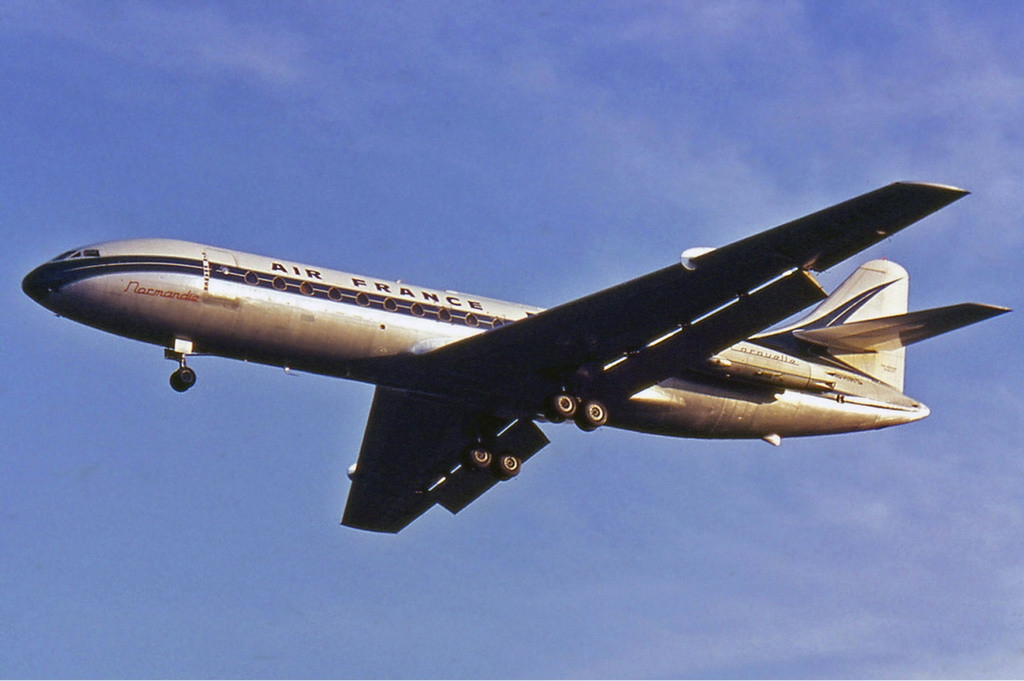
Historical Context & Origins
The mid-1950s marked the dawn of the commercial jet age, with European nations eager to compete with the American giants. In this context of technological fervor, France, through SNCASE (Société Nationale de Constructions Aéronautiques du Sud-Est), gave life to an ambitious project: a medium-range airliner, the SE 210 Caravelle. Its development was a crucial step in the revival of the post-war French aviation industry.
The idea took shape from a 1951 French government specification for an aircraft capable of carrying 70-90 passengers on routes of approximately 2,000 km. On 26 May 1955, the Caravelle prototype made its first flight, piloted by Pierre Nadot, opening a new chapter for European civil aviation. Its configuration was radically innovative and destined to influence the design of future aircraft.
Architecture & Technological Design
The Caravelle immediately stood out for its avant-garde architecture, in particular the bold choice to mount the two jet engines in the rear of the fuselage. This solution, a first for a commercial jet, freed the wings from heavy engine nacelles, allowing for a cleaner and more aerodynamically efficient design. It also helped significantly reduce cabin noise for passengers, improving flight comfort.
Initial versions, such as the Caravelle I, were equipped with Rolls-Royce Avon RA.29 Mk. 506, known for their reliability. Subsequently, the Caravelle III saw the introduction of upgraded versions of the Avons, such as the Mk. 527B or Mk. 532R, which increased its performance and range, consolidating its position in the medium-range jet market. The fuselage, derived in part from the Comet bomber for reasons of economy and timing, was pressurized and offered large panoramic windows.
Onboard Specifications
- ◆Rear fuselage engines: Key innovation that provided a quieter cabin and more efficient wings.
- ◆Integrated thrust reversers: An advanced solution for its time, which improved braking ability and reduced landing spaces.
- ◆Advanced pressurization and air conditioning system: Offered superior comfort for passengers even at high altitudes, with a stable and pleasant environment.
Operational Career & Operators
The Sud Aviation Caravelle entered service with Air France on 6 May 1959, ushering in the continental jet era with a flight between Paris and Rome. Its elegance, high passenger comfort and excellent performance quickly made it a favorite among airlines around the world. It became a symbol of luxury air travel and European efficiency.
In addition to Air France, prestigious carriers such as SAS, Swissair, Sabena, Alitalia, Lufthansa and even some American companies such as United Airlines operated the Caravelle. Its versatility allowed it to excel on short and medium routes, making it a mainstay of European fleets and beyond, with a reputation for robustness and reliability that lasted for decades.
Legacy & Cultural Impact
The Caravelle was not only a commercial success, but a true pioneer that left an indelible mark on aeronautical design. Its configuration with tail-mounted engines was widely imitated by numerous subsequent designs, including iconic aircraft such as the Douglas DC-9, the Boeing 727 and the Tupolev Tu-134, demonstrating the effectiveness and foresight of the French design choice.
A symbol of post-war European ingenuity and industrial capacity, the Caravelle represented French elegance in the sky. Many examples are now preserved in museums around the world, testimony to a golden era of aviation and a design that redefined the concept of airline travel, maintaining an unchanged appeal for enthusiasts.
Telemetria Specs (HUD)
Hangar Trivia & Curiosità
- 💡È stato il primo jet di linea per corto-medio raggio ad entrare in servizio, precedendo il Boeing 727 e il Douglas DC-9.
- 💡La sua distintiva configurazione con motori montati posteriormente fu successivamente adottata da numerosi altri progetti di successo, inclusa la serie DC-9/MD-80 e il Boeing 727.
- 💡I finestrini della cabina di pilotaggio del Caravelle derivavano da quelli del de Havilland Comet, poiché Sud Aviation aveva acquisito i diritti per utilizzare quel design.
Archivio Avvistamenti Spotter
Immagini scattate dalla community in tutto il mondo
Vettori Rilevati (Flotta Attiva)






Vettori Rilevati (Flotta Storica / Dismessa)

Indian Airlines
Stato: Dismesso

Swissair
Stato: Dismesso

EAS Europe Aero Service
Stato: Dismesso

LTU International
Stato: Dismesso
Air Inter
Stato: Dismesso
JAT Yugoslav Airlines
Stato: Dismesso
Sabena
Stato: Dismesso

United Airlines
Stato: Dismesso

Alitalia
Stato: Dismesso

Aviaco
Stato: Dismesso