C-74 Globemaster
Douglas
Historical Context & Origins
The Douglas C-74 Globemaster emerged from a pressing strategic need, conceived in the advanced stages of World War II. The US Army Air Force, anticipating complex operations in the Pacific Theater, required a transport aircraft capable of moving exceptional loads and troops over intercontinental distances, well beyond the capabilities of existing C-54 Skymasters. This bold vision sparked Douglas' Project MX-112.
The idea was to create an "air giant" that could support the logistics of a global conflict, ensuring a constant flow of supplies and personnel across oceans. Despite its wartime genesis, the first flight occurred on August 31, 1945, just days after Japan's surrender, shifting its role from wartime force projection to the critical postwar need to support nascent strategic aviation and global airlifts.
Architecture & Technological Design
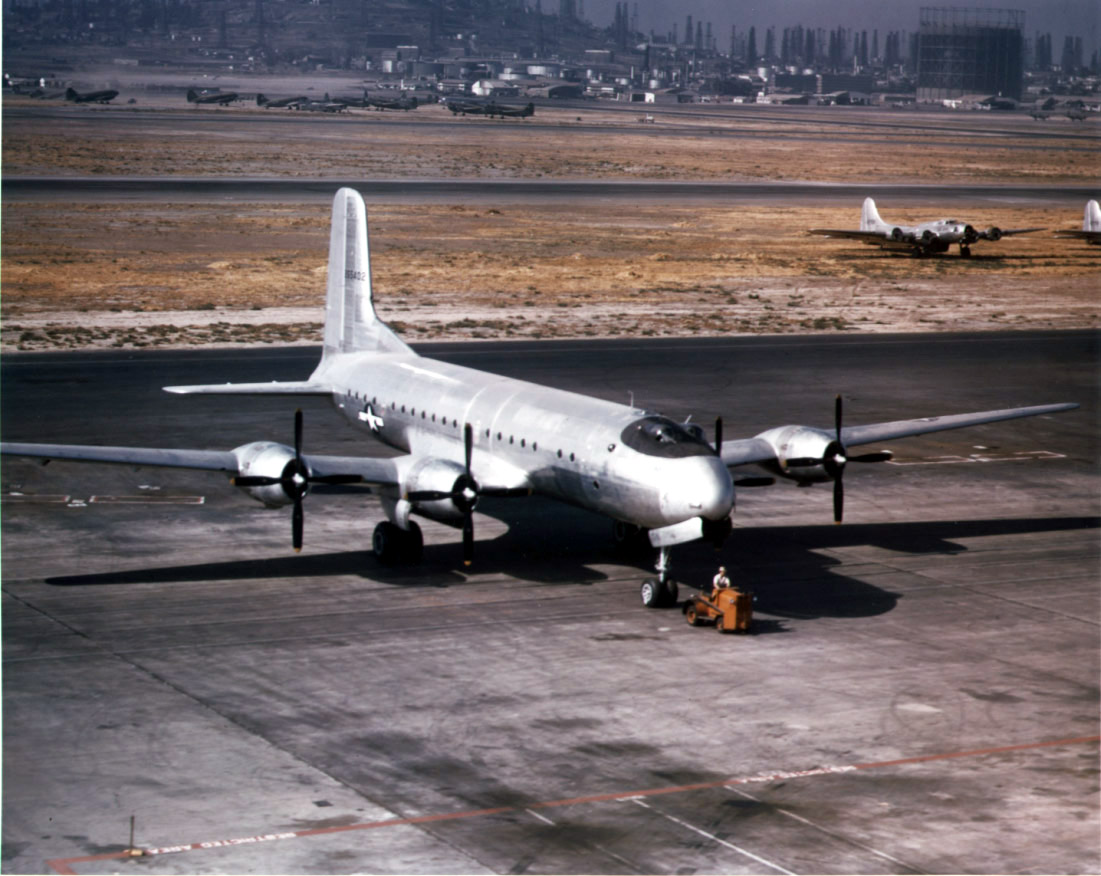
The C-74 was an engineering marvel for its time, a true monument to payload capacity. With a massive fuselage and a wingspan of almost 58 meters, it was powered by four Pratt & Whitney R-4360 Wasp Major radial engines. These engines, among the most powerful available, each delivered 3,000 horsepower, providing the thrust needed to take off with unprecedented loads.
The design featured a high wing architecture, a measure that allowed the loading floor to be reduced in height from the ground, greatly facilitating the loading and unloading of bulky goods and vehicles. The flight deck was unusually spacious, designed to accommodate a crew of 13, including reserve crews, to support long duration non-stop missions.
Onboard Specifications
- ◆Record payload for the time (up to 20,000 kg)
- ◆Double cockpit: one above the other for the flight crew and the reserve crew
- ◆Structural preparation for the installation of eight engines (never built)
Operational Career & Operators
Despite its impressive size and initial ambitions, production of the C-74 was limited to just 14 examples, all acquired by the US Air Force (USAF). These aircraft operated primarily under the command of the Military Air Transport Service (MATS), where they became the workhorses for the transatlantic and transpacific routes, demonstrating their incredible long-range transport capability.
His career saw crucial deployments, albeit in limited numbers, in support of the Berlin Airlift and later during the Korean War. However, the Globemaster was plagued by engine reliability problems and significant maintenance complexity, which reduced its operational flexibility and accelerated its retirement. These giants of the air were progressively replaced by more advanced and reliable models such as the C-124 Globemaster II.
Legacy & Cultural Impact
The Douglas C-74 Globemaster, although a relative commercial and operational failure in terms of numbers, represents a critical link in the evolution of strategic airlifts. He was a pioneer, a true "flying test bed" who pushed the boundaries of aeronautical design. His challenges and innovations laid the foundation for later, larger and more efficient transport aircraft.
The lessons learned from the Globemaster, both in terms of capabilities and limitations, were capitalized in the development of subsequent heavy transport aircraft. Its impact, although not massive for the number of examples produced, is undeniable: it demonstrated the feasibility of strategic intercontinental air transport and helped define the guidelines for the air transport giants that still dominate the skies today, making it an unlucky but visionary giant in the history of aviation.
Telemetria Specs (HUD)
Hangar Trivia & Curiosità
- 💡Furono costruiti solo 14 esemplari del C-74 Globemaster a causa della fine della Seconda Guerra Mondiale, limitandone significativamente la presenza operativa.
- 💡L'aereo presentava un distintivo cockpit a 'doppio ponte', separando i piloti e i copiloti su un ponte superiore dal navigatore e dall'ingegnere di volo su un ponte inferiore.
- 💡È stato uno dei primi aerei progettati con un sistema integrato di paranco e verricello per il carico, consentendo operazioni di carico e scarico indipendenti.
Archivio Avvistamenti Spotter
Immagini scattate dalla community in tutto il mondo