C.23
Caudron
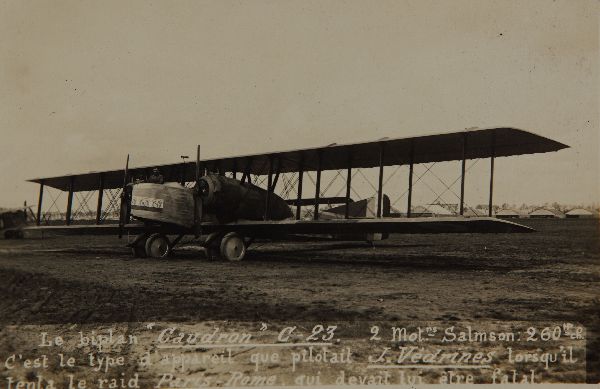
Historical Context & Origins
The Caudron C.23, with its first flight in 1919, emerged in an era of profound transformation for aviation, marking the transition from the purely military era to that of civil and commercial applications. The Great War had spurred unprecedented technological development, leaving a legacy of powerful aircraft and expert engineers, ready to explore new frontiers.
This post-war phase saw Caudron, a company founded by brothers Gaston and René, consolidate its reputation as an innovator, already established with a vast range of trainers and war bombers. The C.23 was conceived as a large, versatile aircraft, capable of tackling both heavy transport tasks and long-range reconnaissance or bombing roles, capitalizing on the lessons learned in combat.
Architecture & Technological Design
The C.23 presented itself as an impressive twin-engine biplane, a configuration that at the beginning of the century guaranteed maximum stability and lifting capacity for aircraft of this size. The choice of two Salmson 9ZM nine-cylinder star engines, capable of delivering approximately 260 HP each, was essential to ensure the necessary power for a vehicle intended to transport significant loads or a large crew.
Its structure was a masterpiece of aeronautical engineering of the time, based on a framework of carefully crafted wood, covered with treated canvas. This combination offered an excellent compromise between strength and lightness, crucial for flight performance and load capacity. The generous dimensions of the wingspan, which exceeded 23 meters, and the elongated fuselage underlined its nature as a "giant" of the post-war skies.
Onboard Specifications
- ◆Twin-engine configuration for greater reliability and payload, a crucial step towards long-range commercial flight.
- ◆Wooden structure and canvas covering, a robust but flexible design, typical of the era but refined for aerodynamic efficiency.
- ◆Large load capacity, foreshadowing cargo and passenger transportation, with room for several passengers or tons of cargo.
Operational Career & Operators
Despite its promising characteristics, the Caudron C.23 did not experience mass production or extensive operational use. Rapid technological evolution and the huge surplus of post-war convertible military aircraft limited the demand for major new designs. It was mainly used for test flights, demonstrations and experiments, offering valuable data for future development.
His role was more that of technical pioneer than workhorse, exploring the potential of large multi-engine aircraft. Despite his limited operational career, he quietly contributed to defining the requirements and challenges for future civil transport aircraft, laying the foundations for the airlines that would dominate the following decades.
Legacy & Cultural Impact
The Caudron C.23, although not a commercial success, represents a fundamental link in the evolution of aeronautics. It embodies the transition from improvised war machines to more sophisticated aircraft, designed for a future of peace and commerce. Its bold design and technical solutions, such as the twin-engine configuration, have become milestones for the sector.
Its innovative spirit is a tribute to the ingenuity of the Caudron brothers and the enthusiasm of an era when the sky opened to infinite possibilities. Today, the C.23 is remembered as a silent precursor, an aircraft that, despite remaining in the shadow of more famous models, helped shape the future of air transport, indirectly influencing the giants that would follow.
Telemetria Specs (HUD)
Hangar Trivia & Curiosità
- 💡Nonostante il suo primo volo nel 1919 (come specificato nel prompt), il C.23 fu progettato durante la Prima Guerra Mondiale con l'intenzione di un servizio tardo-bellico, ma vide un uso operativo limitato prima dell'armistizio.
- 💡Il C.23 fu un biplano bimotore, una configurazione relativamente avanzata per l'epoca, che forniva maggiore ridondanza e potenza per le sue dimensioni considerevoli.
- 💡Fu un predecessore del più noto Caudron C.33, una versione da trasporto passeggeri che evidenziò il passaggio di Caudron verso l'aviazione civile, dimostrando la versatilità del progetto base.
Archivio Avvistamenti Spotter
Immagini scattate dalla community in tutto il mondo