BZ.308
Costruttore Sconosciuto
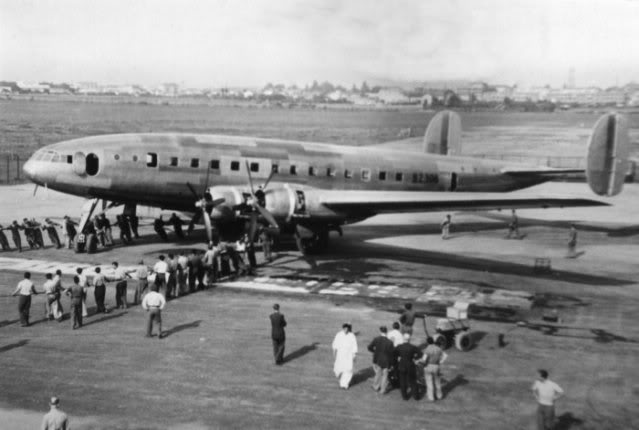
Historical Context & Origins
The year 1948 marks a crucial moment for post-war Italy, an era of reconstruction and profound aspiration for progress. In this context of rebirth, the Italian aeronautical industry fervently sought to reaffirm its excellence, looking to the future with ambitious and innovative projects.
From this perspective of renewal, the Aviation BZ.308 project emerged, conceived as a modern long-range civil transport aircraft. The engineer Filippo Zappata, a leading figure in the Italian aeronautics, was its main creator, aiming for an aircraft that could compete on an international level.
The primary objective was to provide Italian civil aviation with a cutting-edge vehicle, capable not only of guaranteeing efficiency and safety, but also of offering superior comfort for passengers, symbolizing the technological and industrial recovery of the nation.
Architecture & Technological Design
The BZ.308 presented itself as an elegant four-engine high-wing monoplane, a configuration designed to optimize aerodynamic performance and maximize load capacity. Its structure, entirely in light alloy, reflected the most advanced construction techniques of the time.
Propulsion was entrusted to four powerful Bristol Hercules 758 radial engines, each capable of delivering as many as 1,675 horsepower. This choice guaranteed the aircraft robustness, reliability and the power necessary to cover long distances with significant loads.
One of the most innovative and distinctive features of the BZ.308 was its pressurized cabin, a technological solution that was still rare at the time and reserved for a few airliners. This measure aimed to guarantee maximum comfort for passengers and crew on high-altitude flights.
Onboard Specifications
- ◆Pressurized passenger cabin for high altitude flights, an innovation for comfort and reduction of passenger fatigue.
- ◆Cantilevered high wing which improved stability, offered better visibility from the flight deck and optimized interior space for cargo or passengers.
- ◆Retractable tricycle landing gear, an advanced solution that guaranteed better aerodynamics in flight and greater stability during take-off and landing phases.
Operational Career & Operators
Despite its promising characteristics, the Aviation BZ.308 remained a project with an unfinished destiny. A single prototype was made, making its first flight on 27 August 1948, but never saw series production.
The reasons for this limited operational career were multiple and complex. Italy's severe post-war economic difficulties, strong international competition in the civil aviation sector and rapid technological progress hindered its commercialization.
The prototype carried out a series of flight tests which confirmed its excellent aerodynamic qualities and the effectiveness of its innovative solutions. However, the absence of concrete orders from civil airlines marked the end of its operational ambitions.
Legacy & Cultural Impact
Although it never entered commercial service, the Aviation BZ.308 holds a prominent place in the history of Italian aviation. It represented a technological demonstrator of great importance, testifying to the engineering capacity and planning audacity of the country in a time of reconstruction.
The BZ.308 embodies a symbol of Italy's post-war aspirations, a concrete attempt to reaffirm leadership in aeronautical design, despite adverse circumstances. Its story evokes a sense of unexpressed potential and vision projected towards the future.
Even today, the BZ.308 is remembered as an emblematic example of how innovation and determination can emerge even in difficult times, leaving a legacy of inspiration for future generations of engineers and aviation enthusiasts.
Telemetria Specs (HUD)
Hangar Trivia & Curiosità
- 💡Despite its advanced features like a pressurized cabin, only a single prototype of the BZ.308 was ever completed due to post-war economic difficulties and the availability of cheaper surplus aircraft.
- 💡The aircraft was powered by four British Bristol Hercules 750 radial engines, highlighting international cooperation in component supply even shortly after World War II.
- 💡Designed by the renowned engineer Filippo Zappata, the BZ.308 was Italy's ambitious attempt to re-establish itself in the civil aviation market after the war, competing with established American designs.
Archivio Avvistamenti Spotter
Immagini scattate dalla community in tutto il mondo