Britannia
Bristol
Historical Context & Origins
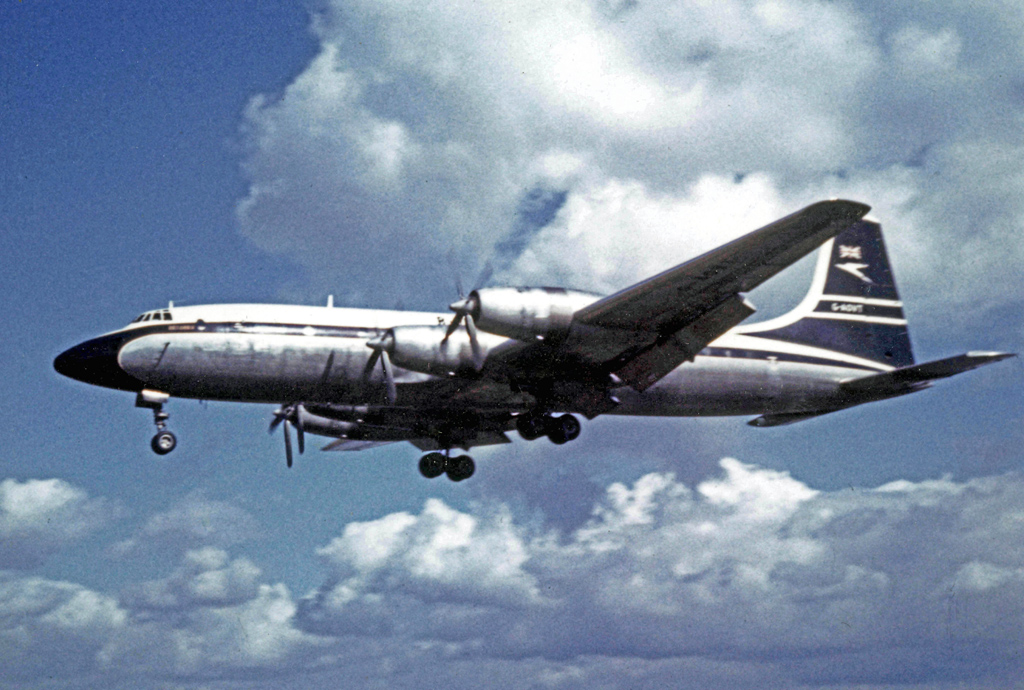
The Bristol Britannia, an icon of post-war British aeronautical engineering, emerged in an era of profound transformation for civil aviation. After the Second World War, Great Britain aimed to reaffirm its leadership in the sector by developing innovative, long-range airliners for imperial routes.
The project, initially called Type 175, was started in the late 1940s with the aim of creating an aircraft capable of competing with nascent jets and established piston aircraft. Attention was focused on turboprop engines, a cutting-edge technology that promised greater efficiency and silence compared to traditional engines.
The Britannia's first flight occurred on 16 August 1952, marking the beginning of a new era for British aviation. Despite initial technical challenges, the aircraft was poised to become one of the pillars of intercontinental air transport.
Architecture & Technological Design
The Bristol Britannia stood out for its avant-garde architecture, centered on the adoption of four Bristol Proteus turboprop engines. This technological choice guaranteed a notable advantage in terms of operating economy and an exceptionally silent and smooth flight experience for the time, earning it the nickname "Whispering Giant".
The wing design, with a high aspect ratio, contributed to the aerodynamic efficiency and stability of the aircraft, making it ideal for long distances. The pressurized fuselage ensured passenger comfort at high cruising altitudes, which was crucial for intercontinental flights.
Its aesthetics, while functional, evoked a sense of robustness and reliability, fundamental characteristics for an aircraft destined to serve the most demanding routes in the world. The overall design was a balance between propulsive innovation and proven aeronautical practices.
Onboard Specifications
- ◆Bristol Proteus turboprop engines: four powerful units that offered remarkable efficiency and a quieter flying experience.
- ◆Advanced pressurization system: guaranteed maximum comfort for passengers even at high cruising altitudes.
- ◆Robust and reliable construction: Designed for durability and safety on long-haul routes.
Operational Career & Operators
The operational career of the Bristol Britannia officially began in 1957 with BOAC (British Overseas Airways Corporation), after overcoming complex problems related to engine freezing in specific atmospheric conditions. These initial challenges, although delayed its full introduction, were crucial in refining the aircraft's reliability.
Once in service, the Britannia quickly established itself as a 'workhorse' for long-haul routes, effectively connecting the UK with destinations in Africa, Asia and Australia. Its carrying capacity and the comfort offered to passengers made it popular among airlines.
In addition to BOAC, it was operated by numerous international carriers, including Canadian Pacific Airlines, El Al and Cubana. Its success also extended to the military and cargo sector with the Canadair CL-44/CC-106 Yukon variant, further consolidating its reputation as a versatile and robust aircraft.
Legacy & Cultural Impact
The Bristol Britannia left a significant legacy in aviation, serving as a crucial bridge between the era of piston-powered aircraft and the advent of pure jets. It demonstrated the full potential of turboprop technology for transporting passengers and cargo over long distances, influencing the development of future aircraft.
Although its career was relatively short due to the rapid rise of jet aircraft such as the Boeing 707 and Douglas DC-8, the Britannia cemented Britain's role as a pioneer in aeronautical engineering. Its nickname, "Whispering Giant", is still evocative today of its innovative nature and the comfort it offered.
The Britannia was not just an aircraft, but a symbol of post-war British ambition, a bastion of technical innovation and a seminal chapter in the history of commercial flying. Its memory endures as that of a sleek, quiet and technically advanced aircraft that helped shape the future of global air travel.
Telemetria Specs (HUD)
Hangar Trivia & Curiosità
- 💡It earned the nickname 'Whispering Giant' due to its exceptionally quiet turboprop engines and smooth ride.
- 💡Development was hampered by engine icing issues, particularly over tropical oceans, delaying its commercial introduction and affecting its early reputation.
- 💡The Britannia was pivotal for BOAC's long-haul routes, demonstrating early turboprop efficiency before ultimately being superseded by jet airliners like the Comet and Boeing 707.
Archivio Avvistamenti Spotter
Immagini scattate dalla community in tutto il mondo
Vettori Rilevati (Flotta Attiva)

Vettori Rilevati (Flotta Storica / Dismessa)

East African Airways
Stato: Dismesso

Air Faisal
Stato: Dismesso
British United Airways
Stato: Dismesso

Globe Air
Stato: Dismesso
BOAC (British Overseas Airways Corporation)
Stato: Dismesso

Canadian Pacific Air Lines
Stato: Dismesso