AW.650 Argosy
Armstrong Whitworth
Historical Context & Origins
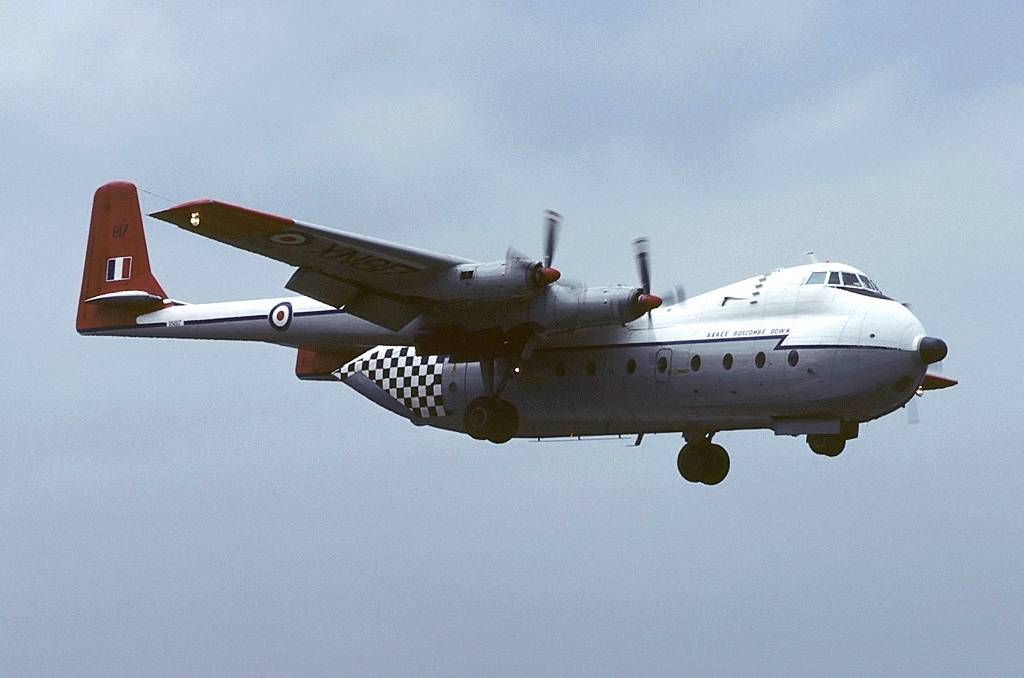
The Armstrong Whitworth AW.650 Argosy emerged in an era of fervent aeronautical innovation, marking the transition from piston-powered to turboprop transport aircraft. Its first flight in 1959 placed it at the center of Britain's post-war needs for a versatile, economical and robust cargo aircraft for medium-range routes.
The project was born from the need for a modern replacement for obsolete cargo transports, combining the efficiency of new turbine engines with an optimized configuration for the transport of bulky goods. The AW.650 was conceived to serve both the civilian market and to attract the interest of the Royal Air Force, positioning itself as a cutting-edge solution for air logistics.
Architecture & Technological Design
The Argosy sported an instantly recognizable and functional design, dominated by its "pod-and-boom" configuration. The wide, non-pressurized, rectangular-section central fuselage was suspended beneath a high wing, while the tail was supported by two separate beams extending from the wing root, providing unobstructed rear access to the cargo compartment.
This particular architecture, combined with the high position of the wings, allowed for easy cargo handling and the use of semi-prepared runways, giving the Argosy extraordinary operational flexibility. Its four Rolls-Royce Dart turboprop engines, known for their reliability and quietness (for the time), provided adequate thrust and remarkable fuel efficiency.
Onboard Specifications
- ◆Simultaneous front and rear loading capacity: Thanks to a system of clamshell doors at both ends of the main fuselage, the Argosy allowed for quick and efficient loading/unloading operations, a true innovation.
- ◆Fail-safe wing structure: The incorporation of fail-safe design principles ensured greater structural strength and crucial redundancy, increasing the operational safety and service life of the aircraft.
- ◆Rolls-Royce Dart quad-turboprop engine: The use of four proven and successful Dart engines provided not only the necessary power but also excellent reliability and simplified maintenance, essential for a transport aircraft.
Operational Career & Operators
The AW.650 Argosy found its main niche in civilian cargo transport, although a military version, the AW.660, was used extensively by the Royal Air Force. Airlines such as Transair and later British European Airways (BEA) appreciated its ability to move large volumes of cargo on short and medium haul routes, contributing to the rapid delivery of mail and goods.
Its distinctive configuration made it a reliable "workhorse" for many operators, albeit in a limited number of examples. The military version AW.660 proved its worth in tactical and logistical transport scenarios for the RAF, cementing the Argosy's reputation as a robust and versatile aircraft, albeit with a very recognizable sonic identity, hence the nickname "The Whistling Wheelbarrow".
Legacy & Cultural Impact
The Armstrong Whitworth AW.650 Argosy, with its "pod-and-boom" configuration and load-oriented functionality, has made a distinctive mark on aviation, while not achieving the popularity of other air giants. Its innovative design was a precursor to modern air transport concepts, demonstrating the effectiveness of a completely unobstructed cargo compartment for maximum flexibility.
Today, the Argosy is remembered as an example of post-war British engineering, an aircraft that responded to the specific needs of its time. Although most have been withdrawn from service, some examples are preserved in aeronautical museums, bearing witness to an era of great creativity and pragmatism in transport aircraft design.
Telemetria Specs (HUD)
Hangar Trivia & Curiosità
- 💡It earned the nickname "Whispering Giant" due to its relatively quiet Rolls-Royce Dart turboprop engines, a stark contrast to many piston-engine transports of its era.
- 💡The unique "pod and boom" fuselage with clamshell doors at both ends allowed for simultaneous loading and unloading, significantly reducing ground turnaround times.
- 💡A military version, the AW.660 Argosy, featured larger side-loading doors, more powerful engines, and a stronger floor, serving as a tactical transport for the Royal Air Force.
Archivio Avvistamenti Spotter
Immagini scattate dalla community in tutto il mondo