AW.27 Ensign
Armstrong Whitworth
Historical Context & Origins
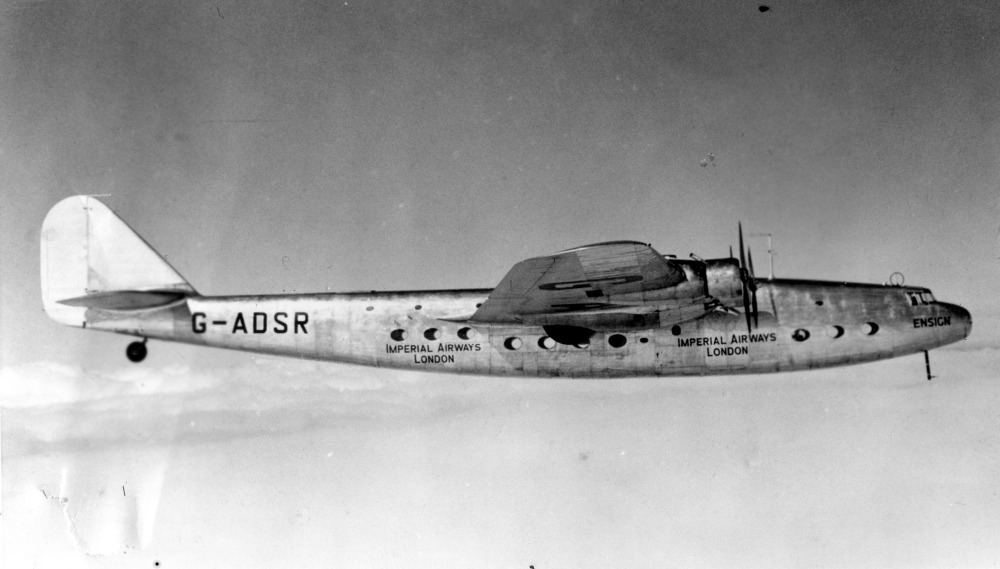
The Armstrong Whitworth AW.27 Ensign, with its first flight in 1938, emerged as an ambitious British design on the eve of World War II. It represented Armstrong Whitworth's response to the growing demand for spacious and comfortable airliners, in an era of fervent development of global civil aviation. The objective was ambitious: to offer Imperial Airways, the British national carrier, an aircraft capable of covering the Empire's long-range routes, challenging the supremacy of American models such as the Douglas DC-3.
It was a strategic initiative for the United Kingdom, keen not to fall behind international aeronautical advances. The Ensign was intended to symbolize British technological advancement and provide prestigious air services on vital routes linking the motherland to its colonial possessions, from the Middle East to India, Australia and Africa.
Architecture & Technological Design
The AW.27 Ensign was notable for being one of Britain's first all-metallic four-engined airliners, a significant step forward from previous mixed-use constructions. Its architecture featured a high wing design, designed to offer passengers an unparalleled view and improve the clearance of the engines and propellers from the ground.
The construction was predominantly semi-monocoque in light alloy, an avant-garde solution for the time, which guaranteed sturdiness and structural lightness. Initially equipped with four Armstrong Siddeley Tiger IXC radial engines, the Ensign promised superior comfort through a spacious cabin and careful attention to sound insulation, crucial for long Imperial voyages.
Onboard Specifications
- ◆High Capacity: Designed to carry up to 27 passengers in a night configuration or 40 passengers during the day, with ample space for luggage and cargo.
- ◆All-Metal Structure: One of the first British airliners with fuselage and wings made entirely of semi-monocoque light alloy, ensuring strength and longevity.
- ◆Luxury Comfort: Pressurized cabin (although later eliminated in later models due to complexity) and significant soundproofing efforts to minimize engine noise, an innovation for scheduled flights at the time.
Operational Career & Operators
The operational career of the Armstrong Whitworth AW.27 Ensign was unfortunately punctuated by significant initial difficulties. The Armstrong Siddeley Tiger IXC engines proved to be underpowered and unreliable, causing exhausting delays and hindering the aircraft's performance. These problems severely limited its effectiveness and reputation in the eyes of Imperial Airways.
Only 14 examples were built. With the outbreak of the Second World War, the Ensigns were quickly repurposed for military transport, operating under the newly formed BOAC (British Overseas Airways Corporation), formed from the merger of Imperial Airways and British Airways. They were used to transport troops, supplies and mail, mainly on African and Middle Eastern routes, demonstrating unexpected resilience in war conditions.
Legacy & Cultural Impact
Despite its initial flaws and limited production, the Armstrong Whitworth AW.27 Ensign holds a significant place in aviation history. It represents a pioneering British attempt to develop a large four-engine airliner, helping to lay the foundations for future generations of civil aircraft.
The lessons learned from the challenges encountered with the Ensign, particularly around engine integration and reliability, were invaluable to the British aviation industry. Its bold design and commitment to passenger comfort showcase the ambitions of the era. The Ensign remains a tangible symbol of an era of transition and daring, a crucial chapter in the history of British commercial aviation, marking a fundamental shift towards modernity.
Telemetria Specs (HUD)
Hangar Trivia & Curiosità
- 💡Plagued by underpowered engines, its initial Armstrong Siddeley Tiger IXC powerplants caused significant performance and reliability issues.
- 💡Many Ensigns were re-engined with more powerful American Wright Cyclone engines, significantly improving their operational capabilities.
- 💡Despite its troubled early service, it offered a notably spacious and luxurious cabin for passengers on Imperial Airways' long-distance routes.
Archivio Avvistamenti Spotter
Immagini scattate dalla community in tutto il mondo