ATL-98 Carvair
Aviation Traders
Historical Context & Origins
In the vibrant post-war landscape of the 1950s and 1960s, Europe witnessed an explosion of automotive tourism. With increased mobility, there was a growing demand to transport cars and passengers across the English Channel quickly and efficiently, a service that traditional ferries struggled to fully meet in terms of speed and convenience.
The most popular solution at the time was the Bristol Freighter, but its side loading method and limited capacity were not ideal. It was in this context that Aviation Traders (ATL), a subsidiary of Air Charter Ltd., saw a unique opportunity. The bold idea was to convert an existing passenger aircraft into a flying "car ferry", optimized for front-loading and unloading vehicles.
The ATL-98 Carvair project (a portmanteau of "Car via Air") took shape, aiming to capitalize on the availability of robust and reliable Douglas DC-4/C-54 Skymaster airframes. The goal was to create an aircraft that could comfortably accommodate a significant number of cars and their occupants, revolutionizing cross-border travel for an increasingly demanding clientele.
Architecture & Technological Design
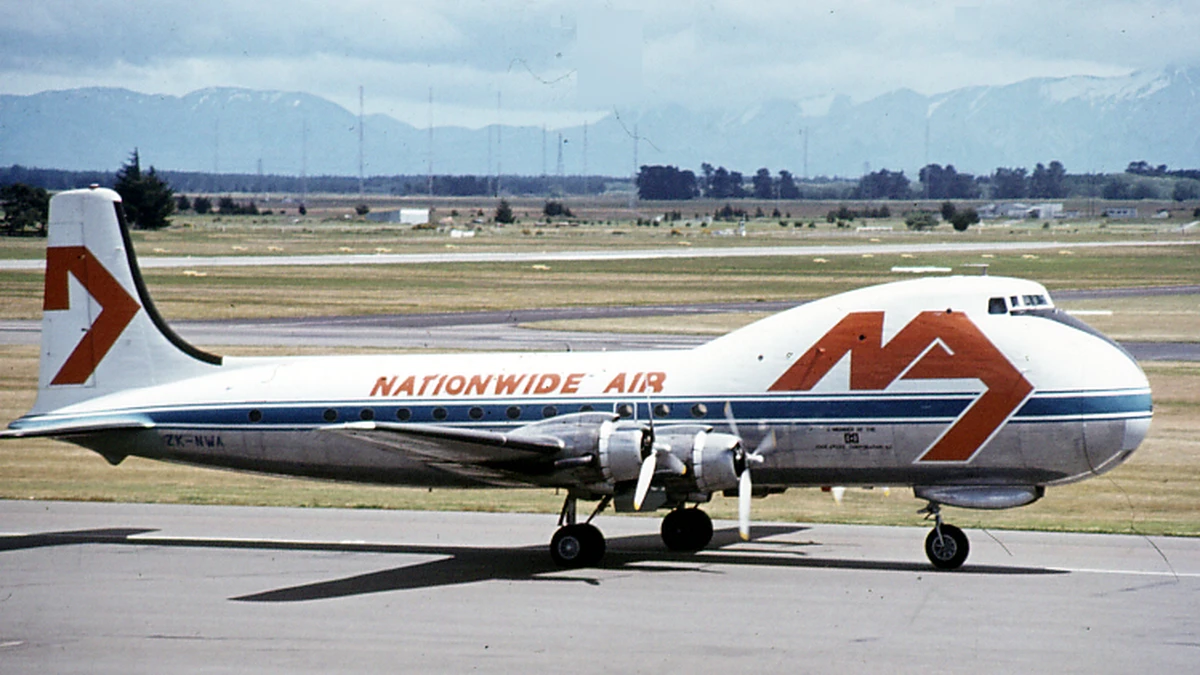
The Carvair was a brilliant example of adaptive engineering, radically transforming the proven Douglas DC-4. The most obvious and iconic modification was the replacement of the forward section of the fuselage with a new nose, elongated and bulbous, equipped with a large "clamshell" side-hinged cargo door, which allowed easy access to the cargo compartment.
To accommodate the new nose and ensure that the cockpit had an unobstructed view during loading and flight, the cockpit was raised significantly above the fuselage, creating the unmistakable "hump" that characterizes the ATL-98. This engineering solution not only solved a practical problem, but gave the Carvair an instantly recognizable and functional silhouette.
The aircraft retained its robust and reliable four Pratt & Whitney R-2000 radial engines, mounted on wings essentially unchanged from the original DC-4. The Carvair was designed to carry up to five cars and 22 passengers, or three cars and 55 passengers, depending on configuration, offering operational flexibility that made it one-of-a-kind.
Onboard Specifications
- ◆Front loading capacity: Clamshell doors for quick loading/unloading of vehicles.
- ◆Raised Cockpit: Improved visibility and maximum load capacity under the flight deck.
- ◆Modular conversion from DC-4: Using existing airframes for low cost and proven reliability.
Operational Career & Operators
The Carvair's first flight occurred on June 21, 1961, marking the beginning of a niche but significant operational career. The main carrier was Channel Air Bridge, later part of British United Air Ferries (BUAF), which used it intensively on trans-Channel routes, connecting cities such as Southend with Ostend, Calais and Le Touquet.
These flights were actual air ferries, allowing tourists to drive their cars directly onto the plane and land on the other side of the Canal, then continuing their journey by road. Although the golden age of car ferries was relatively short due to the advent of cheap charter flights and modern Ro-Ro ferries, the Carvair proved its versatility.
Many Carvairs found a second life as general cargo aircraft, operating in various parts of the world, including flights to support oil exploration and humanitarian missions. Some examples were even used for scheduled cargo services in Africa and North America, attesting to the robustness and adaptability of its basic architecture.
Legacy & Cultural Impact
The ATL-98 Carvair represents a fascinating and unique chapter in the history of commercial aviation. Although it was never produced in large numbers (only 21 examples were converted), its distinctive silhouette and specialized function have made it an icon of post-war British aeronautical ingenuity.
The Carvair anticipated concepts that would be revived decades later in modern cargo aircraft, such as front loading and passenger/vehicle deck separation. Its existence has demonstrated the feasibility and attractiveness of air transport of cars, inspiring future solutions and consolidating the idea of aviation increasingly integrated with other forms of mobility.
Today, few Carvairs remain, mostly idle or destined for museums, bearing witness to an era when bold innovation and creative engineering solutions opened new frontiers in transportation. His legacy is that of a pioneer, a gentle giant of the skies who allowed millions of people to start their holidays in a then-revolutionary way.
Telemetria Specs (HUD)
Hangar Trivia & Curiosità
- 💡Each Carvair was meticulously constructed by converting existing Douglas DC-4 or C-54 Skymaster aircraft, involving extensive modifications to the fuselage and flight deck.
- 💡The name 'Carvair' is a portmanteau, cleverly combining 'Car via Air' to clearly communicate its primary purpose as an aerial car ferry.
- 💡A Carvair made a memorable appearance in the 1964 James Bond film 'Goldfinger', transporting 007's Aston Martin DB5, cementing its place in cinematic history.
Archivio Avvistamenti Spotter
Immagini scattate dalla community in tutto il mondo