ANT-9
Tupolev
Historical Context & Origins
In the 1920s, the Soviet Union harbored ambitions to develop its own aircraft industry, reducing its dependence on foreign imports. The Tupolev ANT-9, with its first flight in 1930, emerged as a crucial response to this need, embodying the vision of efficient, all-Soviet passenger air transport to connect the country's vast regions.
Andrei Nikolaevich Tupolev, a central figure in Soviet aeronautical engineering, led the development of the ANT-9 within his OKB (Experimental Design Bureau). The aircraft was designed specifically for domestic routes, aiming to offer reliable and comfortable passenger service in an era of rapid expansion for civil aviation.
This aircraft was not just a means of transportation, but a tangible symbol of the growing technological and industrial capacity of the USSR. Its designation, ANT-9, was part of the Tupolev series of prototypes and production aircraft, all featuring advanced engineering for their time.
Architecture & Technological Design
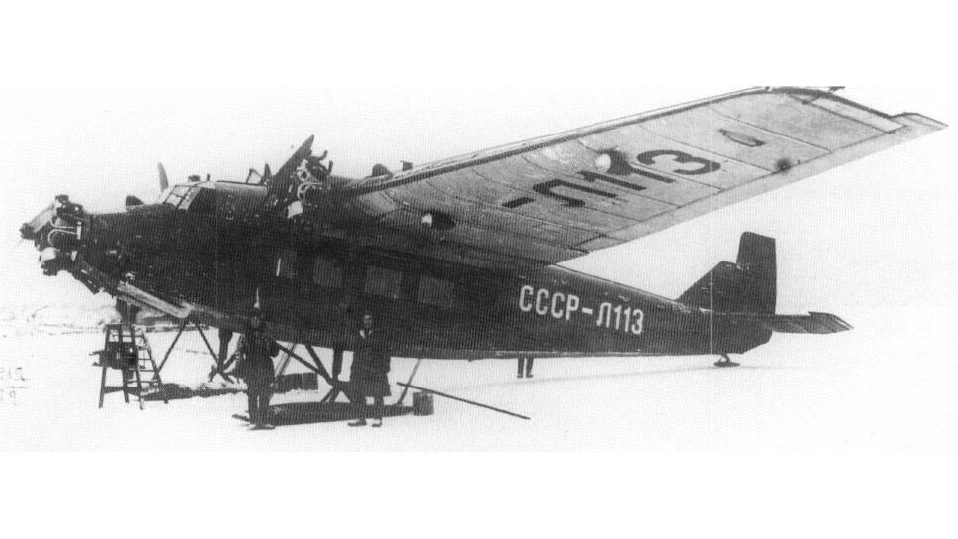
The ANT-9 stood out for its avant-garde architecture, adopting an all-metal duralumin construction, a pioneering choice for Soviet passenger aircraft of the time. This structural robustness, typical of Tupolev designs, ensured operational durability and reliability in different climatic conditions.
Initially designed as a trimotor, the ANT-9 employed Gnome-Rhône Titan engines (or their Soviet M-26 equivalents), located one on the nose and two under the wings. Subsequently, some versions were converted to twin-engine with the more powerful M-17, optimizing performance and maintenance without compromising safety.
The high wing configuration offered excellent visibility to the 9 passengers and good stability, while the fixed landing gear ensured simplicity of construction and robustness, essential for operating from unprepared runways common in remote areas of the Soviet Union.
Onboard Specifications
- ◆Fully metal construction in duralumin: a cutting-edge solution that provided lightness, resistance and structural durability.
- ◆Tri-engine (later twin-engine) configuration: Offered redundancy and greater safety in flight, a critical factor for early passenger services.
- ◆Heated and soundproofed passenger cabin: significant comfort for its time, designed to cope with harsh Soviet climate conditions and enhance the travel experience.
Operational Career & Operators
The ANT-9 found its main use with Aeroflot, the Soviet national airline, becoming a mainstay of domestic routes. It connected important cities and remote regions, significantly contributing to the development of the country's air transport network.
A famous example, christened "Krylya Sovetov" (Wings of the Soviets), made an impressive demonstration flight across several European capitals in 1930. This highly publicized trip served to show the world the growing capabilities of the Soviet aircraft industry, strengthening the USSR's technological prestige.
Although not produced in very high numbers, the ANT-9 proved to be a reliable and robust aircraft, appreciated for its operational simplicity and its ability to operate in often difficult conditions. Its operational career, although relatively short due to rapid technological progress, was instrumental in consolidating Soviet civil aviation.
Legacy & Cultural Impact
The Tupolev ANT-9 represents a milestone in Soviet aviation, not only as a passenger aircraft, but as a symbol of a nascent industry capable of producing advanced technologies. It demonstrated the feasibility of a completely indigenous aircraft design, paving the way for future generations of Soviet transport aircraft.
Its operational success and demonstration missions have had a significant cultural impact, inspiring confidence in the country's engineering and manufacturing capabilities. He helped shape the public perception of aviation, transforming it from a curiosity to a vital means of transportation and an instrument of progress.
Ultimately, the ANT-9 was not just an aircraft, but a flying laboratory that allowed the Soviet Union to gain valuable experience in the design, construction and operation of complex metallic aircraft. His legacy extends to the training of engineers, pilots and technicians, cementing the foundation for the massive aviation industry that would emerge in later years.
Telemetria Specs (HUD)
Hangar Trivia & Curiosità
- 💡The ANT-9 was also known as the PS-9, an abbreviation for 'Passazhirskiy Samolyot' or passenger aircraft, reflecting its primary role.
- 💡It was one of the first successful passenger aircraft designed and built entirely within the Soviet Union, marking a key milestone for Soviet aviation.
- 💡Its duralumin construction, a lightweight aluminum alloy, was advanced for its time and contributed to its structural integrity and performance.
Archivio Avvistamenti Spotter
Immagini scattate dalla community in tutto il mondo