An-74
Antonov
Historical Context & Origins
The vastness of the Soviet Union's Arctic and Antarctic regions, with their extreme climatic conditions and lack of adequate infrastructure, required an exceptionally robust and versatile transport and reconnaissance aircraft. The need was for an aircraft capable of operating in hostile environments, from improvised runways to freezing temperatures, laying the foundation for the Antonov An-74.
Originally conceived as a specialized variant of the smaller and already innovative An-72 "Coaler", the Antonov An-74 was designed specifically for polar missions, geophysical research and transport of cargo and personnel to remote areas. With its first flight in 1983, it represented the necessary evolution to extend operational capabilities into even more inhospitable environments, overcoming the limits of conventional aircraft.
Architecture & Technological Design
The design of the An-74 is a masterpiece of aeronautical engineering, where every technical choice is dictated by extreme functionality. Its distinctive architecture focuses on STOL (Short Take-off and Landing) capabilities, critical for operating from short, unprepared runways typical of polar or remote regions.
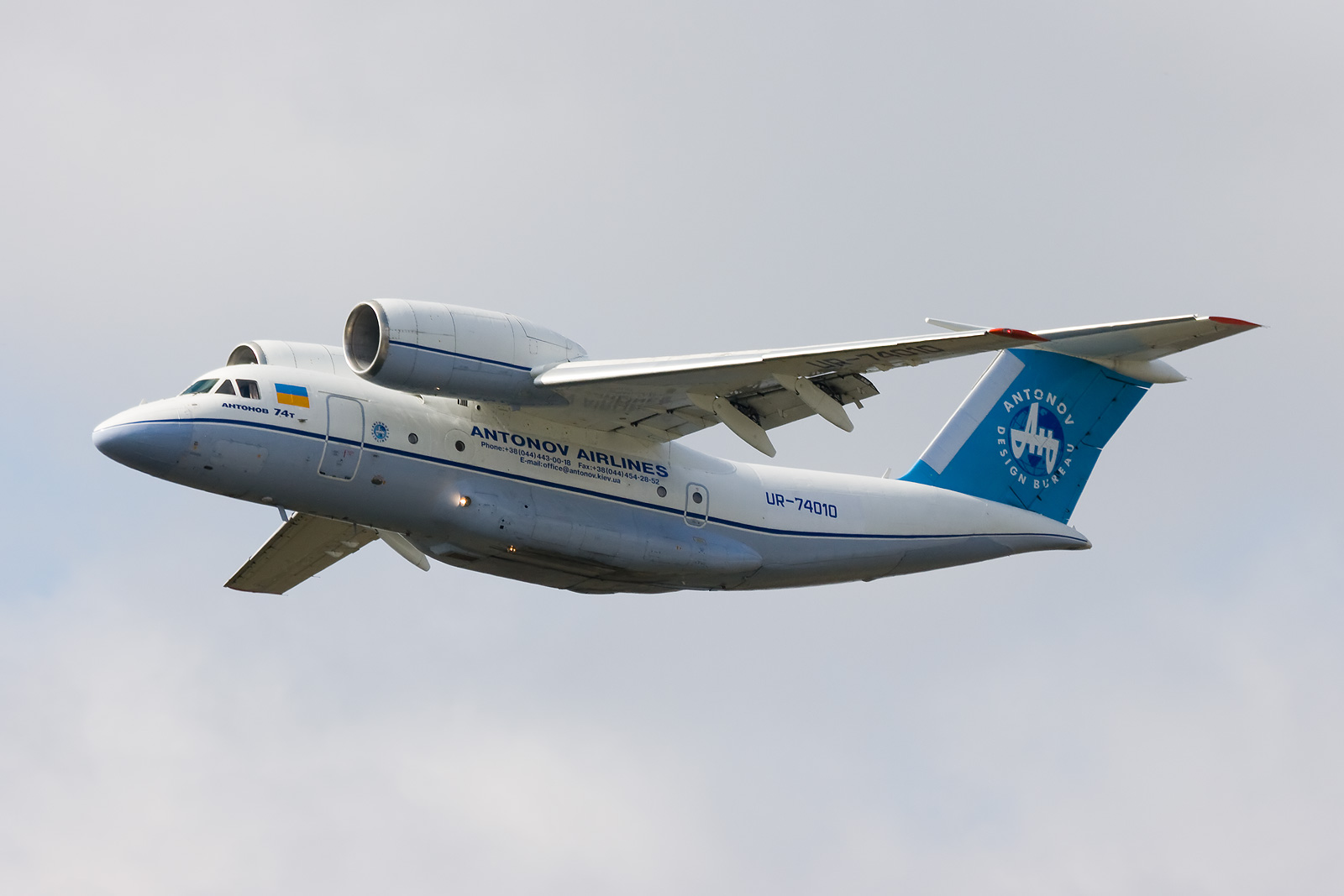
The two D-36 turbofan engines are mounted in a unique and iconic configuration above the wings. This solution is not just aesthetic: it exploits the Coandă effect, directing the exhaust gases at high speed over the extrados of the wing and onto the slotted flaps. This measure significantly increases lift at low speeds, drastically reducing the distances needed for take-off and landing.
The rugged retractable tricycle landing gear, featuring low-pressure tires and advanced damping, allows the An-74 to operate confidently on snow, ice, dirt or gravel. Its spacious, fully pressurized and insulated cargo hold is extremely versatile, capable of carrying bulky cargo, containers or up to 52 passengers in configurable cabins.
Onboard Specifications
- ◆Coandă Effect Design: Maximizing lift for superior STOL capabilities.
- ◆D-36 engines mounted above the wing: protection from debris ingestion and aerodynamic optimization.
- ◆Reinforced, low-pressure landing gear: Reliable operation on unprepared surfaces and ice.
Operational Career & Operators
The An-74 quickly cemented its reputation as an unstoppable workhorse in the most inhospitable regions of the world. Employed by militaries, scientific organizations and civilian airlines, it has carried out crucial missions from the Siberian Arctic to Antarctica, transporting essential supplies, trained personnel and cutting-edge scientific instrumentation.
Its ability to withstand extreme temperatures, down to -60°C, and operate in heavy ice conditions has made it irreplaceable for polar research and logistics in harsh climates. Specialized versions, such as the An-74P for maritime patrol or the An-74TK for passenger/cargo transport, demonstrate its exceptional operational flexibility and adaptability.
Prominent carriers such as UTair Cargo airline and the militaries of Russia, Ukraine and Iran have taken full advantage of the An-74's unique capabilities. The aircraft has become a key pillar for logistics in extreme environments, contributing significantly to both scientific research and humanitarian support in otherwise unreachable regions.
Legacy & Cultural Impact
The Antonov An-74 is not simply an airplane, but a Soviet, then Ukrainian tangible symbol of resilience and engineering innovation. It has redefined the concept of air transport in extreme environments, enabling scientific and logistical advances in areas previously considered inaccessible or extremely dangerous, opening new frontiers for exploration.
Its unmistakable silhouette, characterized by the engines positioned above the wings, makes it instantly recognizable and loved by aviation enthusiasts, bearing witness to an era of bold engineering challenges and ingenious solutions. It represents a visual reminder of human ingenuity in the face of the harshest environments.
Even today, decades after its debut, the An-74 continues to serve in vital roles around the world, demonstrating the extraordinary durability and foresight of its original design. His legacy endures, embodying faith in man's ability to face and overcome the most challenging geographical and climatic limitations.
Telemetria Specs (HUD)
Hangar Trivia & Curiosità
- 💡It's affectionately nicknamed "Cheburashka" in Russia, after a beloved Soviet cartoon character with large ears, due to its distinctive high-mounted engines.
- 💡The engines are mounted over the wings, utilizing the Coandă effect to enhance lift and improve STOL (Short Take-Off and Landing) performance by blowing exhaust over the wing's upper surface.
- 💡Designed to operate in extreme conditions, it can function in temperatures ranging from -60°C to +45°C, making it suitable for polar expeditions and desert operations alike.
Archivio Avvistamenti Spotter
Immagini scattate dalla community in tutto il mondo