An-38
Antonov
Historical Context & Origins
The Antonov An-38 emerges on the aeronautical scene as the direct heir of the famous An-28, an aircraft already known for its robustness and reliability in extreme operating conditions. Its concept responded to the pressing need for a light regional transport aircraft, capable of operating efficiently in remote environments and with limited airport infrastructure, typical of the vast northern and eastern regions of Russia and the CIS countries.
The design aimed to overcome the capacity and performance limitations of its predecessor by integrating more modern technologies and greater versatility. The first flight of the prototype occurred in 1994, marking the beginning of an ambitious chapter for Ukrainian aeronautical engineering, aimed at offering a vital transportation solution for isolated communities and specific industrial sectors.
Architecture & Technological Design
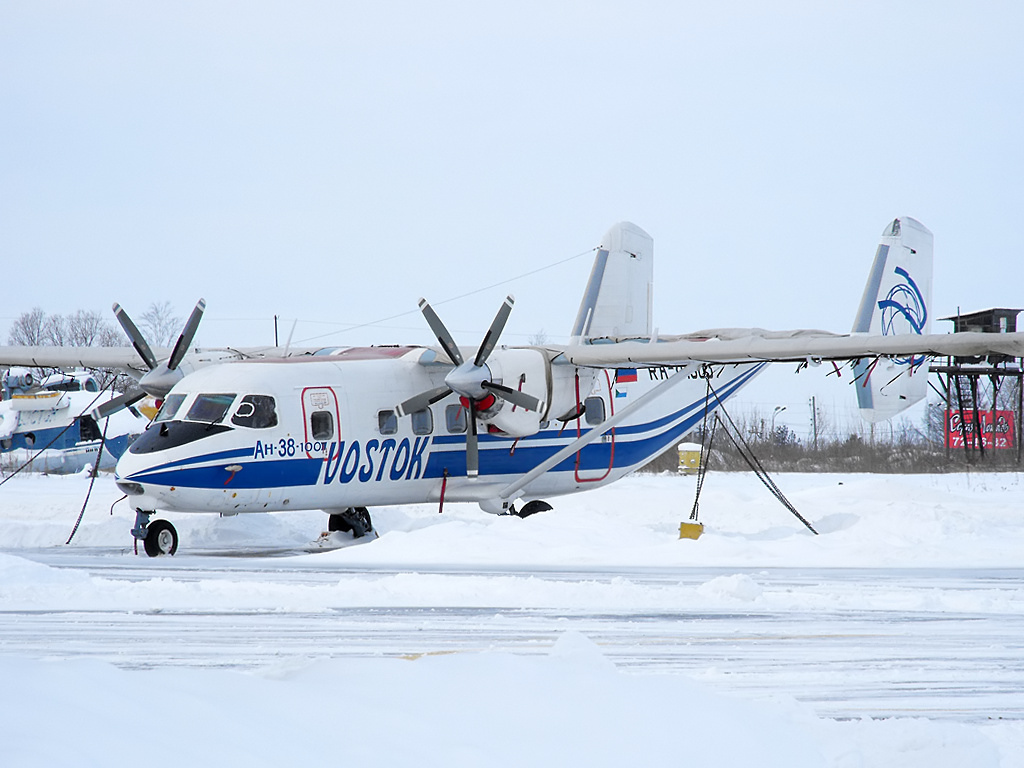
The An-38 stands out for its robust and functional architecture, a signature of the Antonov design bureau. Its high-wing design, fixed and reinforced landing gear, and semi-monocoque fuselage have been specifically designed to provide excellent short take-off and landing (STOL) capabilities on unprepared runways, gravel or snow, making it a true "workhorse" of the skies.
Its motorization is an example of its intrinsic flexibility. The An-38 was offered with two different types of turboprop engines: the powerful Pratt & Whitney Canada PW123D or the Russian Omsk MKB "Saturn" TVD-20. This dual option not only guaranteed the reliability and power needed for operations in harsh environments, but also offered carriers the ability to choose the solution best suited to their maintenance and spare parts supply needs.
Onboard Specifications
- ◆Extreme STOL Capability: Designed to operate from unprepared runways as long as 500 meters, thanks to high-lift double-slotted flaps and robust landing gear.
- ◆Bifuel Engine (Optional): The possibility of equipping Pratt & Whitney Canada PW123D (2,750 shp) or TVD-20 engines offers versatility and reliability in different operating conditions and logistical contexts.
- ◆Quickly Reconfigurable Cabin: The interior can be easily transformed from a passenger configuration (up to 27 seats) to cargo, medical or special mission configuration, maximizing the usefulness of the aircraft.
Operational Career & Operators
Despite its promising characteristics, the An-38's operational career was characterized by limited production. The few examples produced have found use mainly with regional airlines and cargo operators in Russia and some neighboring countries. Here, the An-38 demonstrated its reliability and ability to connect remote communities, transporting essential cargo, personnel and occasionally passengers to otherwise difficult to access areas.
Its robustness and ability to operate in extreme climatic conditions, from the Siberian taiga to the Arctic territories, have made it an invaluable asset for specific missions. However, the complex post-Soviet economic situation and strong competition on the global market have prevented the An-38 from reaching the diffusion and commercial success of its predecessor, confining it to a niche but crucial role.
Legacy & Cultural Impact
The Antonov An-38 represents a significant example of aeronautical engineering oriented towards functionality and resilience. Although it did not reach mass production, it demonstrated the importance of specialized aircraft for regional transport in areas with limited infrastructure. Its existence highlights the persistent need for aircraft capable of overcoming environmental challenges, rather than conforming to traditional airport standards.
Its legacy manifests itself in demonstrating that a robust design, combined with flexible powertrain and superior STOL capabilities, can create a vital means of air transportation for specific industries. The An-38 remains a symbol of Ukrainian ingenuity, a testament to the commitment to connecting the world's most isolated regions across the sky, a "flying truck" that fulfilled its task with admirable tenacity.
Telemetria Specs (HUD)
Hangar Trivia & Curiosità
- 💡L'An-38 è un ulteriore sviluppo dell'Antonov An-28, a sua volta basato sul polacco PZL M28 Skytruck/Bryza.
- 💡È stato progettato per soddisfare la domanda di un velivolo da trasporto regionale ad alte prestazioni, capace di operare da piste remote e spesso non asfaltate.
- 💡È alimentato da due motori turboelica Honeywell TPE331-14GR-801E, che offrono prestazioni migliorate rispetto al suo predecessore.
Archivio Avvistamenti Spotter
Immagini scattate dalla community in tutto il mondo