An-158
Antonov
Historical Context & Origins
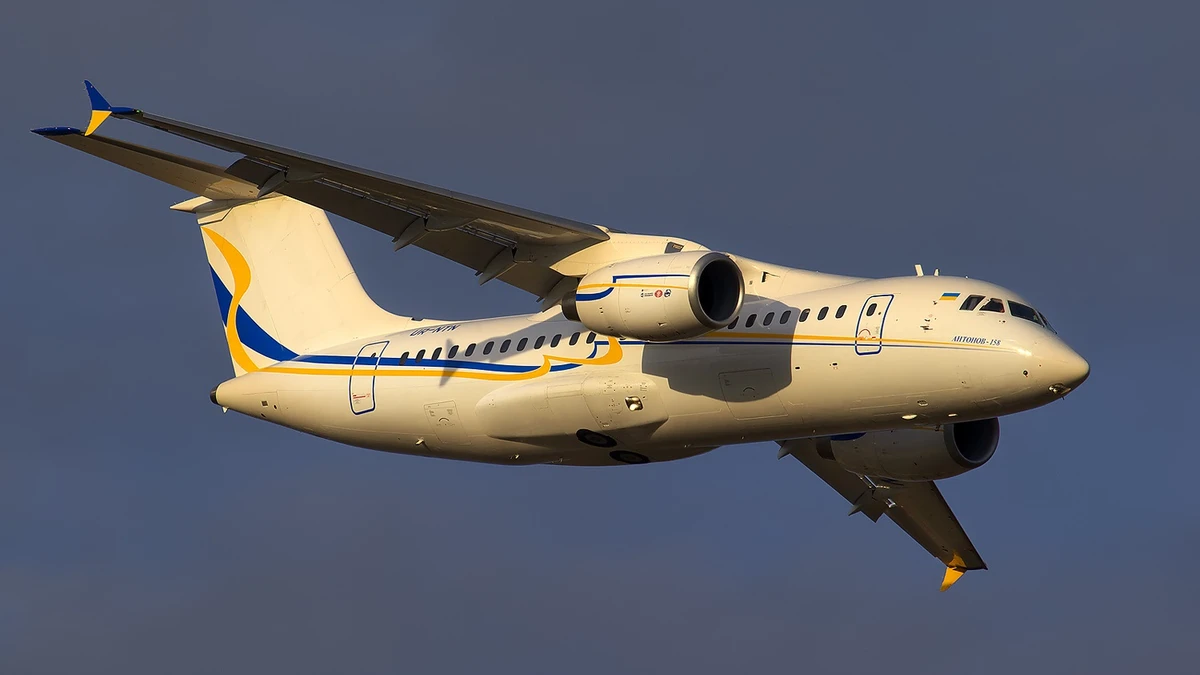
The Antonov An-158 emerges as a strategic evolution in the regional aviation landscape, representing the Ukrainian Antonov State Company's ambitious attempt to compete in the short-medium range passenger jet segment. Designed as a lengthened variant of the already established An-148, its development aimed to offer greater passenger carrying capacity, responding to growing market needs.
The An-158 project was officially launched to bridge the gap between smaller and higher-category regional aircraft, with a focus on operational versatility and economic efficiency. The first flight of this innovative jet took place successfully on April 28, 2010, marking a key milestone in the program.
The certification, obtained in February 2011, opened the doors to commercial service, positioning the An-158 as a direct competitor to aircraft such as the Embraer E-Jets and the Sukhoi Superjet 100, while maintaining the distinctive characteristics of robustness and operational capabilities inherited from the Antonov tradition.
Architecture & Technological Design
The Antonov An-158 boasts a refined aerodynamic architecture, characterized by the distinctive high wing configuration typical of many Antonov aircraft. This design choice not only improves aerodynamic stability but also provides excellent ground clearance for the engines and nacelles, allowing operations on less prepared runways and facilitating maintenance.
The propulsion is entrusted to two D-436-148 turbofan engines produced by Ivchenko-Progress, positioned under the wings. These engines are known for their reliability and compliance with international noise and emissions standards, contributing to the overall efficiency of the aircraft. The cabin, designed for comfort, offers more space and reduced interior noise compared to its predecessors.
On board, the An-158 integrates modern, digitalized avionics, equipped with a "glass" cockpit that offers pilots clear information and simplified flight management. Although not full fly-by-wire, the advanced flight control system improves maneuverability and operational safety, consolidating its technological profile.
Onboard Specifications
- ◆Capacity extended to 99 passengers: By optimizing costs per seat, this extended configuration allows for greater profitability on regional routes.
- ◆Integrated digital avionics systems: Advanced cockpit with multi-function display reduces pilot workload and improves situational awareness.
- ◆Robust undercarriage for semi-prepared runways: A distinctive feature that makes the An-158 particularly suitable for operating at airports with limited infrastructure.
Operational Career & Operators
The operational career of the An-158 began with great anticipation, with the first commercial flight taking place in April 2011 on behalf of Cubana de Aviación, the Cuban national carrier. This company was among the main and most faithful users of the type, appreciating its robustness and ability to operate in sometimes difficult conditions.
Despite initial interest from several airlines, especially in the Russian Federation and CIS countries, the production and deployment of the An-158 has been limited. Complex geopolitical factors and economic challenges have hindered the program's large-scale expansion.
The aircraft has demonstrated its capabilities in various operating conditions, earning a reputation as a reliable and versatile jet, ideal for regional connections with substantial traffic volumes. Its operational history is an example of how external factors can profoundly influence the commercial success of a well-designed aircraft.
Legacy & Cultural Impact
The Antonov An-158 stands as a symbol of the resilience and ingenuity of the Ukrainian aviation industry, an attempt to establish itself with a modern and competitive product in the difficult regional jet market. Although its diffusion was limited, it demonstrated Antonov's considerable design and construction skills.
Its legacy lies in demonstrating that the company was capable of developing cutting-edge aircraft, capable of meeting international standards in both performance and passenger comfort. The An-158 represented a bridge between the glorious Soviet tradition and the modern ambitions of the manufacturer.
Despite operational and commercial challenges, the An-158 has made its mark as an aircraft with great untapped potential. It remains a significant chapter in Antonov's story, a reminder of an era when the Ukrainian aviation industry actively sought to redefine its role in the global industry.
Telemetria Specs (HUD)
Hangar Trivia & Curiosità
- 💡It is a derivative of the An-148, featuring a fuselage stretch that significantly increases its passenger capacity compared to its predecessor.
- 💡The An-158's high-wing design allows its engines to be mounted well above the ground, providing better protection from foreign object debris on rough or unpaved runways.
- 💡Designed and manufactured by the Ukrainian Antonov State Company, it targets the regional jet market for routes typically up to 2,500 kilometers (1,350 nautical miles).
Archivio Avvistamenti Spotter
Immagini scattate dalla community in tutto il mondo