An-124 Ruslan
Antonov
Historical Context & Origins
During the Cold War, the Soviet Union had a pressing need for super-heavy strategic airlift capability, to compete with America's Lockheed C-5 Galaxy. It was in this context that the Antonov Design Bureau, under the leadership of Oleg Antonov, began the development of a colossus of the skies. The project culminated with the first flight of the An-124 prototype, christened Ruslan – a name that evokes a Slavic mythological hero – on 24 December 1982.
The An-124 was not simply an aircraft, but a technological and strategic statement, designed to carry bulky military cargo such as tanks, mobile ICBMs and other heavy equipment. Its conception mirrored the Soviet doctrine of power projection, requiring the ability to rapidly move significant masses over long distances. From the start, it stood out for its imposing size and its unprecedented capabilities.
Architecture & Technological Design
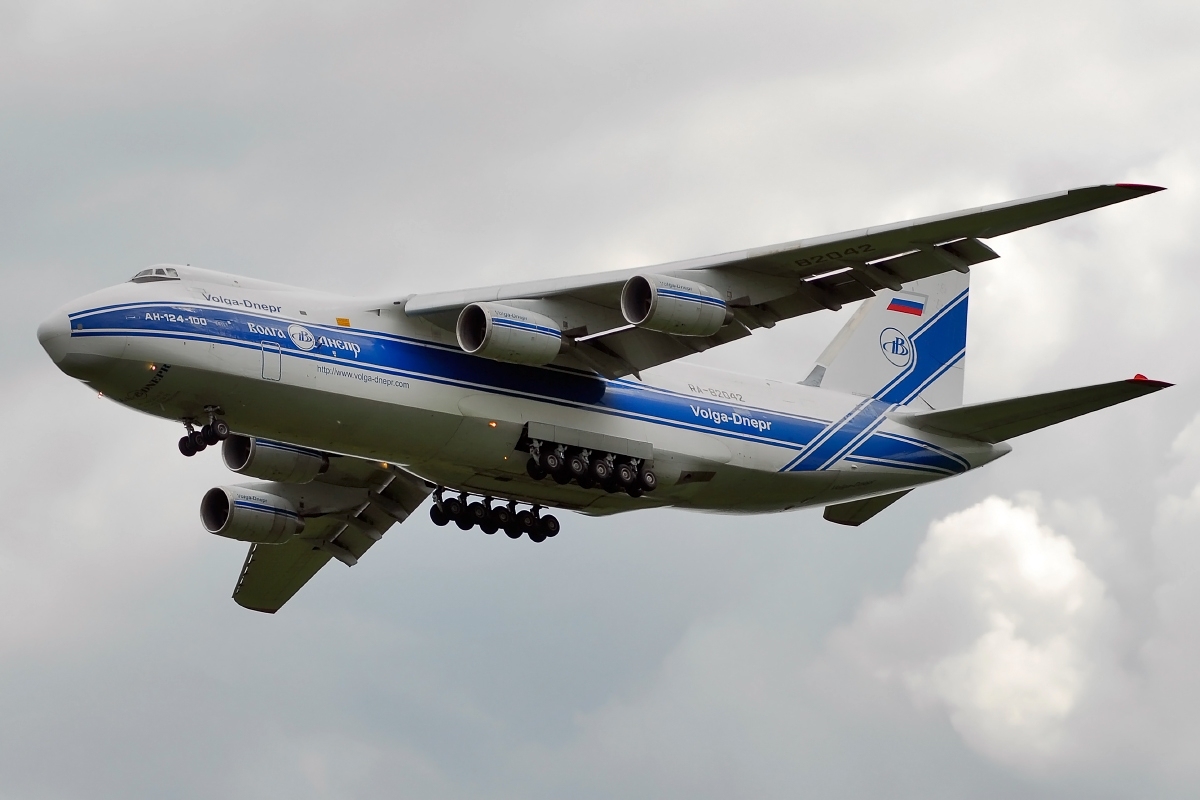
The An-124 Ruslan sports an impressive architecture, characterized by a high-wing configuration and a wide fuselage, designed to maximize cargo volume. It is powered by four Lotarev D-18T turbofan engines, each capable of generating 229.5 kN thrust, giving it extraordinary power needed for takeoff at maximum loads. Its structure incorporates lightweight alloys and composites, balancing strength and weight reduction.
One of the most distinctive features is its advanced loading and unloading system, which includes a hinged nose that lifts completely, as well as a rear loading ramp. This design allows for the simultaneous loading and unloading of bulky cargo, including vehicles. The landing gear, composed of 24 wheels, is designed to operate even on unprepared runways and offers a "kneeling" capability to lower the fuselage and facilitate loading operations.
Onboard Specifications
- ◆Exceptional load capacity: Up to 150 tons of standard payload, with a record of 171.2 tons for a single piece.
- ◆Innovative loading and unloading system: Equipped with an opening front ramp and a rear ramp, as well as two electric hoists with a capacity of 20 tons each.
- ◆Strategic autonomy: Capable of flying for over 5,000 km with maximum load, extendable to almost 10,000 km with reduced load.
Operational Career & Operators
The An-124 has quickly assumed a crucial role in both the military and civilian sectors, becoming the workhorse for transporting exceptional and oversized cargo globally. Since its introduction, it has transported everything from wind turbine components to satellites, from locomotives to entire prefabricated bridges, demonstrating unrivaled versatility. Operators such as Volga-Dnepr Airlines and Antonov Airlines have built their reputations around its capabilities.
It has played an irreplaceable role in numerous humanitarian and relief missions, delivering essential aid to areas affected by natural disasters or conflicts. Its ability to reach remote and difficult places has saved lives and facilitated recoveries. Each An-124 mission is a test of modern logistics and sheer engineering might, making it the subject of countless impossible transportation anecdotes.
Legacy & Cultural Impact
The Antonov An-124 Ruslan is not just a transport aircraft; it is a monument to Soviet engineering and a persistent symbol of aeronautical power and innovation. Its unmistakable silhouette in the skies continues to capture the imagination and represents the overcoming of technical and logistical limits. It is a constant reference in the heavy air transport sector, often the only possible solution for truly gigantic loads.
The An-124 also paved the way for future developments, influencing design and engineering concepts for large transport aircraft. Although the An-225 Mriya, its even larger and now tragically lost variant, has often stolen the show, the Ruslan remains the operational juggernaut that continues to serve the world. Its legacy lies in its reliability and its ability to change the global logistics geography, making the impossible possible.
Telemetria Specs (HUD)
Hangar Trivia & Curiosità
- 💡Fino all'arrivo dell'unico An-225 Mriya (un derivato dell'An-124), il Ruslan deteneva il record di aereo di produzione più grande al mondo.
- 💡Presenta un sistema di carico unico con un muso che si solleva (visor nose) per il carico frontale e una rampa posteriore, permettendo il carico/scarico simultaneo.
- 💡Il suo robusto carrello d'atterraggio a 24 ruote gli consente di operare anche da piste semi-preparate o non asfaltate.
Archivio Avvistamenti Spotter
Immagini scattate dalla community in tutto il mondo