Ambassador
Airspeed
Historical Context & Origins
The Airspeed Ambassador emerges from the fervor of post-war Britain, a period in which the nation was determined to restore its leadership in civil aviation. The prestigious Brabazon Committee, established in 1942, played a crucial role, outlining the requirements for a new generation of airliners. Among his recommendations was the need for a sleek, medium-range, twin-engine passenger aircraft specifically designed for European routes.
Thus it was that Airspeed, a subsidiary of de Havilland, took on the ambitious task of designing and building the Type II, an aircraft that would embody the most modern design philosophies. Its development officially began in 1943, aiming to create a competitive, comfortable and reliable aircraft, capable of replacing obsolete pre-war models and competing with emerging American proposals. The goal was a smooth flight experience for passengers, in a non-pressurized but spacious environment.
Architecture & Technological Design
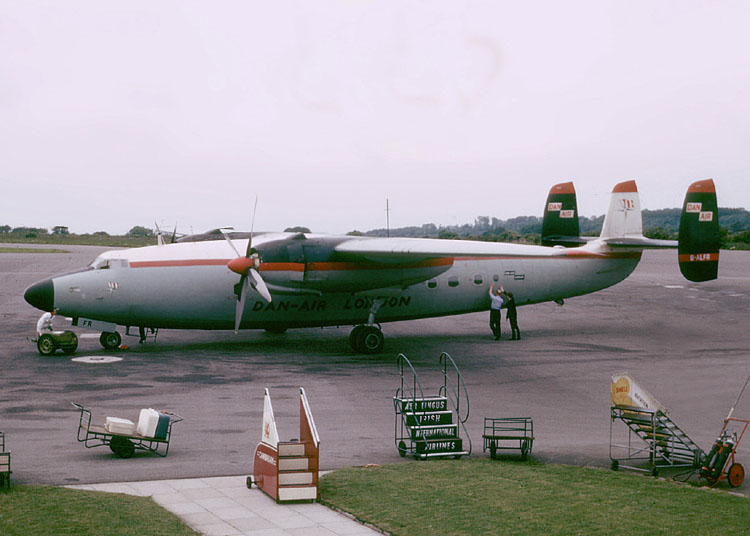
The Airspeed Ambassador was presented as an elegant high-wing monoplane, a configuration chosen to offer excellent visibility for passengers and greater ground clearance for the propellers, while reducing engine size. The entire aircraft was built with a working shell metal structure, cutting edge for the time, which guaranteed strength and lightness.
The beating heart of the Ambassador was made up of two Bristol Centaurus 661 radial engines, true engineering masterpieces. These engines, each capable of delivering 2,625 HP (horsepower), provided impressive power and renowned reliability, essential for commercial operations. Their integration into the wing design contributed to a clean and highly efficient aerodynamic profile.
One of the most innovative features was its laminar flow wings, carefully designed to minimize drag and maximize efficiency. The tricycle landing gear, a modern solution for the time, offered better stability on the ground and facilitated taxiing and landing operations, distinguishing itself from the more common tail wheel landing gear.
Onboard Specifications
- ◆Spacious and quiet cabin for 40-49 passengers
- ◆High efficiency laminar flow wings for reduced fuel consumption
- ◆Tricycle landing gear for better ground stability and maneuverability
Operational Career & Operators
The first flight of the Airspeed Ambassador occurred on January 10, 1947, an event that marked the beginning of a phase of intensive testing and certification. Despite its promising design, production was relatively limited, with a total of 20 examples built for commercial use beyond the initial prototypes. The main and almost exclusive customer was British European Airways (BEA).
BEA deployed the Ambassador on a wide network of European routes, progressively replacing its Vickers Vikings and becoming a visible part of the continental airscape. The aircraft was prized for its comfort and smooth performance, although its lack of pressurization put it at a disadvantage compared to aircraft such as the Vickers Viscount, which quickly made a name for themselves with turboprop propulsion.
The Ambassador's operational career was tragically marked by the Munich air disaster in 1958, which involved a BEA aircraft with the Manchester United football team on board. Although the accident was not attributable to any design flaws of the aircraft, the event cast a shadow on its reputation and hastened its withdrawal from passenger service, with many examples converted to freight.
Legacy & Cultural Impact
The Airspeed Ambassador, whilst not reaching mass production, represents a significant chapter in the history of post-war British aviation. It was a technological bridge between the era of large piston aircraft and the advent of turboprops, demonstrating that British industry was capable of producing technologically advanced and refined airliners.
Its design, with its laminar flow wings and high-wing configuration, indirectly influenced subsequent generations of aircraft, providing important lessons in aerodynamic efficiency and passenger comfort. It was a symbol of Britain's aspiration to dominate the civilian skies and recover its status as an aviation power.
Today, the Ambassador is often remembered as a "near-success", an excellently crafted aircraft that was sadly overshadowed by the emergence of turboprop technology. However, for aviation history buffs, it remains a telling example of the ingenuity and challenges faced by British designers in an era of rapid technological evolution.
Telemetria Specs (HUD)
Hangar Trivia & Curiosità
- 💡Most of the Ambassadors built (20 of 23) were operated by British European Airways (BEA).
- 💡An Airspeed Ambassador was famously involved in the tragic Munich air disaster in 1958, carrying the Manchester United football team.
- 💡Despite its advanced design for a piston airliner, its operational life was cut short by the rapid development and adoption of turboprop aircraft like the Vickers Viscount.
Archivio Avvistamenti Spotter
Immagini scattate dalla community in tutto il mondo