A340-300
Airbus
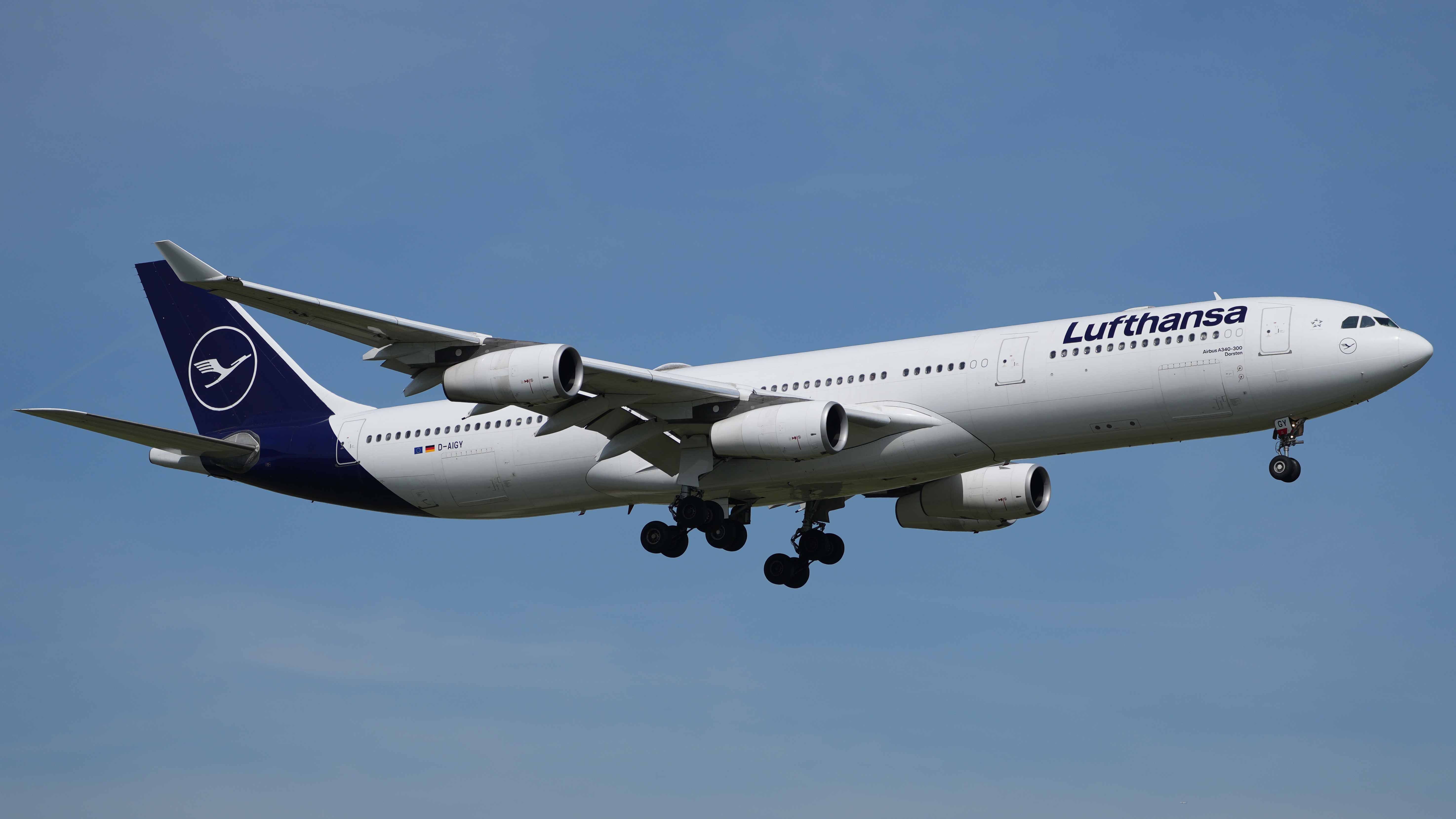
Historical Context & Origins
In the early 1990s, the Airbus A340-300 emerged as Europe's answer to American dominance in long-range aircraft. Designed to meet the challenge of the Boeing 747 and anticipate the growing demand for direct intercontinental connections, it represented a bold step for the then young Airbus consortium into the four-engine segment. The aim was to offer a modern, comfortable and efficient alternative for long-distance routes.
The A340 project was conceived in tandem with the twin-engine A330, sharing extensive structural and avionics commonality to optimize development and production costs. This synergy allowed Airbus to propose two complementary platforms for different market needs. The first flight of the A340-300 occurred on 25 October 1991, marking the beginning of a new era for ultra-long-range air travel.
Architecture & Technological Design
The Airbus A340-300 was a pioneer in its segment, featuring a wide-body twin-aisle architecture that ensured superior comfort for passengers on extended flights. The choice of four engines was fundamental in a pre-ETOPs era, where regulations favored such configurations for ocean routes. This guaranteed a level of safety and redundancy perceived as superior by carriers and passengers.
Equipped with CFM International CFM56-5C engines, the A340-300 offered a combination of reliable thrust and competitive efficiency for its time. The design included an advanced, aerodynamically optimized wing, the result of years of Airbus research, which contributed to excellent lift performance and remarkable autonomy. The integration of the fly-by-wire system, an Airbus innovation, reduced pilot workload and improved maneuverability.
Onboard Specifications
- ◆Fly-by-wire system with sidestick: a revolution in the piloting interface, reducing cabin space and improving ergonomics.
- ◆Advanced composite materials: Widely used to reduce structural weight and increase the overall efficiency of the aircraft.
- ◆Transcontinental autonomy of approximately 13,000 km: it allowed direct connections between distant cities, such as Europe-Asia or Europe-Latin America.
Operational Career & Operators
The A340-300 quickly established itself as the ideal aircraft for "thin and long" routes, i.e. those long-haul connections with sufficient but not so high passenger demand to justify a Boeing 747. Prestigious airlines such as Lufthansa, Air France, Virgin Atlantic and Singapore Airlines included it in their fleets, taking advantage of its ability to serve emerging markets or specific routes without intermediate stops.
Its reliability and the comfort of its cabin made it popular among passengers and crews. However, as ETOPs certifications for twin-engines advanced and more efficient aircraft such as the Boeing 777 were introduced, the higher operating costs associated with four engines began to take their toll. Despite this, the A340-300 maintained a crucial role for many carriers for a long time, especially on more complex routes with high reliability requirements.
Legacy & Cultural Impact
The Airbus A340-300 represents a milestone in the history of commercial aviation, consolidating Airbus' position as a global player capable of competing in the long-range aircraft segment. Although its production has ceased in favor of more modern and efficient models, such as the Airbus A350, its influence in the development of avionics and structural technologies is undeniable.
This majestic four-engine aircraft was not just a means of transportation, but a symbol of progress and global connection, allowing millions of people to explore distant destinations. The A340-300 will remain a classic, a testament to an era when four-engine power and redundancy were synonymous with borderless travel, leaving a legacy of innovation and adventure in the hearts of aviation enthusiasts.
Telemetria Specs (HUD)
Hangar Trivia & Curiosità
- 💡È stato sviluppato contemporaneamente all'A330 bimotore, condividendo gran parte della struttura e dei sistemi, inclusi la fusoliera e le ali, per ridurre i costi di sviluppo.
- 💡L'A340-300 è stato uno dei primi aerei di linea a implementare un sistema di controllo di volo fly-by-wire completamente digitale per tutte le superfici di controllo.
- 💡Nonostante i suoi quattro motori fornissero ridondanza e permettessero voli transoceanici senza restrizioni ETOPS, questa caratteristica è diventata uno svantaggio competitivo rispetto agli aerei bimotore più efficienti nei consumi.
Archivio Avvistamenti Spotter
Immagini scattate dalla community in tutto il mondo
Vettori Rilevati (Flotta Attiva)




Vettori Rilevati (Flotta Storica / Dismessa)


Air Canada
Stato: Dismesso

Air France
Stato: Dismesso

Virgin Atlantic
Stato: Dismesso
Austrian Airlines
Stato: Dismesso
Finnair
Stato: Dismesso
Philippine Airlines
Stato: Dismesso
South African Airways
Stato: Dismesso

Iberia
Stato: Dismesso
Air Mauritius
Stato: Dismesso
TAP Air Portugal
Stato: Dismesso

Cathay Pacific
Stato: Dismesso