A340-200
Airbus
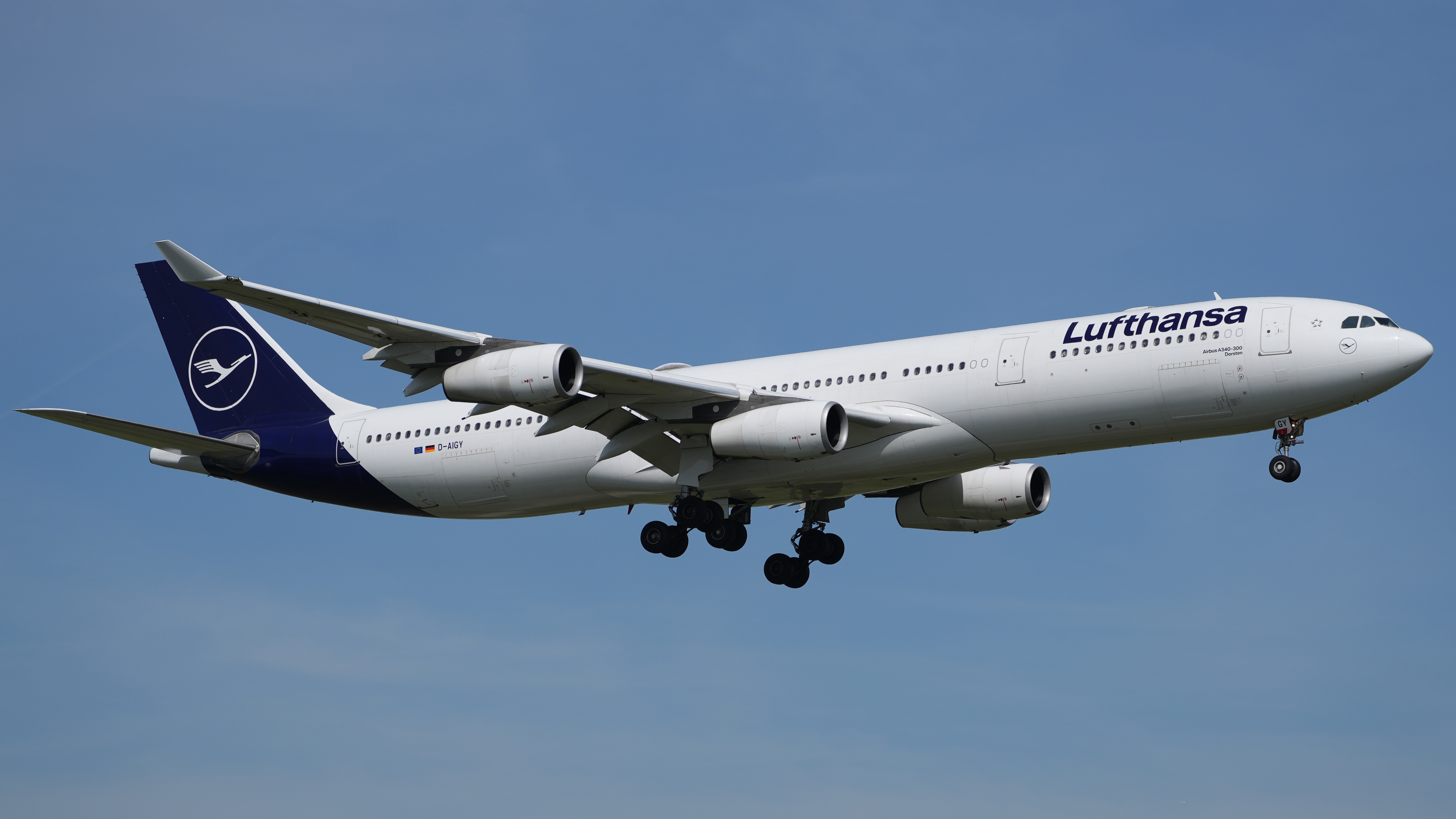
Historical Context & Origins
The Airbus A340-200 represents a milestone in Airbus' ambitious strategy to challenge Boeing's duopoly in the long-range aircraft market. Developed in tandem with the A330, the A340 was conceived to offer a four-engine option at a time when ETOPS (Extended-range Twin-engine Operational Performance Standards) restrictions still significantly limited twin-engine operations on transoceanic routes.
The A340-200 project, with its first flight in 1992, was positioned as the "short" variant of the family, emphasizing maximum range rather than pure passenger capacity. It aimed to serve ultra-long routes with moderate traffic demand, offering a more efficient alternative to larger four-engine jumbo jets.
This version responded to the need of operators who needed direct intercontinental connections on "thin" markets, where frequency and capacity were balanced by an exceptional extension of autonomy. It was a bold step for Airbus, which consolidated its presence in the wide-body segment.
Architecture & Technological Design
The Airbus A340-200 boasted cutting-edge architecture for the early 1990s, inheriting much of the design philosophy common to the Airbus family. Its four-engine configuration, with four CFM56-5C turbofan engines, guaranteed not only redundancy and reliability, but also the ability to operate on polar and oceanic routes without the stringent limitations then imposed on twin-engine aircraft.
The cockpit, equipped with an advanced digital fly-by-wire system, was highly common with that of the A330, reducing training and maintenance costs for airlines. This modular approach was an Airbus signature, confirming its vision of interoperability between models.
The "wide-body" fuselage was designed for maximum passenger comfort on long-haul flights, with room for a wide variety of cabin configurations. Refined aerodynamics and composite materials contributed to significant operational efficiency for the time.
Onboard Specifications
- ◆Extended range: up to 14,800 km (approximately 8,000 nautical miles), allowing direct connections such as Sydney-Johannesburg.
- ◆Four CFM56-5C engines: provided a combined thrust of approximately 138,800 lbf (617 kN), robust and reliable for long-range flights.
- ◆Comfortable wide-body cabin: Typically configured for 260-300 passengers in two classes, optimized for long-distance comfort.
Operational Career & Operators
The A340-200 entered service with prestige operators such as Lufthansa and Air France, who deployed it on key intercontinental routes. Although it was a capable aircraft, its niche nature, with lower capacity than the more popular A340-300 but slightly greater range, limited its commercial uptake.
Airlines such as Philippine Airlines and South African Airways used it for transpacific and transcontinental connections. It was appreciated for its quietness in the cabin and in-flight stability, fundamental characteristics for passenger comfort on ultra-long flights.
Despite its excellent technical capability, production of the A340-200 was relatively short, with only 28 built. Many were later replaced by larger variants or twin-engined aircraft with less restrictive ETOPS, which offered a better capacity/operating cost ratio.
Legacy & Cultural Impact
The Airbus A340-200, although not reaching the sales volumes of other models, has left an indelible mark on commercial aviation. It demonstrated Airbus' ability to design and build competitive long-range aircraft, setting the stage for the success of the subsequent A340-300, -500 and -600.
This aircraft symbolized an era when the four-engine configuration was still the default choice for reliability and range on extreme routes. It has helped shape passenger expectations in terms of comfort and global connectivity, making new direct routes accessible.
His legacy also lies in having anticipated, in a certain sense, the need for ultra-long "point-to-point" flights. Although its sales have not matched initial expectations, the A340-200 remains a witness to Airbus' engineering innovation and strategic vision as the new millennium dawns.
Telemetria Specs (HUD)
Hangar Trivia & Curiosità
- 💡L'A340-200 è stata la versione più corta della famiglia Airbus A340, ottimizzata per rotte molto lunghe ma con minore capacità passeggeri rispetto ai suoi fratelli maggiori.
- 💡Ne furono prodotti solo 28 esemplari, rendendolo un modello relativamente raro e meno comune rispetto ad altre varianti dell'A340 o all'A330.
- 💡Condivideva gran parte della sua ala e sezione della fusoliera con il bimotore Airbus A330, evidenziando l'approccio modulare di Airbus nella progettazione degli aeromobili.
Archivio Avvistamenti Spotter
Immagini scattate dalla community in tutto il mondo
Vettori Rilevati (Flotta Storica / Dismessa)


Air France
Stato: Dismesso

Swissair
Stato: Dismesso
Austrian Airlines
Stato: Dismesso
EgyptAir
Stato: Dismesso
Syrianair
Stato: Dismesso

Qatar Amiri Flight
Stato: Dismesso
Royal Jordanian
Stato: Dismesso
Philippine Airlines
Stato: Dismesso