A300-600ST Beluga
Airbus
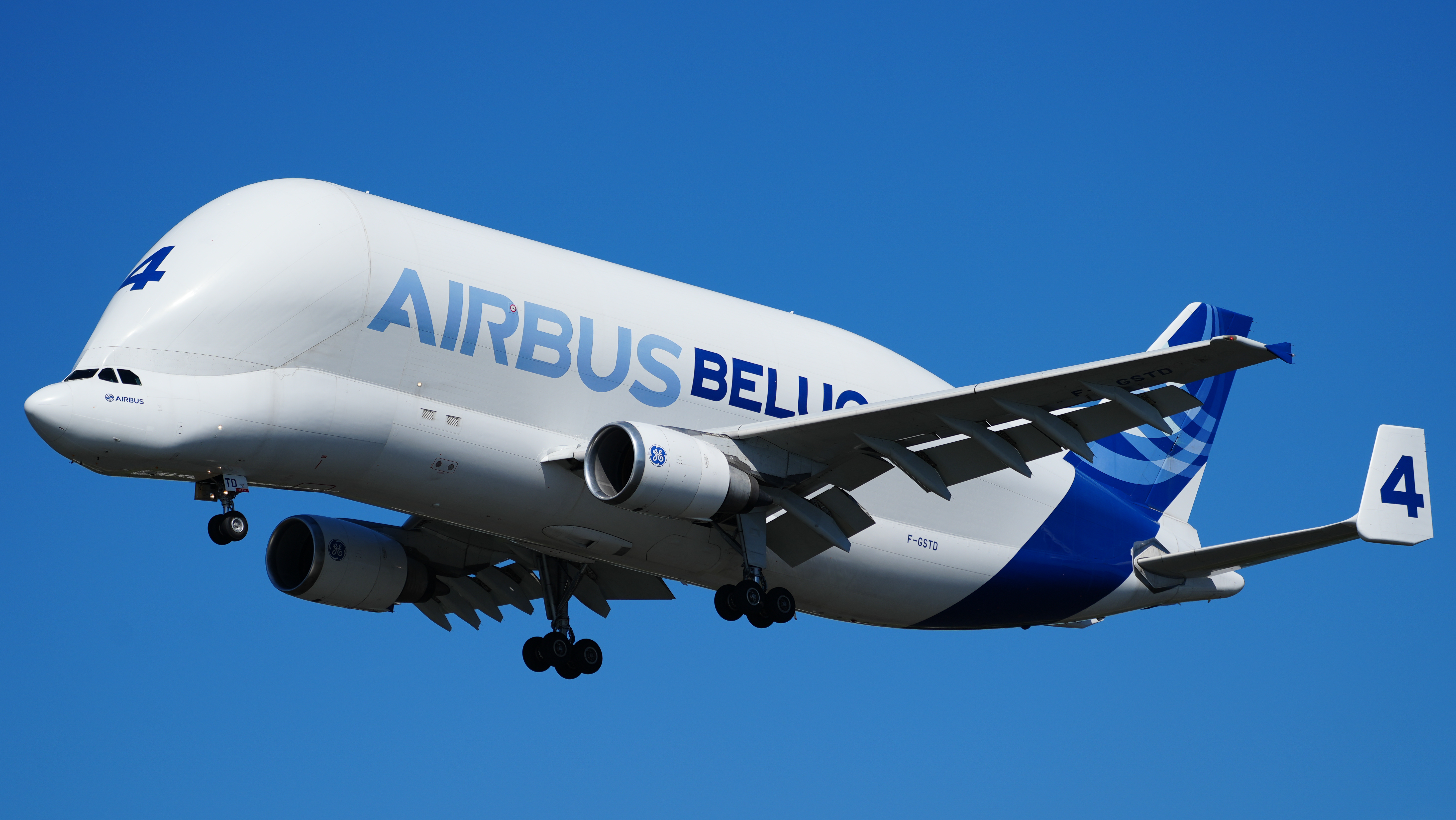
Historical Context & Origins
In the dynamic landscape of the aviation industry, the need to transport large components between Airbus' various production sites quickly became a critical need. Towards the end of the 1980s, the fleet of Super Guppies, modified cargo aircraft dating back to the 1960s, was proving obsolete and insufficient to support the growing production volumes and size of new programs, such as the Airbus A330 and A340.
From this stringent logistical necessity the idea of a more modern and efficient successor was born. The project, initially named A300-600ST (Super Transporter), aimed to reuse the established platform of the successful twin-engine Airbus A300-600R to dramatically reduce development time and costs. The goal was to create a giant of the skies capable of swallowing entire sections of fuselage and wings.
- ◆*September 13, 1994marked the first flight of this extraordinary aircraft, which was immediately nicknamed"Beluga"** due to its unmistakable rounded shape, incredibly similar to the Arctic cetacean of the same name. This iconic silhouette was not just an aesthetic curiosity, but the clear manifestation of bold and purposeful engineering.
Architecture & Technological Design
L'Airbus A300-600ST Beluga non è un semplice aereo da trasporto, ma una profonda riprogettazione dell'A300-600R. The most obvious and functional modification was the integration of a gigantic cargo fuselage, whose maximum diameter reaches 7.7 meters, making it capable of accommodating loads of unprecedented dimensions for a production aircraft.
To provide access to this massive cargo hold, engineers elevated the entire cockpit, placing it above the cargo section. This allowed the installation of a huge nose-hinged cargo door, which opens upwards nearly 90 degrees, revealing an unobstructed opening for the insertion of massive components such as complete A320 wings or entire aircraft center sections.
In terms of propulsion, the Beluga is equipped with two powerful General Electric CF6-80C2A8 engines, the same ones that power many versions of the A300 and A310. The internal structure and tail section were also extensively reinforced and redesigned to handle the exceptional loads and additional lift generated by the gigantic aerodynamic "back".
Onboard Specifications
- ◆Record volumetric load capacity: 1,210 cubic meters, almost double that of a traditional Boeing 747 freighter.
- ◆Maximum range: Up to 47 tons of payload, combined with the ability to carry objects up to 38.6 meters long.
- ◆Front Loading Opening: Distinctive hinged nose door eliminates the need for costly and complex side loading operations.
Operational Career & Operators
Since its first appearance in the air, the Airbus A300-600ST Beluga has been the true logistics engine behind Airbus' success. Operated by its dedicated subsidiary, Airbus Transport International (ATI), the fleet of five examples played an irreplaceable role in connecting the consortium's European factories, from Toulouse to Hamburg, from Broughton to Saint-Nazaire.
These giants of the sky are the custodians of a constant flow of wings, fuselage sections, stabilizers and other key components essential to Airbus' just-in-time assembly line. Without their transport capacity, the European manufacturer's decentralized production network would have been economically unsustainable and logistically impractical.
Although primarily dedicated to Airbus' internal needs, the Beluga has also occasionally offered its services for oversized commercial cargo, carrying helicopters, satellites or even exceptionally large artistic artefacts. Its unparalleled versatility has made it a valuable asset far beyond its primary mission.
Legacy & Cultural Impact
The Airbus A300-600ST Beluga is much more than just a cargo plane; it is a living symbol of European engineering and transnational industrial collaboration. Its unmistakable silhouette and highly specialized function have made it an icon loved and respected by aviation enthusiasts around the world.
Its introduction revolutionized Airbus' logistics capabilities, allowing the consortium to expand production and consolidate its position as a global leader in the aeronautical sector. It has demonstrated that, with innovation and ingenuity, existing platforms can be adapted to meet extreme logistical challenges.
The legacy of the Beluga continues today with its successor, the even larger and more capable Beluga XL (A330-743L), which continues the tradition started by the A300-600ST. The latter remains a testament to the human ability to overcome technical limitations, transforming a functional necessity into an engineering marvel that continues to fascinate and inspire.
Telemetria Specs (HUD)
Hangar Trivia & Curiosità
- 💡Il nome 'Beluga' deriva dalla balena beluga, a causa della somiglianza della sua fusoliera rigonfia con la testa della balena.
- 💡È stato sviluppato per sostituire i precedenti Super Guppy di Airbus, offrendo una maggiore capacità di carico e velocità, necessarie per i programmi di produzione più ampi.
- 💡La sua area di carico ha un diametro di 7,4 metri, rendendolo capace di trasportare la maggior parte delle sezioni della fusoliera di aeromobili Airbus, incluso l'A380 (anche se non la fusoliera intera).
Archivio Avvistamenti Spotter
Immagini scattate dalla community in tutto il mondo

