90 Scandia
Costruttore Sconosciuto
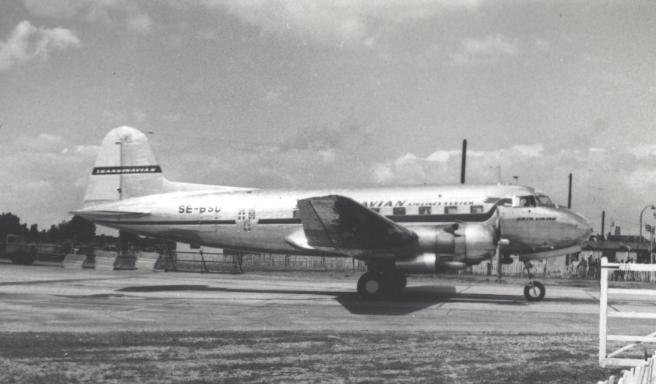
Historical Context & Origins
In the post-war turmoil of the mid-1940s, the global aviation industry faced a new challenge: retooling from fast-paced war production to the rebirth of civil aviation. In this restart scenario, the Swedish Saab (Svenska Aeroplan Aktiebolaget), already established in the construction of military aircraft, saw the opportunity to expand its range of action in the passenger transport sector, giving life to an ambitious project.
The objective was clear: to develop a modern, reliable and efficient airliner, capable of competing with giants such as the Douglas DC-3. The result was the Saab 90 Scandia, an aircraft that was supposed to symbolize Swedish ingenuity and ability to transition to an era of peace and connectivity. The first flight took place on 16 November 1946, marking the beginning of a new adventure for Saab in the civilian market.
Architecture & Technological Design
The Saab 90 Scandia was a robust low-wing twin-engine aircraft designed to meet the needs of regional and medium-range air transport. Its architecture reflected the best engineering practices of the time, focusing on reliability, comfort and safety. The design, while not revolutionary, was refined and functional, ensuring solid performance for its time.
Powered by two Pratt & Whitney R-2180 Twin Wasp E radial engines of 1,450 horsepower each, the Scandia was capable of carrying 24 to 32 passengers, offering competitive cruising speeds and adequate range for European routes and beyond. The wide fuselage and well-lit cabin contributed to a surprisingly comfortable travel experience by the standards of the time.
Onboard Specifications
- ◆Semi-monocoque all-metal structure: It guaranteed considerable strength and longevity to the aircraft, a fundamental characteristic for commercial aviation.
- ◆Cantilever low-wing configuration: Contributed to aerodynamic stability and offered a better view for passengers, an element appreciated in post-war design.
- ◆Interior optimized for passenger comfort: Despite the technological limitations of the time, great attention was paid to creating a spacious and welcoming cabin environment.
Operational Career & Operators
Despite its qualities, the Saab 90 Scandia never reached mass production, partly due to stiff competition from the war surplus DC-3 and the Convair CV-240. Only 18 examples were built, a limited number which today makes it a collector's item for aeronautical history enthusiasts.
The main operator was SAS (Scandinavian Airlines System), which used the Scandia on its European routes between 1950 and 1957. Subsequently, all examples were sold to the Brazilian airline VASP, where they served for many years, proving their robustness and reliability in different operating conditions, until their final withdrawal in the early 1970s.
Legacy & Cultural Impact
The Scandia represents a significant milestone in Saab's history, marking its entry into the difficult but promising civil aviation market. Although it did not become a resounding commercial success, it provided the Swedish company with valuable experience and a solid foundation for the development of future civil and military projects.
Today, only one example of the Saab 90 Scandia has survived and is carefully preserved in Belo Horizonte, Brazil, at the Aeronautical Technical Museum. This rare aircraft is a tangible testament to post-war Swedish ingenuity and a reminder of the period when civil aviation took its first bold steps towards the democratization of air travel, leaving a legacy of innovation and perseverance.
Telemetria Specs (HUD)
Hangar Trivia & Curiosità
- 💡It was Saab's first and only attempt to build a large commercial airliner, following its successful military aircraft production.
- 💡The Scandia faced strong commercial headwinds due to the abundance of cheap, surplus military C-47s (DC-3s) after World War II.
- 💡Only 18 Scandias were built, with the last one retiring from service with VASP in Brazil in 1969. One fuselage exists as a museum piece.
Archivio Avvistamenti Spotter
Immagini scattate dalla community in tutto il mondo