763 Deux-Ponts
Breguet
Historical Context & Origins
France, in the aftermath of the Second World War, found itself faced with the arduous task of rebuilding its economic and infrastructural fabric. An urgent need emerged for robust, high-capacity transport aircraft, capable of supporting both civil recovery and military needs to connect with overseas territories.
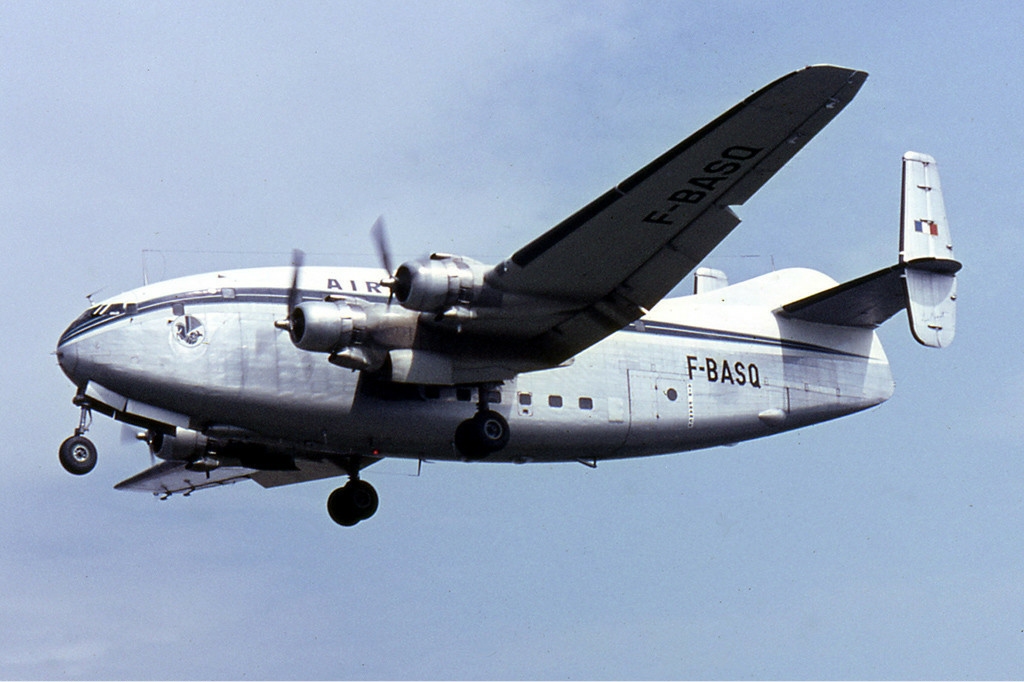
In this context of reconstruction and innovation, Breguet Aviation responded with a bold project: a double-deck aircraft, designed to maximize passenger or cargo carrying capacity. The prototype, the Breguet Br.761, took flight for the first time in 1949, demonstrating the effectiveness and stability of such a futuristic design.
The success of the prototype paved the way for the mass production of the Breguet 763 Deux-Ponts, the final version of which saw its first flight in 1951. This model embodied a progressive vision of aviation, designed to offer versatility and operational efficiency unprecedented for its time.
Architecture & Technological Design
The Breguet 763 Deux-Ponts stood out for its revolutionary architecture, based on an integrated double bridge that offered exceptional modularity. This design allowed the aircraft to be configured both for the exclusive transport of passengers (up to 107 in dense configuration), and as pure cargo, and in a combination of the two modes.
Powered by four powerful Pratt & Whitney R-2800 "Double Wasp" radial engines, each engine produced approximately 2,400 horsepower, giving the aircraft considerable power and reliability. The high-wing configuration not only improved aerodynamic performance, but also facilitated loading and unloading thanks to the height of the fuselage from the ground.
Structural strength was a priority, designed to operate in different conditions, including airports with limited infrastructure. Access to the lower deck was guaranteed by a large ventral loading door, a practical solution that simplified the loading of bulky goods and even light vehicles.
Onboard Specifications
- ◆Pressurized double deck: Unique flexibility to simultaneously transport passengers on the upper deck and cargo (or other passengers) on the lower one, ensuring comfort and operational versatility.
- ◆Pratt & Whitney R-2800 Engines: Four radial engines known for their exceptional reliability and power, critical to the performance of an aircraft of this size and capability.
- ◆Ventral Loading Door: A key innovation that allowed for quick and efficient loading and unloading of bulky cargo, making the Deux-Ponts extremely adaptable to different missions.
Operational Career & Operators
Most of the aircraft produced, redesignated Br.763 Provence, entered service with Air France starting in 1953. These aircraft became the backbone of medium-haul routes, effectively connecting metropolitan France with destinations in North Africa, offering a level of comfort and capacity that was innovative for its time.
The Armée de l'air acquired several units, designated Br.765 Sahara, using them intensively for the transport of troops and strategic materials. The Deux-Ponts proved to be an irreplaceable "workhorse", fundamental for military logistics and force projection operations in often challenging contexts.
Despite its peculiar double-bridge design, the Breguet 763 enjoyed a solid reputation for its reliability and operational longevity. Its imposing figure and ability to move large volumes made it an iconic aircraft in the post-war French air transport scene.
Legacy & Cultural Impact
The Breguet 763 Deux-Ponts remains a monument to French aeronautical ingenuity, a symbol of the industrial capacity to innovate and rebuild after the war. Although the double-deck concept did not find wide application in later piston-powered aircraft, it anticipated ideas that would shape future jumbo jets.
This gentle giant of the air played a crucial role in the history of aviation, serving as a bridge between the era of heavy piston transport and the advent of jet aircraft. Its versatility and its ability to serve both civil and military needs have demonstrated the validity of a bold and forward-thinking design.
Today, the Breguet 763 is remembered as a pioneer, a unique aircraft that left an indelible mark. Its story is a fascinating chapter that tells of engineering, determination and a time when the sky opened up to extraordinary new possibilities for connection and transportation.
Telemetria Specs (HUD)
Hangar Trivia & Curiosità
- 💡The name 'Deux-Ponts' directly translates to 'Two Decks,' referring to its unique double-deck fuselage configuration.
- 💡It was originally conceived as a military transport aircraft (Breguet 761) before being adapted for civilian passenger and cargo roles.
- 💡Despite its innovative design and capacity, only a small number of Breguet 763s were built, making it a relatively rare sight in the skies.
Archivio Avvistamenti Spotter
Immagini scattate dalla community in tutto il mondo

