747-400LCF Dreamlifter
Boeing
Historical Context & Origins
The advent of the Boeing 747-400LCF Dreamlifter, with its first flight in 2006, was a bold and necessary engineering response to an unprecedented logistical challenge. As Boeing prepared for groundbreaking production of the 787 Dreamliner, featuring super-sized composite components, it became apparent that no existing cargo transportation solution could effectively handle such volumes. Traditional maritime transport would have been too slow, and the road network not always compatible with the dimensions of the fuselage segments.
The need to accelerate the global supply chain for the 787, which saw fuselage sections produced on several continents, pushed Boeing to devise an "in-house" solution. Instead of designing a new aircraft from scratch, which would have been prohibitively time-consuming and costly, the company decided to convert a series of decommissioned Boeing 747-400 passenger aircraft. This strategic decision allowed the reuse of a proven platform, accelerating the development of the specialized transporter.
Architecture & Technological Design
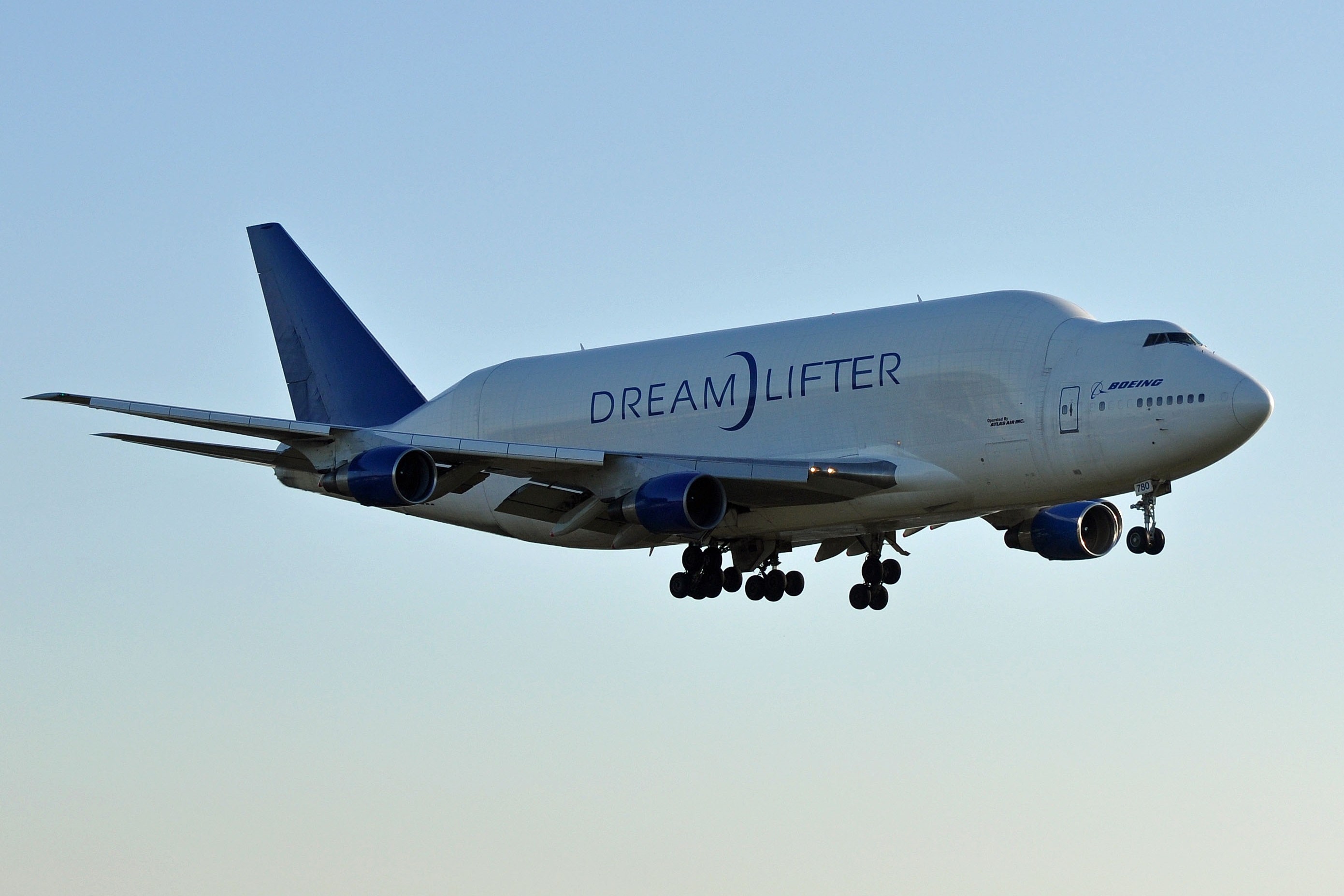
The Dreamlifter is a masterpiece of transformational engineering, instantly recognizable by its massively widened fuselage, which earned it the nickname "pregnant airplane." This radical modification increased the cargo volume by more than three times compared to a standard 747 freighter, reaching a staggering capacity of 65,000 cubic feet (approximately 1,840 cubic meters). This expansion has made it one of the aircraft with the largest cargo compartment in the world, essential to accommodate entire wing and fuselage sections of the 787.
One of its most distinctive features is its swing-tail, an innovation that allows the entire tail section to be rotated 90 degrees to reveal a massive rear opening. This mechanism, operated by complex hydraulic systems, allows the loading and unloading of gigantic components that could never fit through a side loading door. The complexity of this operation requires meticulous attention and specific timing, highlighting the unique and highly specialized nature of the aircraft.
Onboard Specifications
- ◆Oversized fuselage: With a maximum diameter of 8.4 meters, one of the widest among cargo aircraft, crucial for the 787 components.
- ◆Opening tail: An advanced hydraulic system that allows the rear section to rotate for easy loading/unloading of bulky items.
- ◆Dreamlifter Cargo Loader (DTS): An innovative and dedicated ground loading system, among the largest in the world, specifically designed to precisely handle the complex and delicate modules of the 787.
Operational Career & Operators
The operational career of the Dreamlifter is intrinsically linked to the production of the Boeing 787 Dreamliner. Operated primarily by Atlas Air (and previously by Evergreen International Airlines), the mere four built have provided a veritable “air highway” for 787 components. These aircraft regularly connect global suppliers in Italy, Japan and the United States, transporting wings, fuselage sections and horizontal stabilizers to Boeing's final assembly facilities.
Despite its irreplaceable functionality, the Dreamlifter is also known for its reduced cruise speed compared to standard 747s, resulting from the compromised aerodynamics of its enlarged fuselage. This characteristic, combined with its unusual appearance, has made it a frequent subject of curiosity and even some anecdotal “runway landings,” such as the famous one in Wichita, Kansas, in 2013, which made it the subject of global news and highlighted the specialized management needed to operate such a giant.
Legacy & Cultural Impact
The Boeing 747-400LCF Dreamlifter is not just a transport aircraft; it is a tangible symbol of modern engineering and production globalization. Its existence has made a distributed aircraft manufacturing model possible, demonstrating how extreme logistical challenges can be overcome with innovative and bold solutions. It is an icon of the transformative power of ingenuity, capable of adapting existing platforms for entirely new and complex purposes.
Its unmistakable shape and specialized function have given it a unique place in the history of aviation. It represents the fusion of the proven reliability of the Boeing 747 and the futuristic vision of 787 production. The Dreamlifter will remain a lasting reminder of how logistics innovation is as crucial as aerospace engineering to the success of the most ambitious aircraft projects of the 21st century.
Telemetria Specs (HUD)
Hangar Trivia & Curiosità
- 💡Sono stati costruiti solo quattro Dreamlifter, tutti convertiti da 747-400 passeggeri esistenti.
- 💡La coda incernierata dell'aereo si apre per consentire il carico di carichi fuori misura, un processo che può richiedere diverse ore.
- 💡Nel 2013, un Dreamlifter è atterrato per errore in un piccolo aeroporto regionale invece della vicina base militare con una pista molto più lunga, un incidente ampiamente riportato.
Archivio Avvistamenti Spotter
Immagini scattate dalla community in tutto il mondo