747-400
Boeing
Historical Context & Origins
The Boeing 747-400 represents the most famous and iconic evolution of the legendary "Queen of the Skies", born in an era of growing demand for long-haul flights and greater operational efficiency. Airlines, in the 1980s, required an aircraft capable of connecting continents without stopping, reducing operating costs and increasing comfort for passengers compared to previous models.
Officially launched in 1985, the 747-400 responded to the need to modernize the 747 fleet, which had been on the market for over a decade. The goal was to create a version that was more autonomous, more fuel efficient and less dependent on a large flight crew, while maintaining the distinctive partial double-deck configuration that made it unmistakable.
The first flight of this giant of the skies occurred on April 29, 1988, marking the beginning of a new era for transcontinental air travel. It immediately positioned itself as the carrier of choice for high-density intercontinental routes, thanks to its unprecedented load capacity and autonomy.
Architecture & Technological Design
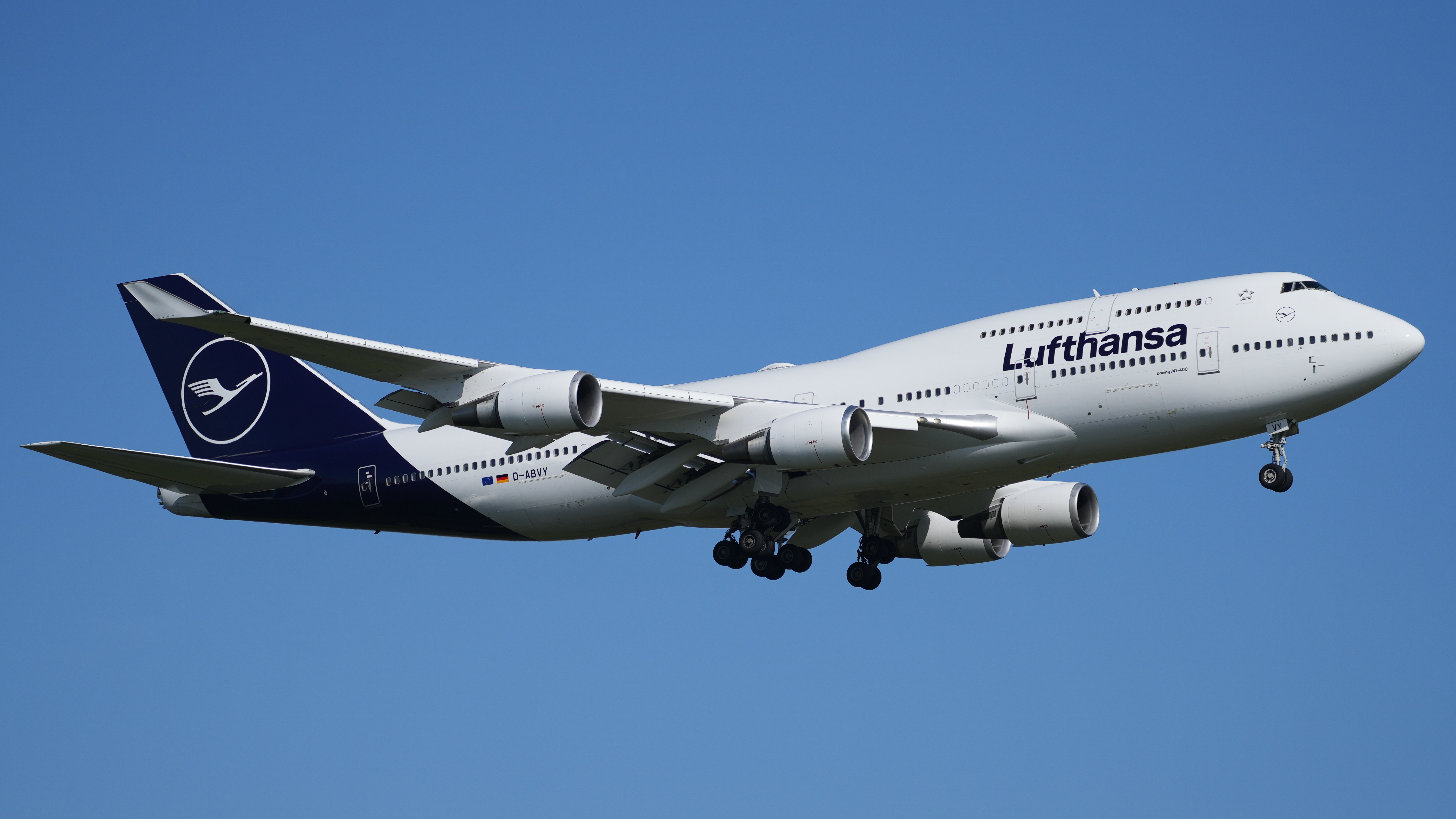
The Boeing 747-400 introduced significant aerodynamic and structural improvements compared to its predecessors, standing out for its innovative features. The most obvious modification was the adoption of winglets, vertical extensions at the tips of the wings, designed to reduce induced drag and improve fuel efficiency, while increasing autonomy.
The technological heart of the 747-400 lay in its glass cockpit. This advancement allowed the reduction of the crew from three to two pilots, a huge operational saving for the airlines. Multifunction digital displays replaced most analog instruments, providing crucial flight information in a clearer and more integrated manner.
Structurally, the aircraft incorporated new composite materials for greater lightness and strength, and cutting-edge avionics systems. This allowed it to extend its flight range up to 13,450 km, carrying almost 500 passengers and establishing it as the undisputed dominator of the long-haul sector for over two decades.
Onboard Specifications
- ◆Glass cockpit with EFIS (Electronic Flight Instrument System): Revolutionized the human-machine interface, reducing the crew to two pilots and improving situational awareness.
- ◆1.8 meter winglets: These vertical extensions have dramatically improved aerodynamic efficiency, reducing fuel consumption and increasing flight range.
- ◆Advanced Flight Management Systems (FMS): Enabled automated and precise flight planning and execution, optimizing routes and flight profiles.
Operational Career & Operators
The operational career of the Boeing 747-400 officially began in 1989, with the delivery of the first example to Northwest Airlines. From that point, the aircraft quickly became the workhorse for the intercontinental routes of major global airlines, including British Airways, Lufthansa, Qantas, Singapore Airlines and Japan Airlines, setting new standards in global connectivity.
It has broken numerous flight records, the most famous being in 1989, when a Qantas Airways 747-400 completed the world's longest non-stop flight for a commercial aircraft, from London to Sydney, covering over 18,000km in just over 20 hours, with no passengers and minimal cargo. This demonstrated his extraordinary abilities.
Despite the introduction of more efficient twin-engine aircraft such as the Boeing 777 and Airbus A350, the 747-400 continued to operate in passenger and cargo service for decades, a testament to its ruggedness and versatility. Many examples have been converted to freighters, extending their operational lives and continuing to dominate air cargo.
Legacy & Cultural Impact
The Boeing 747-400 was not just a plane, but a true symbol of mass air travel and globalization. Its distinctive "hump" and imposing size made it instantly recognizable around the world, embodying the idea of luxury, adventure and the possibility of connecting cultures and continents.
It has played a vital role in the history of commercial aviation, serving as a bridge for millions of people and goods, and helping shape the world as we know it today. Her iconic presence in films, documentaries and advertisements has cemented her status as a legend, the "Queen of the Skies" par excellence.
Even though its passenger service is gradually declining, the 747-400 continues to fly as a freighter, and its technical and cultural legacy is invaluable. It paved the way for future innovations in aircraft design, and its contribution to global connectivity remains an unforgettable chapter in the history of aviation.
Telemetria Specs (HUD)
Hangar Trivia & Curiosità
- 💡It was the first 747 variant to eliminate the flight engineer position, enabling a two-pilot cockpit, which significantly reduced operating costs for airlines.
- 💡The distinctive winglets, added to the wingtips, improved fuel efficiency by reducing drag, a key feature distinguishing it from earlier 747 models.
- 💡Over 690 units of the 747-400 were built, making it the best-selling variant of the Boeing 747 family.
Archivio Avvistamenti Spotter
Immagini scattate dalla community in tutto il mondo
Vettori Rilevati (Flotta Attiva)






Vettori Rilevati (Flotta Storica / Dismessa)

Asiana Airlines
Stato: Dismesso

Air France
Stato: Dismesso

Virgin Atlantic
Stato: Dismesso
Thai Airways
Stato: Dismesso
British Airways
Stato: Dismesso

United Airlines
Stato: Dismesso
South African Airways
Stato: Dismesso

Qantas
Stato: Dismesso
Malaysia Airlines
Stato: Dismesso

KLM Royal Dutch Airlines
Stato: Dismesso

Singapore Airlines
Stato: Dismesso
Delta Air Lines
Stato: Dismesso

Japan Airlines
Stato: Dismesso
All Nippon Airways
Stato: Dismesso
