720
Boeing
Historical Context & Origins
The Boeing 720-000, whose first flight took place on November 23, 1959, emerged as a strategic response to the evolving commercial aviation market. Despite the overwhelming success of the Boeing 707, Boeing recognized the need for a more agile, high-performance jet liner for medium-range routes, capable of operating from airports with shorter runways.
Designed as a derived and optimized version of the 707, the 720 aimed to compete effectively with new medium-range aircraft such as the Convair 880 and the Douglas DC-8 Series 50. Its conception was driven by the need to offer high speeds and excellent operating economy over shorter distances, typical of US domestic flights and some international routes.
Its introduction in 1960, with United Airlines as the launch operator, marked the beginning of a new era for airlines that needed a smaller, lighter and faster jet than the standard 707 to serve secondary destinations or routes with lower passenger density, without compromising performance.
Architecture & Technological Design
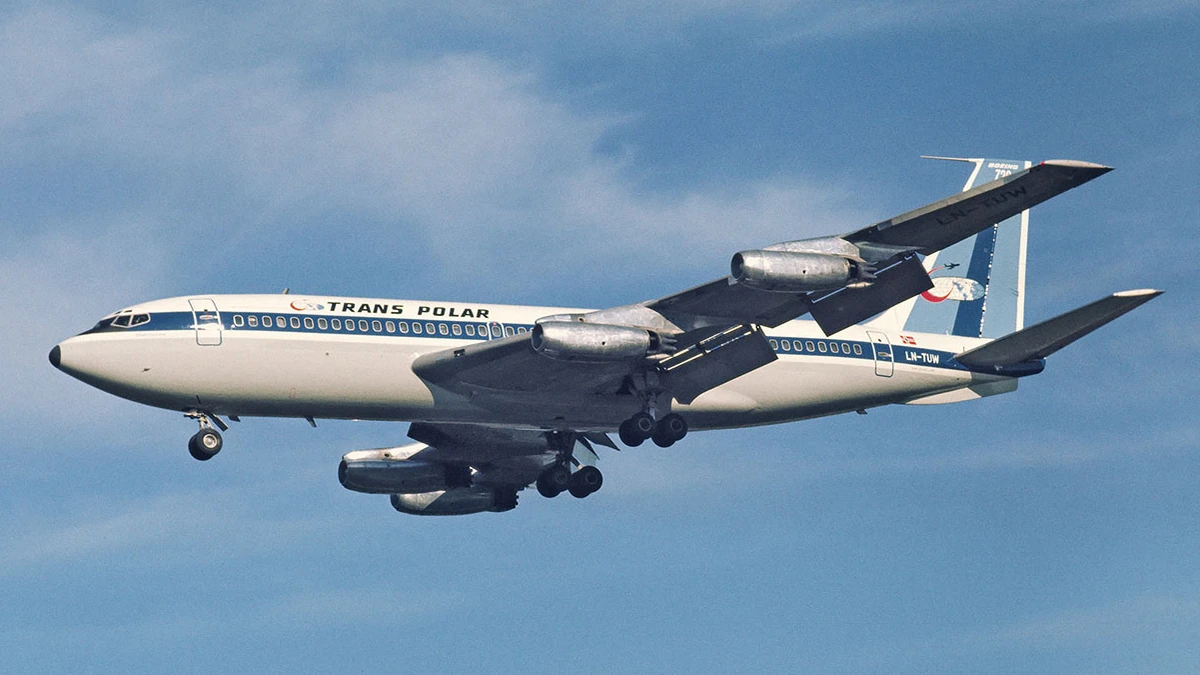
The heart of the Boeing 720 design lay in its intelligent derivation from the 707. It featured a shortened fuselage of approximately 2.54 meters compared to the 707-120, reducing capacity but significantly decreasing structural and operating weight, critical for its medium-range missions.
One of the most significant innovations was the modified wing, which included leading edge extension panels between the inner and outer engines. These modifications, combined with Krueger flaps on the leading edge, dramatically improved low-speed performance, allowing the 720 to use shorter runways and improve rate of climb.
Initially powered by four Pratt & Whitney JT3C turbojet engines, the 720 offered competitive cruise performance. The subsequent 720B version, equipped with the more efficient JT3D turbofans, would further enhance its range, economy and speed, making it a true "hot rod" of the skies.
Onboard Specifications
- ◆Aerodynamically optimized wings: They featured a modified profile for greater efficiency at different speeds and better take-off and landing performance.
- ◆Lightened and shortened fuselage: Reduction in overall weight and passenger capacity to maximize performance on medium-range routes.
- ◆Four Pratt & Whitney JT3C engines: Configured for a balance of power, speed and fuel consumption typical of the first generation of commercial jets.
Operational Career & Operators
The Boeing 720 carved out an important niche for itself in the aviation landscape, with a total of 154 examples built (including 65 720s and 89 720Bs). It was appreciated by airlines such as United Airlines, American Airlines, Braniff International, Western Airlines and numerous others around the world for its versatility and reliability.
Many carriers successfully employed it on high-density domestic and regional routes, taking advantage of its ability to operate from less well-equipped airports for the larger 707s. Its speed made it ideal for rapid connections, reducing travel times for millions of passengers.
Although its production was relatively short, many 720s remained in active service for decades, some converted to freighters, demonstrating the robustness and longevity of the Boeing design. Its iconic presence in the skies lasted well beyond its golden age, well into the 1980s and 1990s.
Legacy & Cultural Impact
The Boeing 720, while not achieving the fame of its bigger brother the 707 or the subsequent 727, left an indelible mark on the history of aviation. It demonstrated the flexibility of Boeing's four-engine jet design, capable of adapting to different market needs with targeted modifications.
It represented a crucial bridge between the introduction of the first long-range jets and the advent of three-engine aircraft such as the Boeing 727, which would later dominate the short- and medium-haul segment. The 720 confirmed the validity of Boeing's modular approach.
Its legacy is that of a "dark horse" of aviation, an aircraft that performed its task excellently, silently but effectively. It allowed more cities to be connected by jet flights, accelerating the process of modernizing global air travel.
Telemetria Specs (HUD)
Hangar Trivia & Curiosità
- 💡Inizialmente fu designato "707-020", ma rinominato 720 per sottolineare il suo ruolo di mercato come variante a corto raggio del 707.
- 💡Il 720 introdusse flap di bordo d'attacco "Krueger flaps" unici tra i motori interni e la fusoliera, una caratteristica di design successivamente adottata da altri jet Boeing.
- 💡Furono costruite solo 154 unità del Boeing 720 e 720B, rendendolo uno dei jetliner Boeing più rari rispetto al suo fratello 707.
Archivio Avvistamenti Spotter
Immagini scattate dalla community in tutto il mondo
Vettori Rilevati (Flotta Storica / Dismessa)


United Airlines
Stato: Dismesso
American Airlines
Stato: Dismesso
Northwest Airlines
Stato: Dismesso
Eastern Air Lines
Stato: Dismesso
Continental Airlines
Stato: Dismesso

Lufthansa
Stato: Dismesso
Braniff International Airways
Stato: Dismesso
Pan American World Airways
Stato: Dismesso

Aer Lingus
Stato: Dismesso
Middle East Airlines
Stato: Dismesso
El Al
Stato: Dismesso

Saudia
Stato: Dismesso
Ariana Afghan Airlines
Stato: Dismesso
Pakistan International Airlines
Stato: Dismesso
Ecuatoriana de Aviación
Stato: Dismesso
Ethiopian Airlines
Stato: Dismesso
Avianca
Stato: Dismesso