707-420
Boeing
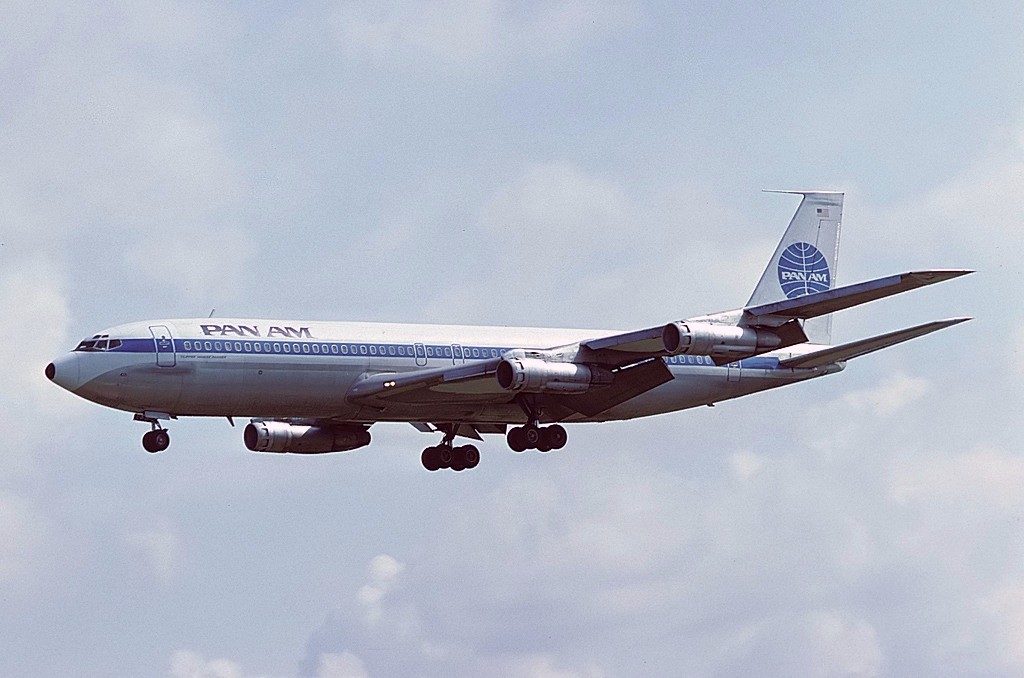
Historical Context & Origins
The Boeing 707, the plane that ushered in the jet age of scheduled travel, revolutionized global air travel. Its genesis dates back to the Dash 80 prototype of 1954, but it was the 707 series that turned a bold vision into operational reality, setting the standard for future airliners.
The Boeing 707-420 variant, with its first flight in 1959, represented a strategic response to the specific needs of the European market and its airlines. These required alternative engines to the American Pratt & Whitney JT3C and JT4A ones, partly for economic reasons and partly for technical preferences.
The 707-420 was the first 707 to employ turbofan engines, the powerful and more efficient Rolls-Royce Conway 508, anticipating a trend that would dominate civil aviation for decades. This innovation made it particularly desirable for long-haul routes, offering greater autonomy and superior operating economy.
Architecture & Technological Design
The architecture of the Boeing 707-420 took up the now iconic design of the 707 series, with its unmistakable 35 degree swept wing. This configuration was not only aesthetically modern, but fundamental for reaching high subsonic speeds, reducing aerodynamic drag and optimizing cruising performance.
The "double bubble" cross-section fuselage offered an excellent compromise between passenger space and lower cargo capacity. The four Rolls-Royce Conway Mk.508 engines, mounted on pylons under the wings, provided formidable combined thrust, significantly reducing long-distance flight times.
On board, the 707-420 was equipped with cutting-edge systems for its time, including a pressurized cabin for passenger comfort at high altitudes and sophisticated avionics that enabled safer and more reliable flight operations, even in adverse weather conditions.
Onboard Specifications
- ◆Rolls-Royce Conway Mk.508 Engines: The first turbofans to power a 707, offering greater fuel efficiency, power and lower noise than previous turbojets.
- ◆35° swept wing: A revolutionary aerodynamic design that allowed high cruising speeds (approximately 970 km/h) while reducing drag.
- ◆Advanced navigation systems and pressurized cabin: Provided more comfortable and safe flights for passengers and more precise flight operations for crews.
Operational Career & Operators
The Boeing 707-420 quickly became a mainstay of transatlantic airline fleets. The launch company was BOAC (British Overseas Airways Corporation), followed by prestigious airlines such as Lufthansa, Air India and Sabena. These carriers exploited its efficiency and autonomy to open new intercontinental routes.
L'aereo non era solo un mezzo di trasporto, ma un simbolo di progresso e lusso. It allowed thousands of people to travel across oceans in comfort and speed unthinkable just a few years earlier, ushering in the era of mass tourism and the "jet set".
Its robustness and reliability made it an invaluable workhorse, capable of dealing with the rigorous demands of scheduled service for decades. The 707-420 has redefined international travel, making it accessible and desirable on a global scale.
Legacy & Cultural Impact
The legacy of the Boeing 707-420 is deep and lasting. Not only did it set the standard for future commercial jets, it also demonstrated the superiority of turbofan engines, influencing the development of all subsequent airliners, including the famous 727, 737 and the giant 747.
It has been a catalyst for globalization, shortening distances and connecting cultures. Its elegant design and performance capabilities have made it an icon of engineering and human progress, often featured in films, television and advertising, embodying an era of optimism and innovation.
Although most examples have been retired from passenger service, its impact continues to be felt on every modern scheduled flight. The Boeing 707-420 was not just a plane; it was a powerful symbol of the aviation revolution, the echoes of which still resonate today.
Telemetria Specs (HUD)
Hangar Trivia & Curiosità
- 💡The 707-420 was one of the few 707 variants to use Rolls-Royce Conway turbofan engines, differentiating it from the more common Pratt & Whitney powered models.
- 💡It was primarily ordered by British Overseas Airways Corporation (BOAC), who operated it extensively on their long-haul routes, especially across the Atlantic.
- 💡The Conway engines provided better fuel economy and a quieter cabin compared to the earlier turbojet engines, representing a significant technological step for its era.
Archivio Avvistamenti Spotter
Immagini scattate dalla community in tutto il mondo