707-320C
Boeing
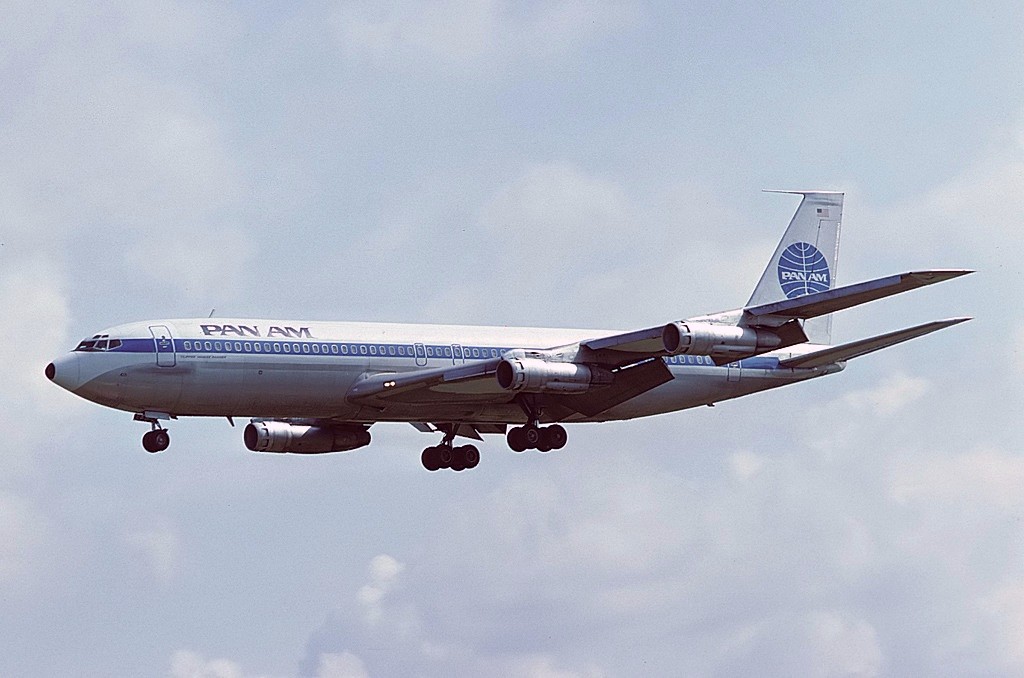
Historical Context & Origins
The advent of the jet age, inaugurated by the commercial success of the Boeing 707, marked an epochal turning point in civil aviation. Born as a response to the growing need for global connectivity, the 707 family represented the pinnacle of aeronautical engineering in the 1950s, consolidating Boeing's supremacy in the market. The 707-320C, with its first flight in 1963, emerged as a crucial evolution of this giant, designed to further expand its capabilities.
This specific model was Boeing's response to the need for an aircraft capable of transporting not only passengers over long distances, but also voluminous cargo. Previous variants, while excellent for passenger transport, could not compete with the versatility required by expanding international trade and military logistics operations, setting the stage for a true revolution in air cargo.
The 707-320C was based on the robust architecture of the 707-320 Intercontinental, already known for its exceptional range, but integrated specific structural and operational changes. Its ability to quickly transform from passenger to cargo aircraft, or vice versa, made it an indispensable tool for airlines and militaries around the world, redefining the standards of operational flexibility.
Architecture & Technological Design
The Boeing 707-320C stood out for a series of technical innovations that enhanced its performance and versatility. The design incorporated a longer fuselage and larger wingspan than its short- and medium-range predecessors, optimizing aerodynamic efficiency for transcontinental and transoceanic flights. Its sturdy structure was reinforced to withstand the heaviest loads, typical of freight transport.
At the heart of its capabilities were the powerful Pratt & Whitney JT3D turbofan engines, which replaced earlier axial-flow turbojets. These engines not only increased available thrust, ensuring better takeoff and cruise performance, but significantly reduced fuel consumption and noise, making the -320C more economically advantageous and more environmentally acceptable for its time.
The distinguishing feature of the "C" (Convertible) version was its ability to quickly adapt to different configurations. This was made possible by a reinforced cabin floor and the installation of a large main cargo door, aspects that made it a true pioneer of combined passenger/cargo transport. Its versatile architecture has established new paradigms for future transport aircraft.
Onboard Specifications
- ◆Pratt & Whitney JT3D turbofan engines: Powerful and efficient, improving thrust and range.
- ◆Main cargo door on left side of fuselage: One of the largest cargo doors of the time, essential for quick conversion.
- ◆Roller and winch load management system: Allowed rapid loading and unloading of standard pallets and containers.
Operational Career & Operators
The operational career of the Boeing 707-320C was extraordinarily long and had a huge impact. Adopted by nearly every major airline globally, such as Pan Am, Lufthansa, Air France and TWA, it quickly became the workhorse for long-haul routes and expanding cargo networks. Its reliability and ability to transport large volumes made it an invaluable asset.
In addition to its civilian role, the 707-320C also found extensive use in military contexts, often with its own designations such as the C-137 Stratoliner for VIP transport or as the basis for specialized platforms. Its robustness and autonomy made it suitable for complex missions, from strategic transport to logistical support, demonstrating unprecedented versatility in both sectors.
Even today, some units derived from the 707-320C, such as the tanker (KC-135) or AWACS (E-3 Sentry) versions, continue to soar the skies, a direct testimony to its exceptional engineering durability and the foresight of its design. Its introduction dramatically accelerated globalization, making air cargo efficient and accessible on a global scale.
Legacy & Cultural Impact
The Boeing 707-320C was not just an airplane, but a catalyst for change that shaped the aviation industry and global commerce. Its ability to combine passenger and freight transport into a single efficient platform has opened up new routes and markets, significantly contributing to the birth of the modernized global economy. He was a pioneer who anticipated the needs of the future.
Its legacy can be seen in the evolution of subsequent wide-body aircraft, such as the Boeing 747 Freighter, which continued to expand on the concepts of versatility and cargo capacity pioneered by the 707-320C. It demonstrated that a passenger plane could be successfully converted into a high-capacity freighter, influencing decades of aircraft design and logistics strategies.
The Boeing 707-320C remains an icon of engineering and progress, a symbol of the era in which air travel went from luxury to everyday necessity. Its introduction not only revolutionized the way goods moved across continents, but also consolidated the image of the jetliner as an indispensable tool for connecting peoples and cultures, leaving an indelible imprint on aviation history.
Telemetria Specs (HUD)
Hangar Trivia & Curiosità
- 💡La 'C' nel nome 707-320C sta per 'Convertible', indicando la sua capacità di essere rapidamente riconfigurato tra trasporto passeggeri e merci.
- 💡Molti 707-320C furono convertiti in aerei militari, servendo come piattaforme per aerocisterne (come il KC-135) o aerei di sorveglianza (come l'E-3 Sentry AWACS).
- 💡Questo modello fu fondamentale per l'espansione del trasporto aereo merci internazionale, offrendo una combinazione di portata e capacità di carico che lo rese popolare per decenni.
Archivio Avvistamenti Spotter
Immagini scattate dalla community in tutto il mondo
Vettori Rilevati (Flotta Storica / Dismessa)

Federal Air
Stato: Dismesso

American Airlines
Stato: Dismesso

Lufthansa
Stato: Dismesso
Pan American World Airways
Stato: Dismesso

Air France
Stato: Dismesso
TWA (Trans World Airlines)
Stato: Dismesso
Pakistan International Airlines
Stato: Dismesso
Cargolux
Stato: Dismesso
Air India
Stato: Dismesso
Sabena
Stato: Dismesso
South African Airways
Stato: Dismesso

Qantas
Stato: Dismesso

BOAC (British Overseas Airways Corporation)
Stato: Dismesso
TAP Air Portugal
Stato: Dismesso

Varig
Stato: Dismesso
World Airways
Stato: Dismesso