707-220
Boeing
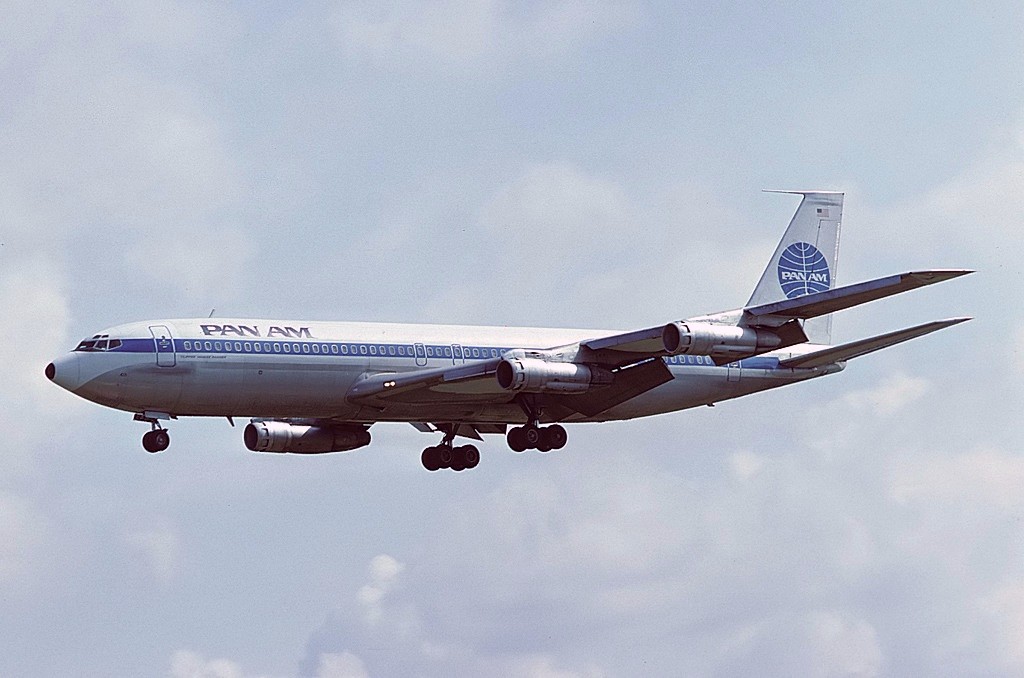
Historical Context & Origins
The epic story of the Boeing 707, undisputed pioneer of the commercial jet era, saw the light in the context of a frenetic race for innovation. While the 707-120 was already redefining the global skies, the need arose for a version that could overcome the challenges posed by high-altitude airports and hot climates, where the original turbojet engines lost efficiency.
This specific need led to the genesis of the Boeing 707-220, a variant developed to offer superior performance in extreme operating conditions. With its first flight in 1959, the -220 was not a simple evolution, but a targeted response to operational demands that the base model struggled to fully meet, marking a significant step in the adaptability of the 707 platform.
Architecture & Technological Design
The heart of the 707-220's distinction lay in its revolutionary powertrain. Retaining the robust and proven airframe of the 707-120, Boeing equipped this variant with the powerful Rolls-Royce Conway Mk. turbofan engines. 508. This choice represented a bold technological leap, as the Conway was one of the first turbofans to be used on a large airliner.
The adoption of the Conway turbofans guaranteed the 707-220 a significant increase in thrust compared to the Pratt & Whitney JT3C turbojets, drastically improving take-off and climb performance, fundamental for operating effectively from airports such as Mexico City or Johannesburg. Although the aerodynamic configuration remained unchanged, the more advanced propulsion redefined its operational potential, making it a true "workhorse" for demanding routes.
Onboard Specifications
- ◆Rolls-Royce Conway Mk. engines 508: The introduction of these turbofans represented a crucial innovation, offering greater efficiency and greater thrust than previous turbojets.
- ◆Extended “Hot and High” Capability: Thanks to the new thrusters, the -220 excelled in operations from airfields located at high altitudes or in regions with high temperatures, where thinner, hotter air reduces thrust from the engines.
- ◆Lower Specific Fuel Consumption: Although early turbofans were still in development, Conways offered slightly higher efficiency per pound of thrust than pure turbojets, foreshadowing future evolutions.
Operational Career & Operators
The operational career of the Boeing 707-220 was as prestigious as it was exclusive. With only five examples produced, all were delivered to the innovative American airline Braniff International Airways. This made the 707-220 a symbol of Braniff's ambition to offer high-quality service on demanding routes, particularly to South America.
The aircraft operated successfully for Braniff, cementing the company's reputation for performance and comfort. Their rarity makes them collector's items in aviation history today, testimony to a period in which airlines sought customized solutions for their specific networks and geographical challenges.
Legacy & Cultural Impact
Despite its limited production, the Boeing 707-220 has left an indelible mark on the history of aviation. It was a critical test bed for the integration of turbofan engines onto a successful platform, demonstrating the flexibility of the 707 design and the feasibility of this new propulsion technology.
The experience gained with the -220 and its Conways paved the way for subsequent variants, in particular the 707-320B and -320C models, which would adopt Pratt & Whitney JT3D turbofans, becoming the most widespread and long-lived of the 707 family. The 707-220 therefore remains a precious link, a silent pioneer that contributed significantly to the evolution of jet airliners, consolidating the era of the transcontinental jet.
Telemetria Specs (HUD)
Hangar Trivia & Curiosità
- 💡Il 707-220 fu l'unica variante del 707 ad essere equipaggiata esclusivamente con motori JT4A-3 fin dalla fabbrica, su richiesta di Braniff International Airways.
- 💡Nonostante le prestazioni migliorate in condizioni di caldo e alta quota, furono prodotti solo cinque esemplari del 707-220, rendendolo una delle varianti più rare.
- 💡Tre dei cinque 707-220 furono successivamente riconvertiti in 707-138B (una versione a fusoliera più corta) dopo che Braniff li sostituì con i 707-320 intercontinentali.
Archivio Avvistamenti Spotter
Immagini scattate dalla community in tutto il mondo