707-138B
Boeing
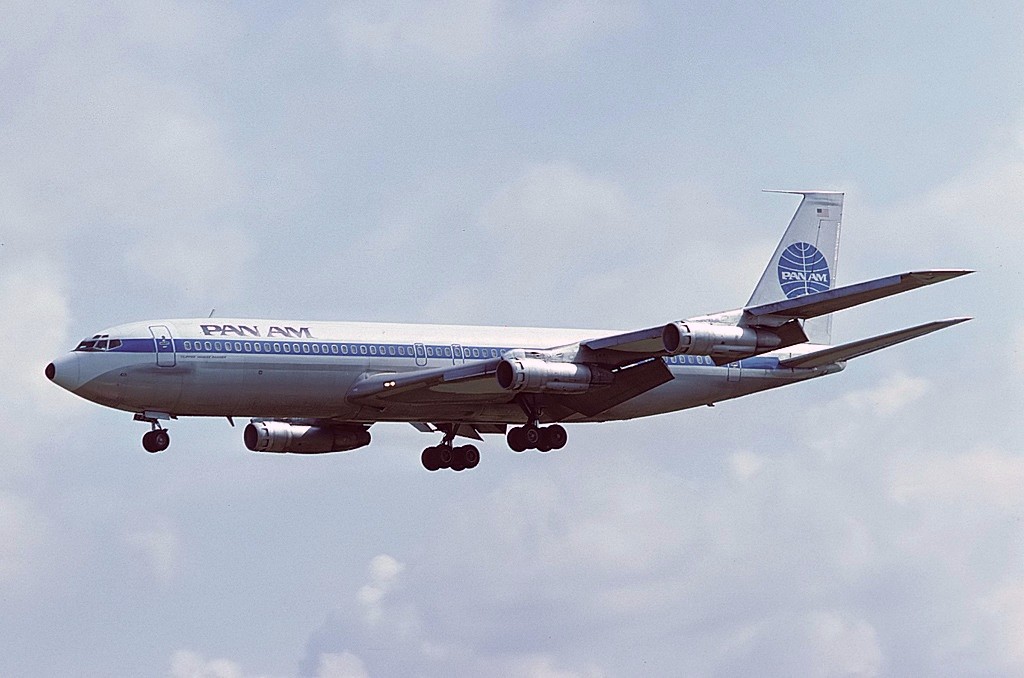
Historical Context & Origins
The dawn of the jet age, ushered in by the Boeing 707, represented an unimaginable revolution in air travel. After the Dash 80 prototype and the first operational versions, Boeing continued to refine its extraordinary four-engine aircraft, responding to the specific needs of global airlines. The 707 family quickly became the symbol of global connectivity.
It was in this context of expansion and innovation that the Boeing 707-138B was born, an extremely targeted and powerful variant. Developed to meet the stringent requirements of the Australian airline Qantas, this model had to combine the ability to operate on very long transoceanic routes with the need to access airports with less extensive runways.
The 707-138B made its maiden flight in 1961, further cementing the 707's reputation as a pioneer of the skies. This aircraft was not just a breakthrough, but a precise engineering answer, designed to overcome unique geographical challenges and to open new trade and tourism routes across continents.
Architecture & Technological Design
The 707-138B retained the iconic 707 architecture, with its swept wings and engines housed in underwing nacelles, but incorporated crucial improvements. The most obvious and functional modification was the fuselage shortened by approximately 10 feet (about 3 meters) compared to the standard 707-120 variant, a distinctive feature that optimized its weight and aerodynamic resistance.
This reduction in size, combined with increased fuel capacity, gave the -138B an extraordinary range, making it ideal for long transpacific routes. A fundamental innovation was the adoption of the new turbofan Pratt & Whitney JT3D engines, which replaced the previous turbojets. These engines offered superior thrust, significantly improved fuel efficiency and reduced noise, key elements for long-haul flights.
The introduction of turbofans and aerodynamic refinements allowed the 707-138B to fly further, faster and with greater operating economy, an engineering triumph that strengthened its competitiveness. These advancements made it an extremely valuable aircraft, especially for the intercontinental operations that Qantas wished to expand.
Onboard Specifications
- ◆Pratt & Whitney JT3D-1 Turbofan Engines: Essential for fuel efficiency and significantly extended range.
- ◆Fuselage Shortened by 10 feet (approximately 3 meters): A specific optimization to reduce weight and drag, ideal for long-range transoceanic routes.
- ◆Aerodynamic Improvements to the Wing: Optimization of the leading edges and flaps for greater efficiency in flight and better low speed performance.
Operational Career & Operators
The operational career of the Boeing 707-138B was inextricably linked to Qantas, which was its launch operator and main user. These aircraft allowed the Australian airline to inaugurate new direct routes and drastically reduce travel times between Australia and the rest of the world, connecting Sydney, Melbourne and Perth with key destinations in Asia, Europe and North America.
Qantas' 707-138Bs were often called "V-Jets" (due to their turbofan engines) and became synonymous with luxury air travel and long-distance reliability. Their ability to cover vast ocean distances with unprecedented comfort for the time revolutionized the concept of international travel for millions of passengers.
These aircraft were fundamental to Australia's economic and cultural expansion, transforming a geographically isolated continent into a crucial hub for global trade and tourism. Their reliability and excellent performance made them real workhorses for the Australian flag carrier.
Legacy & Cultural Impact
The Boeing 707-138B was not just an airplane; he was a symbol of progress and connectivity, a pioneer who opened the world. Although produced in limited numbers due to its specific nature, its impact on transoceanic routes and the establishment of Qantas as a global airline was immense, influencing the development of subsequent wide-body and long-range jets.
Its presence in the skies helped define the romantic and adventurous image of aviation in the 1960s and 1970s. This specific model demonstrated Boeing's ability to adapt and refine its designs to meet the most demanding requests, consolidating its leadership in the aeronautical market.
Today, the 707-138B is remembered as an icon, a testament to American ingenuity and the vision of companies like Qantas who dared to dream of airline routes that defied geography. His legacy lies not only in the technical innovations he brought, but also in the profound cultural change he triggered, making the world an infinitely smaller and more accessible place.
Telemetria Specs (HUD)
Hangar Trivia & Curiosità
- 💡The '-138' in its designation specifically denotes Qantas as the original launch customer for this unique shorter variant.
- 💡The 'B' suffix indicates a significant upgrade from early 707s, featuring more efficient and powerful Pratt & Whitney JT3D turbofan engines instead of turbojets.
- 💡Its optimized design allowed the 707-138B to perform non-stop trans-Pacific flights with a full passenger load, a crucial capability for Qantas's routes.
Archivio Avvistamenti Spotter
Immagini scattate dalla community in tutto il mondo