707-138
Boeing
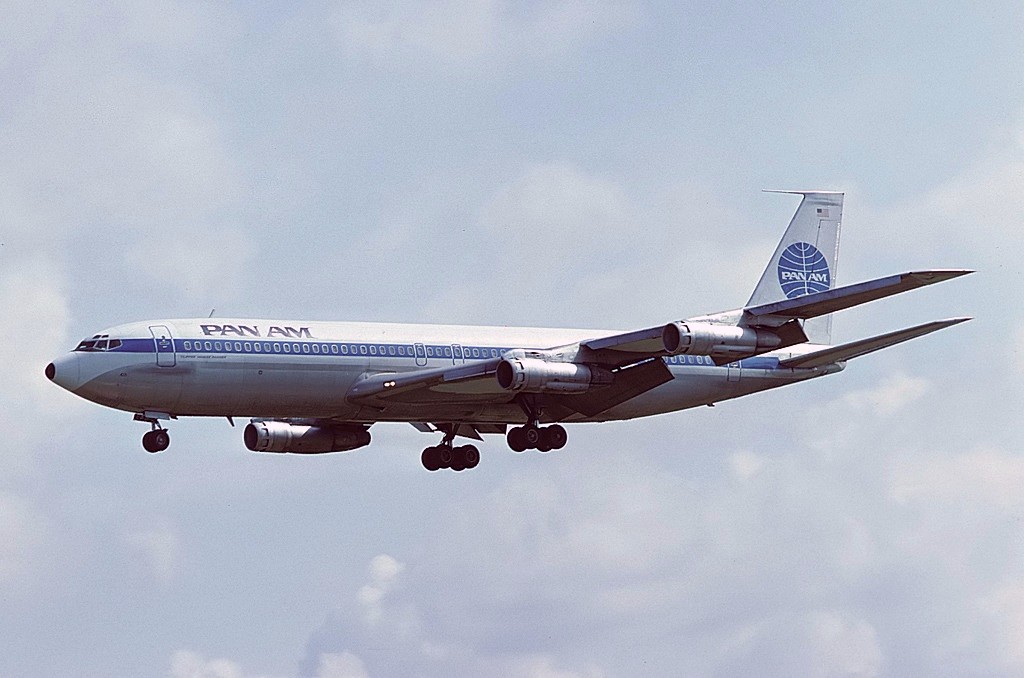
Historical Context & Origins
The advent of the commercial jet era was an epochal turning point in aviation, and the Boeing 707 was its undisputed pioneer. Developed from the prototype 367-80 (the legendary "Dash 80") that first flew in 1954, the 707 embodied the vision of a future where air travel would be fast, efficient and accessible. It was a bold bet for Boeing, which firmly believed in the potential of jet engines.
The Boeing 707-138, a variant specifically requested by Australian airline Qantas, represents a unique chapter in this saga. Featuring a fuselage shortened by approximately 2.54 metres (100 inches) compared to the standard 707-120, this configuration aimed to optimize performance for Qantas' longer transoceanic routes, balancing weight and range. Its first flight occurred in 1959, marking the beginning of a new era for air links with Australia.
Architecture & Technological Design
The 707-138 inherited the revolutionary architecture of its predecessor, with a design that made it instantly recognizable and technologically advanced for its time. Its iconic 35-degree swept wings, optimized for high subsonic speeds, and four turbojet engines mounted in underwing nacelles, set the standard for future airliners. This configuration not only improved aerodynamics but also allowed easier maintenance.
Initially equipped with the powerful Pratt & Whitney JT3C engines, the 707-138 was a pure performance machine. The reduction in fuselage length resulted in a slight decrease in passenger capacity but in an increase in maximum take-off weight relative to structural weight, thus allowing more fuel to be carried for long-haul routes. This engineering compromise proved crucial to the specific needs of Qantas, which needed aircraft capable of covering extended distances.
Onboard Specifications
- ◆Advanced cabin pressurization: Allowed comfortable cruising at high altitudes (up to 12,000 meters), reducing passenger fatigue.
- ◆Redundant hydraulic flight systems: Provided precise control and superior safety, a first for commercial jets of this scale.
- ◆Swept wing with spoiler: Offered exceptional stability and maneuverability, especially during takeoff and landing, maximizing aerodynamic efficiency.
Operational Career & Operators
The operational career of the Boeing 707-138 was intrinsically linked to Qantas, which was its only original operator and took full advantage of its unique capabilities. The introduction of these jets radically transformed air travel to and from Australia, dramatically reducing flight times on routes such as the "Kangaroo Route" to London and connections to the United States. The first commercial Qantas service with the 707-138 was in July 1959.
These planes not only symbolized modernity but allowed Qantas to compete globally by offering a fast and comfortable service. The 707-138 helped shape Qantas' image as a cutting-edge airline, a reliable jet operator and a pioneer in serving remote destinations with never-before-seen frequency and speed, cementing its position in the international aviation landscape.
Legacy & Cultural Impact
The Boeing 707, and especially specialized variants such as the 707-138, left an indelible legacy in commercial aviation and popular culture. It was not just an airplane, but a catalyst for change that opened the world to mass travel. Its elegant aesthetics and revolutionary performance made it an icon of technological progress and the "Jet Age", influencing generations of aeronautical engineers and designers.
The 707's impact on culture was immense: it became synonymous with glamorous travel, appeared in countless films and songs, and symbolized the acceleration of modern life. Paving the way for future giants like the 747, the 707-138, with its tailor-made history for Qantas, demonstrated Boeing's design flexibility and ability to adapt to operators' specific needs, cementing its place as one of the most important aircraft in aviation history.
Telemetria Specs (HUD)
Hangar Trivia & Curiosità
- 💡Il suffisso '138' nella designazione identificava Qantas come il cliente di lancio per questa variante specifica, in linea con il sistema di codifica dei clienti di Boeing dell'epoca.
- 💡Era una versione 'short-body' del 707, ovvero aveva una fusoliera più corta rispetto ad altri modelli come il 707-320, ma manteneva ali più grandi e una maggiore capacità di carburante per ottimizzare l'autonomia per rotte molto lunghe.
- 💡Ha svolto un ruolo cruciale nell'apertura della 'Kangaroo Route' tra l'Australia e l'Europa, rendendo i viaggi intercontinentali molto più rapidi e accessibili per un pubblico più ampio.
Archivio Avvistamenti Spotter
Immagini scattate dalla community in tutto il mondo