707-120
Boeing
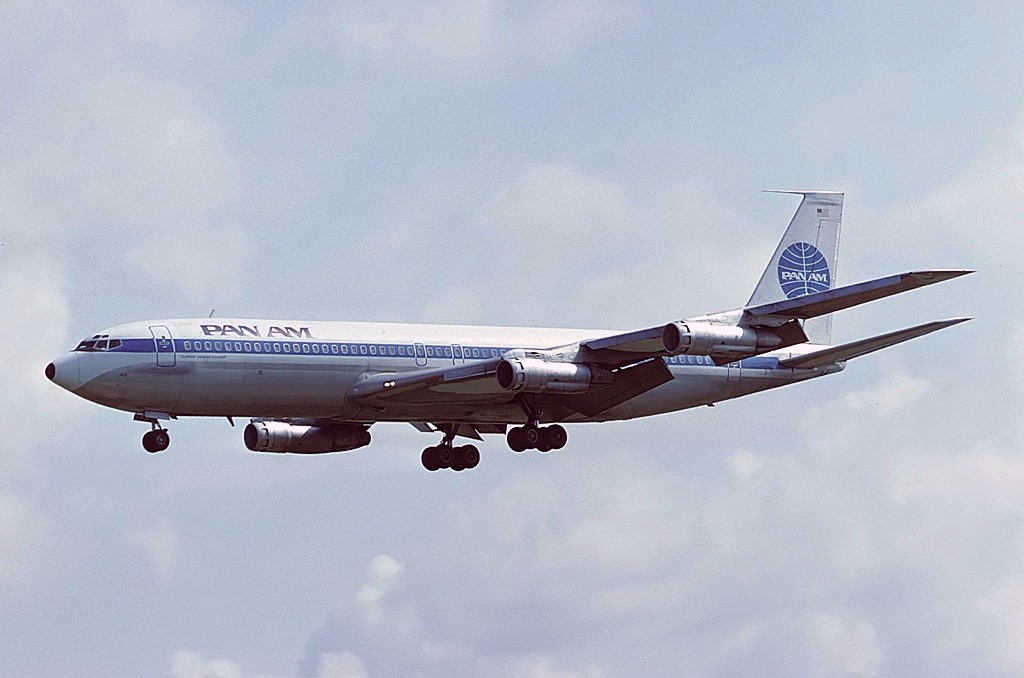
Historical Context & Origins
The Boeing 707-120 is widely considered the airplane that kicked off the era of mass commercial jets. Developed from the Dash 80 prototype in the mid-1950s, the 707 was Boeing's response to the British de Havilland Comet, introducing higher standards of speed, capability and reliability.
The initial 707-120 version first flew in December 1957 and entered commercial service in October 1958 with the famous Pan American World Airways airline. This inaugural transatlantic route forever changed the perception of long-haul air travel.
Architecture & Technological Design
The design of the Boeing 707 was characterized by the configuration with 35 degree swept wings and four turbojet engines mounted in underwing pods. This aerodynamic choice, inherited from military bombers, became the standard for modern airliners.
The engines of the first -120 series were the Pratt & Whitney JT3C-6 turbojets, which required water injection to increase thrust during takeoff, generating the famous and spectacular trails of black smoke. Subsequently, the 707-120B version introduced the more efficient JT3D turbofans, significantly improving consumption and autonomy.
Onboard Specifications
- ◆Four underwing engines Pratt & Whitney JT3C (later JT3D)
- ◆Cabin configuration with 6 seats per row (3+3), which set the standard for narrow-body designs
- ◆Cruise speed of approximately 960 km/h, almost double that of older propeller aircraft
Operational Career & Operators
The 707-120 quickly became the preferred choice of major global airlines. In addition to the pioneer Pan American World Airways, the US TWA (Trans World Airlines) and American Airlines built their long-haul networks around this model.
The plane made it possible to connect the American coasts in a few hours and reduced transatlantic travel to a non-stop day or night flight, decreeing the commercial end of ocean liners. It was also used by prestigious carriers such as Qantas.
Legacy & Cultural Impact
The legacy of the Boeing 707 is immense: not only did it shape the architecture of modern jet airliners, but it also redefined globalization, making the world smaller and more accessible.
He popularized the term "Jet Set" to describe the social elite who could travel quickly between New York, Paris and London. Its cabin design was reused by Boeing for subsequent models, including the 727, 737 and 757, leaving a lasting imprint on aeronautical engineering.
Telemetria Specs (HUD)
Hangar Trivia & Curiosità
- 💡Il 707 non fu il primo jet di linea in assoluto (primato del de Havilland Comet), ma fu il primo ad avere un successo commerciale travolgente.
- 💡Durante i voli dimostrativi del prototipo Dash 80 nel 1955, il pilota collaudatore Tex Johnston eseguì a sorpresa un tonneau (barrell roll) sopra Seattle.
- 💡La fusoliera del 707 fu allargata di pochi centimetri all'ultimo minuto su insistenza di Pan Am, permettendo la configurazione a 6 posti per fila.
Archivio Avvistamenti Spotter
Immagini scattate dalla community in tutto il mondo
Vettori Rilevati (Flotta Storica / Dismessa)


Braniff International Airways
Stato: Dismesso
American Airlines
Stato: Dismesso
Pan American World Airways
Stato: Dismesso

Air France
Stato: Dismesso
TWA (Trans World Airlines)
Stato: Dismesso

Qantas
Stato: Dismesso
National Airlines
Stato: Dismesso