62
Potez
Historical Context & Origins
The Potez 62, whose first flight took place in 1935, emerged in a period of great turmoil for commercial aviation worldwide, a crucial decade between the two world wars that saw the transformation of air transport from a mere curiosity to an indispensable service. France, in particular, aspired to strengthen its network of air connections, both internally and towards the colonies, requiring modern and efficient aircraft.
In this context, Société des Avions Henri Potez, one of the most prestigious French manufacturers, was tasked with developing an innovative airliner. The goal was to create a successor to the previous, less performing models, ensuring greater speed, reliability and, above all, superior comfort for passengers, key elements for competitiveness.
The Potez 62 was specifically designed to meet the needs of Air France, the newly formed national airline, consolidating France's image as a pioneer in civil air transport. Its concept reflected the desire to offer a cutting-edge travel experience, projecting the country towards the future of aviation.
Architecture & Technological Design
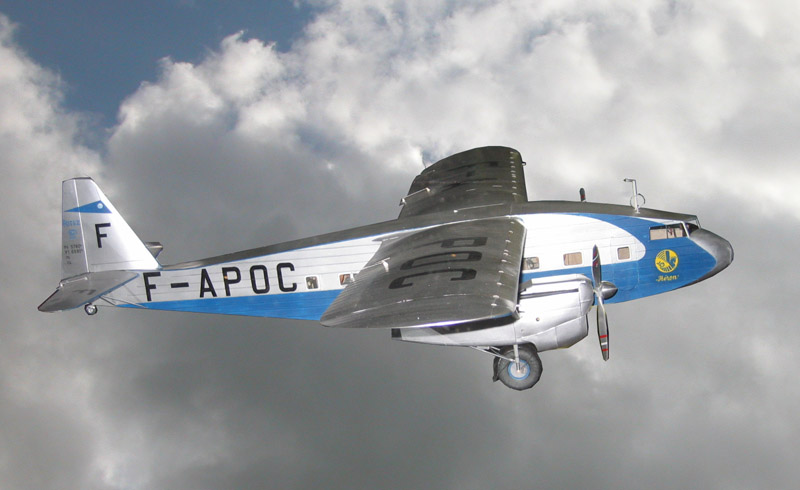
The Potez 62 presented itself as an elegant high-wing monoplane, a configuration chosen to optimize passengers' visibility and improve take-off and landing performance. Its all-metal structure, a cutting-edge solution for its time, gave the aircraft strength and durability, a significant step forward compared to the mixed-structure biplanes still in use.
The aerodynamic design was further refined by the adoption of retractable landing gear, a feature which, although not unprecedented, was still relatively rare on airliners and contributed greatly to reducing drag and increasing cruising speed. This made it one of the most modern aircraft in the European panorama.
The aircraft was powered by two Gnome-Rhône 14K Mistral Major radial engines, renowned for their power and reliability. These thrusters, installed in the underwing nacelles, provided the necessary thrust to comfortably carry 14-16 passengers in a cabin designed to provide a pleasant and safe travel experience.
Onboard Specifications
- ◆Soundproofed and heated passenger cabin: A luxury for the time, which guaranteed unprecedented comfort even on long routes.
- ◆Retractable and dampened landing gear: Improved in-flight aerodynamics and ensured softer landings for passengers.
- ◆Gnome-Rhône 14K Mistral Major Radial Engines: Powerful, proven powertrains essential for performance and reliability on international routes.
Operational Career & Operators
The Potez 62 quickly became the workhorse of Air France, operating prestigious routes connecting Paris to several European capitals and emerging colonial airlines. His flights to North Africa and Indochina symbolized the expansion of French influence and the modernization of imperial connections.
The aircraft stood out for its reliability, helping to forge Air France's reputation as a cutting-edge airline. Although its commercial career was relatively short due to rapid technological development before World War II, the Potez 62 played a crucial role in shaping the air travel experience of a generation.
Some examples were requisitioned and converted for military transport or liaison roles during the conflict, demonstrating the versatility of its robust platform. However, its main vocation remained that of passenger, bearing witness to a golden age of civil aviation.
Legacy & Cultural Impact
The Potez 62 was not just an airplane; it was a symbol of progress and modernity for France in the 1930s. Its presence in European and colonial skies consolidated the image of a leading nation in technological innovation and civil air transport.
Although it did not reach the fame of other giants of the time, the Potez 62 laid the foundations for future generations of French airliners, contributing with its bold technical solutions to defining the standards of comfort and safety. Its architecture influenced subsequent development, demonstrating the validity of the high-wing metallic monoplane design for civilian purposes.
Today, the Potez 62 is remembered as an elegant pioneer, a fundamental link in the evolutionary chain of commercial aviation. It represents an era when flying was still a luxurious adventure, helping to write important chapters in the history of Air France and global aviation.
Telemetria Specs (HUD)
Hangar Trivia & Curiosità
- 💡Il Potez 62 era una conversione civile diretta del Potez 54, un aereo militare utilizzato per bombardamento e ricognizione, una pratica comune nell'ingegneria aeronautica del periodo interbellico.
- 💡Fu un pilastro della flotta di Air France, operando su rotte importanti che collegavano la Francia con destinazioni in tutta Europa e nel Nord Africa, svolgendo un ruolo chiave nello sviluppo delle reti aeree commerciali.
- 💡Alcune versioni del Potez 62 mantenevano una sezione del muso modificata, derivata dalla postazione del bombardiere del Potez 54, che offriva una vista panoramica ai passeggeri o all'equipaggio, una caratteristica insolita per un aereo di linea.
Archivio Avvistamenti Spotter
Immagini scattate dalla community in tutto il mondo


