4-0-4
Martin
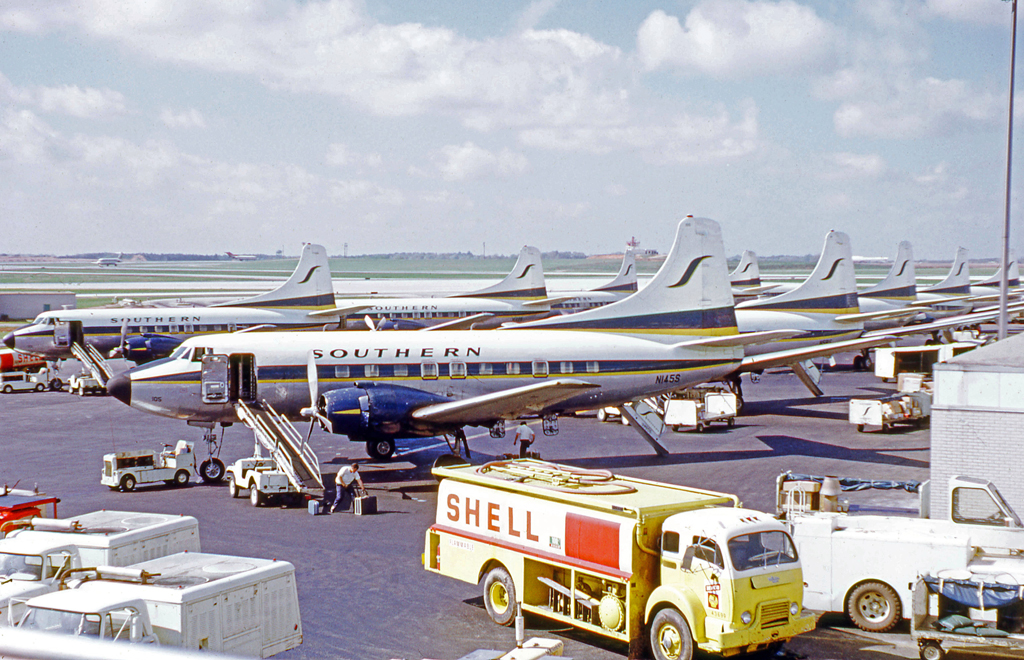
Historical Context & Origins
In the fervent post-war period, the US civil aviation industry was booming, requiring modern, efficient and above all safe regional transport aircraft. The Glenn L. Martin Company initially responded with the Martin 2-0-2, a fast aircraft but plagued by structural problems and a lack of pressurization, which limited its comfort and operational altitudes.
The need to overcome these shortcomings led to the development of the Martin 4-0-4, a direct and improved evolution of its predecessor. This new project aimed to integrate the lessons learned, offering a more robust, comfortable and competitive aircraft in a rapidly evolving market. His first flight occurred in 1950, marking the beginning of a short but significant career.
Architecture & Technological Design
The Martin 4-0-4 appeared as an elegant twin-engine low-wing monoplane, designed to transport 40 passengers. Its architecture represented a notable advance over the 2-0-2, introducing significant structural improvements and greater aerodynamic refinement, essential for efficiency and stability in flight.
The distinctive and most revolutionary feature of the 4-0-4 was undoubtedly its pressurized cabin, a luxury at the time for a regional category aircraft. This innovation allowed flights at higher altitudes, overcoming low-altitude turbulence and offering passengers a significantly more comfortable and quiet travel experience.
Sotto il profilo propulsivo, il velivolo era equipaggiato con due affidabili motori radiali Pratt & Whitney R-2800-CB16 Double Wasp. These powerful, battle-tested engines delivered 2,400 horsepower each, ensuring robust performance and robust operational reliability – crucial to airlines.
Onboard Specifications
- ◆Pressurized cabin: High passenger comfort and ability to operate at higher altitudes, up to 6,000 meters.
- ◆Retractable tricycle landing gear: Optimal stability on the ground and significant reduction in aerodynamic drag in flight.
- ◆Pratt & Whitney R-2800 Radial Engines: 18-cylinder engines, synonymous with power, durability and proven maintenance.
Operational Career & Operators
The operational career of the Martin 4-0-4, although concentrated in a relatively short period of time, was intense and mainly focused on the North American market. Its main operators were Eastern Air Lines and Trans World Airlines (TWA), who ordered 40 and 60 examples respectively, making it a mainstay of their regional routes.
The 4-0-4 earned a reputation as a reliable "workhorse", prized for its ruggedness and ability to operate on less well-equipped airfields. It carried millions of passengers across the United States, helping connect cities and communities in an era of growing demand for air travel. In total, only 103 examples were produced.
Legacy & Cultural Impact
Despite its limited production and the rapid market transition to jets starting in the 1960s, the Martin 4-0-4 left a significant legacy. It represented an important link between post-war piston passenger aircraft and the subsequent generation of turboprops and jets, embodying the pinnacle of radial engine technology for civil transport.
Its focus on passenger comfort through pressurization anticipated standards that would become the norm. Today, few examples remain in flying condition, serving for cargo, executive purposes or as prized museum pieces, testifying to a golden era of American aviation and the Martin Company's ingenuity in providing advanced solutions for regional air transportation.
Telemetria Specs (HUD)
Hangar Trivia & Curiosità
- 💡It was one of the last major piston-powered airliners designed for the US domestic market before the full advent of the jet age.
- 💡Only 103 units were built, primarily for Eastern Air Lines and TWA, making it a relatively rare aircraft.
- 💡The 4-0-4 was unique for its integrated airstairs in the rear fuselage, a feature not common on many twin-engine transports of its era.
Archivio Avvistamenti Spotter
Immagini scattate dalla community in tutto il mondo
Vettori Rilevati (Flotta Storica / Dismessa)


Southern Airways
Stato: Dismesso
Air South
Stato: Dismesso
Air Florida
Stato: Dismesso
Ozark Air Lines
Stato: Dismesso
TWA (Trans World Airlines)
Stato: Dismesso
Pacific Air Lines
Stato: Dismesso
Southeast Airlines
Stato: Dismesso
Provincetown-Boston Airlines
Stato: Dismesso
Piedmont Airlines
Stato: Dismesso
Mohawk Airlines
Stato: Dismesso