307 Stratoliner
Boeing
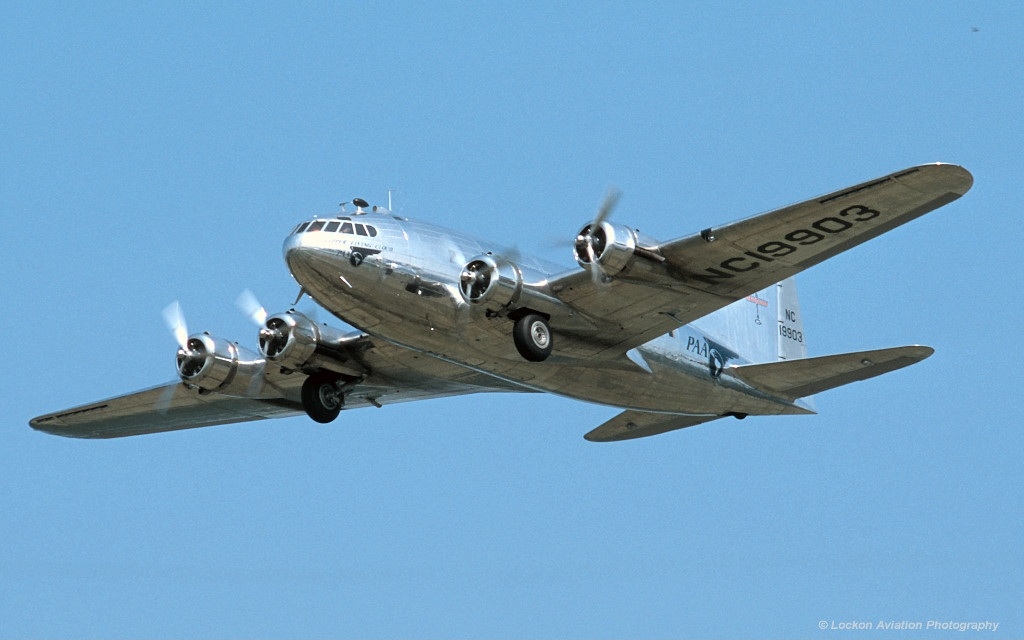
Historical Context & Origins
In the vibrant aviation landscape of the late 1930s, commercial aviation was booming, but limited by weather and relative comfort. The airliners of the time, like the excellent Douglas DC-3, flew at medium-low altitudes, exposing passengers to turbulence and the rigors of bad weather, making long journeys exhausting.
Boeing, thanks to the experience gained with the B-17 Flying Fortress bomber, aspired to overcome these limits. The goal was to create an airliner that could fly over atmospheric disturbances, ensuring unprecedented comfort for passengers and drastically reducing travel times.
This bold vision gave birth to the Boeing 307 Stratoliner, an aircraft that would redefine the standards of air travel. Its first flight on December 31, 1938 marked the dawn of a new era, promising a future in which high-altitude, pressurized flight would become the norm.
Architecture & Technological Design
The heart of the Stratoliner's innovation lay in its fully pressurized cylindrical fuselage, a revolutionary design for civil aviation. This feature allowed the aircraft to maintain an internal pressure equivalent to approximately 8,000 feet (2,400 meters) while the aircraft flew at much higher altitudes, up to 20,000 feet (6,100 meters).
Much of its architecture derived directly from the robust B-17B, from which it inherited the wings, tail and four powerful Wright Cyclone GR-1820 radial engines. This synergy between military and civilian design provided the 307 with proven reliability and remarkable structural strength for an airliner.
The Stratoliner's elegant and functional design was not only a question of engineering, but also of luxury. The cabin, spacious and quiet thanks to pressurization, offered refined interior environments, with bunk beds, an on-board kitchen and even separate compartments, anticipating the comforts of modern jets.
Onboard Specifications
- ◆Pressurized cabin: The first commercial airliner in the world with a pressurized cabin, capable of maintaining comfortable conditions at high altitudes, revolutionizing the travel experience.
- ◆Four Wright Cyclone GR-1820 radial engines: Each engine delivered 1,100 horsepower, providing power and safety for long-range, high-altitude flights.
- ◆Unprecedented Comfort: Offered luxury amenities such as bunk beds, full on-board kitchen and separate lavatories, setting new standards for air travel.
Operational Career & Operators
Despite its extraordinary innovation, the Boeing 307 Stratoliner had a production limited to just ten examples, distributed between the prestigious operators Pan American World Airways (Pan Am) and Transcontinental & Western Air (TWA), plus a VIP example for Howard Hughes.
These aircraft pioneered transatlantic and intercontinental routes, offering passengers a luxurious and quiet flying experience. Pan Am's legendary "Clippers," such as the "Clipper Flying Cloud", became synonymous with exotic, high-class travel, carrying prominent personalities and wealthy travelers across oceans.
Its commercial operating career was short, however, abruptly interrupted by the onset of World War II. Many Stratoliners were requisitioned by the US military, serving as military transports and losing their luxurious interior finishes to suit wartime needs.
Legacy & Cultural Impact
The Boeing 307 Stratoliner, although not a commercial success in terms of numbers produced, represents an irreplaceable milestone in the history of aviation. It demonstrated the feasibility and benefits of high-altitude flight with a pressurized cabin, paving the way for all future airliners.
His technological innovation was the basis for the development of military aircraft such as the B-29 Superfortress and, later, for all modern jetliners, which adopted pressurization as standard. The 307 has redefined passenger expectations in terms of comfort and speed.
Today, a single restored example survives, the "Clipper Flying Cloud", displayed at the Smithsonian's National Air and Space Museum. A symbol of boldness and engineering foresight, the Boeing 307 Stratoliner remains a visionary giant whose legacy resonates in every modern high-altitude, silent and comfortable flight.
Telemetria Specs (HUD)
Hangar Trivia & Curiosità
- 💡The 307 was derived directly from the B-17 Flying Fortress bomber, sharing its wings, tail, and engines, a common practice for rapid development during that era.
- 💡Only ten Boeing 307s were ever built. One famous example was owned by Howard Hughes, who extensively modified it into a luxurious 'flying penthouse'.
- 💡Its pressurized cabin allowed it to fly at altitudes up to 20,000 feet, above most weather, earning it the nickname 'Stratoliner' and significantly improving passenger comfort by reducing turbulence.
Archivio Avvistamenti Spotter
Immagini scattate dalla community in tutto il mondo